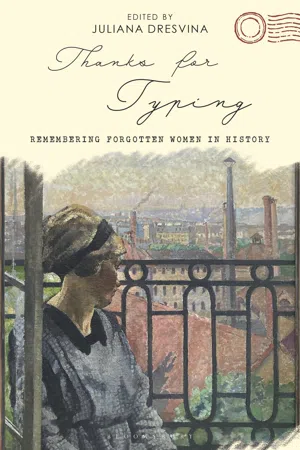
This collection uncovers the wives, daughters, mothers, companions and female assistants who laboured in the shadows of famous men. Revealing the reality of uncredited female contributions throughout history, this book highlights the work of neglected and forgotten women associated with celebrated male writers, scholars, activists and politicians.
As the #ThanksforTyping movement has shown, anonymous women working to support the work of their male relations and colleagues has been, and often still is, a universal phenomenon. These essays show just how long intelligent and determined women have been sidelined, ignored or forgotten throughout history. From a well-connected Roman matrician to the mother of the poet Philip Larkin, these women have their voices returned to them in twenty engaging chapters. Spanning ancient times to the modern day, they return agency to women who occupied crucial roles behind the scenes, but were always restricted to the supporting role they were obliged to play.
The universal importance of these women take on new meaning in our modern era where women's voices are becoming ever-louder and increasingly recognised - including through such a movement as #ThanksforTyping.
- 328 pages
- English
- ePUB (mobile friendly)
- Available on iOS & Android
eBook - ePub
About this book
Trusted by 375,005 students
Access to over 1.5 million titles for a fair monthly price.
Study more efficiently using our study tools.
Information
PART 1
Secretaries and Editors
Secretarial work has been historically unseen and unnamed. If recorded at all, it is in the acknowledgements to books typed by women like Miss Alli Hytti, secretary and research assistant to Professor Puntila in post-war Finland. While secretaries have often been seen as ‘office wives’ to professional men, some wives, like Valerie Eliot and Sophia Mumford, were also their husbands’ secretaries, channelling their creative energies towards the advancement of their partners’ work. Although secretarial employment offered single women a professional identity, the never-ending demands of a job without clear parameters and boundaries between professional and personal assistance could also lead to overwork and exhaustion, as in the cases of M. E. Fitzgerald and Eunice Frost. (Catherine W. Hollis, with Juliana Dresvina)
1
M. E. Fitzgerald
Office Manager to Modernism
Catherine W. Hollis
Unpaid labour is feminist labour. So is underpaid labour. The great interest aroused in social media by the #ThanksForTyping hashtag attests to the persistence of gender and material inequity in art, literature and academia. Particularly in the academy, where we face the crisis of contingent labour and precarious employment, the reliance on unpaid or underpaid work is a significant feminist issue. It is feminist because, regardless of the gender identity of those who perform unpaid or underpaid labour in the culture industries of art, literature and the academy, there is a historic association between women and the economic and social undervaluing of their work. Those who type, organize conferences and review or edit books perform the necessary tasks without which the academy would not flourish, but are often not guaranteed the safe harbour of tenure or a stable multi-year employment contract. The contemporary job crisis in academia makes scholarship on the historic and cultural contexts for the devaluing of women’s work all the more relevant.
While the narrative of the male genius and his silent or silenced female collaborator/muse/helpmeet persists across the centuries and in the accounts collected in this volume, the context for this chapter is literary and artistic modernism. A book on the promotion of modernist literature asks Who Paid for Modernism? (Wexler 1997). Feminist modernist scholarship answers by acknowledging and drawing attention to the invisible labour of the women who built ‘the cultural infrastructure for modernism’ (Olson 2017, 29–30). Wealthy women like Peggy Guggenheim, Nancy Cunard or Harriet Shaw Weaver provided the financial patronage that allowed writers like Djuna Barnes and James Joyce to focus on their art. Acts of service to modernism were also performed by middle-class women like Sylvia Beach or Margaret Anderson, who created venues – The Shakespeare and Company bookstore, The Little Review – to publish and distribute the work produced by experimental writers. Without these material spaces, these matrices, created by women, a modernist work might struggle to be born, as in the infamous case of James Joyce’s Ulysses, which Sylvia Beach published and distributed despite the trials of censorship. Beach’s labour in service to the material production of Ulysses was both necessary and undervalued, even by herself. Upon learning that she would not be receiving any profits from the Random House publication of Ulysses, she infamously said: ‘A baby belongs to the mother and not to the midwife’ (Beach 1959, 205).
In this chapter, I categorize a third space where women’s work supported modernist art, literature and culture: the space of administrative and secretarial support – the office manager, if you will. Someone has to write and type the fundraising letters, find advertisers, publicize books and events, mock-up catalogues and programmes, type manuscripts, proofread copy, do the bookkeeping, manage workflow, sell tickets, raise bail and the thousand other secretarial and managerial tasks critical for the promotion and sustenance of modernist art and revolutionary politics. Like many of the secretaries discussed in this section, M. Eleanor Fitzgerald (1877–1955) was happy to do all of this and more in service to the political and artistic visions of other people, but her biography also documents a struggle with overwork, exhaustion and financial precarity. Fitzgerald is known for two primary administrative commitments: she assisted the anarchists Emma Goldman and Alexander Berkman with the publication of two journals of radical thought, The Blast and Mother Earth, and she also worked as the general manager for the Provincetown Playhouse, the experimental theatre company that produced Eugene O’Neill’s early plays. Fitzgerald, or ‘Fitzi’ as she was commonly known, is the modernist woman as office manager, and her service to modernist art and radical politics was well known at the time, if now obscured.
Fitzgerald’s ability to tap into and reflect the most progressive currents of her age in politics and art is rooted in her childhood religion. Born in 1877, the oldest of five children in rural Wisconsin, Fitzgerald’s sense of mission and responsibility began in the Seventh Day Adventist Church, to which her mother was an enthusiastic convert, although her Irish Catholic father avoided it. Seventh Day Adventism was a millenarian Protestant church, emerging out of the American ‘Great Awakening’: it advocated a Saturday Sabbath, the Second Coming and the importance of holistic health and nutrition. Fitzgerald’s entire professional life bears the traces of this early millenarian training: she sought work – at first religious and later secular – in service to a vision of a better world. Fitzgerald’s idealism shaped the many different contexts of her professional life, as is alluded to by the title of Jeffery Kennedy’s excellent biographical essay on her: ‘Fitzi: True Believer’ (Kennedy 2017, 13).
Fitzgerald began her working life at sixteen as a schoolteacher, but quickly left teaching to train for work as an SDA missionary. She then moved to the SDA’s Battle Creek Sanitarium, where she worked in administration and nursing. The Battle Creek Sanitarium, founded by the SDA and owned by Dr John C. Kellogg, inventor of Kellogg’s corn flakes, emphasized a healthy low-fat vegetarian diet, outdoor exercise and a variety of what we’d now call spa treatments, like massage, salt scrubs and hydrotherapy. It was a tremendously popular spa for wealthy Americans in the early decades of the twentieth century. A biographical sketch in Fitzgerald’s archive suggests that she left Battle Creek and the SDA after being accused of inappropriate intimacy with a married male doctor (Kennedy 2017, 16). Leaving the Adventist church, Fitzgerald then began a successful stint booking lectures for the Chautauqua adult education movement, travelling from town to town organizing speaking tours; she was very successful at this work and became one of the highest paid and best commissioned salespeople.
Fitzgerald became friends with anarchist Ben Capes, who was helping book the lecture tour of his comrade, the infamous anarchist Emma Goldman (Kennedy 2017, 17). A Russian-Jewish immigrant to the United States, Goldman was then at the height of her power and influence as a charismatic and controversial speaker on topics like anarchism, workers’ rights and free love. Lecturing in English, Yiddish and Russian, Goldman was frequently met with local resistance (often violent), as well as constant government surveillance on these lecture tours, and would be characterized by the US government as one of the most ‘dangerous anarchists in America’ (Ferguson 2013, 22). Nonetheless, Goldman’s vision of radically egalitarian world, her ‘beautiful ideal’ (Goldman [1931] 1970, 56) prompted a powerful conversion experience for Fitzgerald that would go on to shape the rest of her professional and personal life. Moving from Adventism to anarchism, Fitzgerald’s value system shifted from a belief in a religious Second Coming to Emma Goldman’s anarchist ‘Ideal’ of a truly egalitarian human community here on Earth.
After her anarchist conversion, Fitzgerald quit the lecture circuit to work within the politically radical milieu surrounding Emma Goldman, which included anarchists, socialists, birth control activists and labour organizers. Fitzgerald began booking Goldman’s lectures, working as an editor at Goldman’s Mother Earth, and functioning in general as Goldman’s chief factotum, manager, secretary and fundraiser. After Fitzgerald fell in love with Alexander Berkman, Goldman’s fellow traveller, she moved with him to San Francisco, where in 1916 they created a worker’s magazine called The Blast. After San Francisco, Fitzgerald returned to New York to helm the Anti-Conscription League upon the United States’ entry into the First World War in 1917, as well as direct and fundraise the amnesty movement for conscientious objectors. When Goldman and Berkman were jailed in 1918 for their anti-Conscription activities, Fitzgerald became their chief fundraiser, raising $150,000 for the conscientious objectors’ legal defence fund (Fitzgerald 1950).
In keeping with the communal ethic of their activist milieu, Fitzgerald was unpaid in her work for Goldman and Berkman; their commitment to shared housing and mutual resources meant that everyone’s needs would be met collectively, as they united to bring a new, more just world into being. Their ‘new type of family’ blended love and work, and included Goldman, her lover Ben Reitman (Fitzgerald’s ex-partner), Berkman, Fitzgerald and other comrades and lovers involved in publishing Mother Earth (Falk 1984, 193). Although Goldman and Fitzgerald were not close, Goldman came to see how devoted Fitzgerald was to Berkman, and by extension, the anarchist cause. Necessary funds were raised by selling books and magazines, by Goldman and Berkman’s constant lecture tours, and by fundraising, which Fitzgerald excelled at. Like many utopian living arrangements, it worked well until it didn’t anymore. Candace Falk’s Love, Anarchy & Emma Goldman (1984) remains the best biographical guide to these dynamic romantic and revolutionary relationships.
The communal model fell apart once Goldman and Berkman began serving their two-year jail sentence, beginning in February 1918. By the fall of 1918, while Goldman and Berkman were in jail, and while continuing to manage their legal and political affairs, Fitzgerald sought paid work. As she explained her decision to Berkman: ‘I will have a look out for some good paying work of some kind. I certainly need to be getting a little money for my services – it is no small task to keep one’s bills paid these days with food sky-high’ (Fitzgerald 1918). Berkman criticized her desire to seek a paying job, arguing that it would detract her from political work managing the Amnesty for Political Prisoners campaign and the publication of a Yiddish translation of his Prison Memoirs of an Anarchist (originally published in English in 1912). He wrote to Fitzgerald: ‘why are you thinking of other work. As I have repeatedly mentioned, one can’t divide his energies in different directions without serious injury to every part of the work. [. . .] why you now speak of other work, I can’t understand’ (Berkman 1918a). Despite Berkman’s critique, Fitzgerald began working on a part-time basis for the Provincetown Players, the Greenwich Village theatrical troupe that combined politically radical thought with innovative artistic expression, where she ‘generally undertook jobs no one else would or could do’ (Barlow 2009, 5) and initially earned $20 a week (Kennedy 2017, 25).
In Berkman’s resistance to Fitzgerald’s new job, we see the persistence of a gendered attitude towards women’s secretarial labour even in the context of otherwise radical politics. Berkman’s commitment to anarchism and the labour movement did not preclude his assumption that Fitzgerald’s role in both life and politics was to manage his affairs in service to their shared ideals. Ironically, Emma Goldman was also known to demand much from the people who supported her work, and like Berkman, she also felt that the anarchist fight for a truly egalitarian society justified these demands. Nonetheless, perhaps because of their romantic relationship, Berkman’s letters to Fitzgerald from prison take on an admonitory tone at odds with the idea of free and equal partnership. Although Berkman would express sympathy for Fitzgerald’s overwork, ‘with your added work as theatrical Secretary, I don’t wonder you are worked to death’ (Berkman 1918b), he also felt that the cause of political amnesty for imprisoned activists in the weeks following the armistice of the First World War was of paramount historical importance: ‘If you should even attempt to do a third of the necessary work, you can’t hold any other secretaryships. In short, you should cancel everything else’ (Berkman 1918b). Fitzgerald’s solution seems to have been to attempt to do it all, both the work of supporting the revolution and the work of supporting herself. Although Berkman encouraged her to pay herself a salary as the secretary of the Political Amnesty League (Berkman 1918b), her integrity and commitment to the cause would preclude her using any of the funds for her own support. Fitzgerald’s commitment was to raise funds for other people, not for herself; she did this through typing endless solicitation letters to friends and supporters of the anarchist and labour causes and managing the flow of these donations to the imprisoned radicals and their families.
Fitzgerald’s scrupulous account books support this assertion. Alexander Berkman and Emma Goldman were deported from the United States in December 1919, along with 247 other people characterized as radical activists in the wake of the Red Scare. Many of the people arrested and deported were recent immigrants to the United States caught in the net of the Espionage Act of 1917 and the Anarchist Exclusion Act (see Wexler 1984, 274, 268). Fitzgerald managed the donations for Goldman, Berkman and the other people awaiting deportation; her heartbreaking accounts carefully balance contributions received against funds given to provide the deportees with food, clothing and even small things like ‘needles for Dora Lipkin (including thread)’ (Fitzgerald 1919). Although Fitzgerald hoped to accompany Berkman to the Soviet Union as his common-law wife, she was not permitted to do so (Wexler 1984, 271), and the correspondence between Fitzgerald and Berkman becomes strained in the next few years as he and G...
Table of contents
- Cover
- Half-Title
- Title
- Dedication
- Contents
- List of Figures
- Notes on Contributors
- Editor’s Introduction Juliana Dresvina
- PART I Secretaries and Editors
- PART II Politicians and Activists
- PART III Artists and Painters
- PART IV Mothers and Others
- PART V Poets and Writers
- Epilogue: ‘That’s Not Writing, That’s Typewriting’: Machines and Masculinity from Cummings to Kerouac
- Index
- Copyright
Frequently asked questions
Yes, you can cancel anytime from the Subscription tab in your account settings on the Perlego website. Your subscription will stay active until the end of your current billing period. Learn how to cancel your subscription
No, books cannot be downloaded as external files, such as PDFs, for use outside of Perlego. However, you can download books within the Perlego app for offline reading on mobile or tablet. Learn how to download books offline
Perlego offers two plans: Essential and Complete
- Essential is ideal for learners and professionals who enjoy exploring a wide range of subjects. Access the Essential Library with 800,000+ trusted titles and best-sellers across business, personal growth, and the humanities. Includes unlimited reading time and Standard Read Aloud voice.
- Complete: Perfect for advanced learners and researchers needing full, unrestricted access. Unlock 1.5M+ books across hundreds of subjects, including academic and specialized titles. The Complete Plan also includes advanced features like Premium Read Aloud and Research Assistant.
We are an online textbook subscription service, where you can get access to an entire online library for less than the price of a single book per month. With over 1.5 million books across 990+ topics, we’ve got you covered! Learn about our mission
Look out for the read-aloud symbol on your next book to see if you can listen to it. The read-aloud tool reads text aloud for you, highlighting the text as it is being read. You can pause it, speed it up and slow it down. Learn more about Read Aloud
Yes! You can use the Perlego app on both iOS and Android devices to read anytime, anywhere — even offline. Perfect for commutes or when you’re on the go.
Please note we cannot support devices running on iOS 13 and Android 7 or earlier. Learn more about using the app
Please note we cannot support devices running on iOS 13 and Android 7 or earlier. Learn more about using the app
Yes, you can access Thanks for Typing by Juliana Dresvina in PDF and/or ePUB format, as well as other popular books in History & Social History. We have over 1.5 million books available in our catalogue for you to explore.