Jonathon Lookadoo guides readers through the early Christian apocalypse known as the Shepherd of Hermas, providing a clear overview of the numerous literary, historical, and theological insights that this text contains for those researching early Christianity.
Dividing his exploration into two sections, Lookadoo first introduces the Shepherd by providing an overview of the text to those with limited familiarity, while also focusing on critical issues such as authorship, date, and the Shepherd's complex manuscript tradition and reception history. He then moves to examine the interpretation of particular passages in detail, and by close exploration of theological and literary features he is able to contextualize the Shepherd alongside contemporary contexts. This volume covers the important thematic issues in the Shepherd, and also provides a fresh perspective that arises from a thoroughly textual focus; in so doing, Lookadoo enables readers to engage both with the Shepherd itself and the scholarship that surrounds the text.
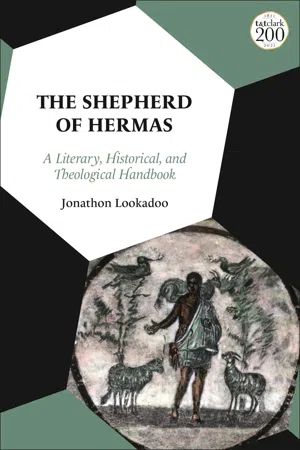
eBook - ePub
The Shepherd of Hermas
A Literary, Historical, and Theological Handbook
- 272 pages
- English
- ePUB (mobile friendly)
- Available on iOS & Android
eBook - ePub
About this book
Trusted by 375,005 students
Access to over 1.5 million titles for a fair monthly price.
Study more efficiently using our study tools.
Information
Part I
Introducing the Shepherd of Hermas
The chapters contained in Part I introduce the story and critical issues associated with the study of the Shepherd. These chapters maintain a thoroughly text-based focus on the Shepherd and only come to matters such as authorship and date after the narrative, manuscripts, and reception of the Shepherd have been discussed. The rationale for this organization stems from a belief that scholarship on ancient documents must begin with a thorough knowledge of the document itself. With that in mind, Chapter 1 opens the volume by introducing the narrative shape of the Shepherd. This brief introduction may be useful given the winding narrative form and lengthy interpretations that can distract from the main narrative thread. By summarizing and necessarily simplifying the narrative, Chapter 1 begins with a focus on the events narrated in the text.
Chapters 2 and 3 turn to the questions of how the Shepherd may be known. Most readers gain access to the Shepherd through printed editions of the Greek text and translations into modern languages. Given that the text originated in the Roman Empire, though, it is important to consider the ways in which the text was transmitted from its earliest readers to readers in the present day. Chapter 2 explores the manuscripts and translations of the Shepherd that are extant. Greek manuscripts of the Shepherd have been preserved in numbers that are analogous to some books of the New Testament. It was also translated into other ancient languages. Knowledge of these textual witnesses will enable readers of this book to understand and evaluate variants that are listed in the textual apparatuses of modern critical editions. Further understanding of how the text was viewed, cited, and interpreted may also aid current readers of the Shepherd in making judgments about how best to understand certain passages. Of particular interest is the question of how much authority was granted to the Shepherd by readers in antiquity. Chapter 3 introduces the reception history of the Shepherd with a particular focus on what was said about the text during the second through fifth centuries and on the authority attributed to the text by these readers.
Finally, Chapter 4 turns to the questions that are perhaps most commonly associated with critical introductions of ancient texts. These are matters such as the genre, audience, authorship, and composition of a document. Chapter 4 is structured with a view to questions that may be asked of the Shepherd. For example, “what is the Shepherd” examines the issue of genre, while “for whom was the Shepherd written” leads to the matter of audience. By answering critical questions, considering the ways in which the Shepherd was transmitted, and exploring the narrative arc of the text, Part I aims to offer a thorough introduction to critical matters related to the study of the Shepherd in a way that privileges a direct examination of the text by all who wish to engage it.
Chapter 1
An Overview of the Shepherd
This chapter summarizes the lengthy text known as the Shepherd of Hermas. The reasons for doing this are twofold. First, this overview may enable those who have never read the Shepherd to grasp the contours of a text that is no longer particularly well-known and whose length and episodic style can make for difficult reading. Although this summary is no substitute for reading the text directly, it may serve as a rope by which to begin to climb aboard the ship with those who study this fascinating early Christian text. Second, for those who have read the Shepherd and may even be familiar with some of the critical introductory issues, this chapter is a reminder that the historical study of an ancient text should begin with a focus on the text itself. Since this book is intended to assist a broad range of readers in coming to a better understanding of the Shepherd, continued reflection on how the Shepherd unfolds is vital to fulfilling the aim of this volume. The Shepherd should ideally be read alongside and in conversation with this book, and the summary that follows aims to place the text at the center of the discussion.
Visions (1.1–25.7)
The opening section of the Shepherd is referred to as the Visions. This section comprises four primary visions in which Hermas interacts with a woman who shows him his failings and offers an opportunity for him and his family to repent. The fifth vision is shorter and opens the Mandates and Similitudes by recording the first appearance of the shepherd to Hermas. Collectively, the Visions introduce Hermas and his two revelatory agents as the three main characters in the Shepherd. The Visions also familiarize readers with the primary reasons why Hermas is visited, while also elaborating visionary and pedagogical themes that are key to the entire work.
Vision 1 (1.1–4.3)
The story begins by introducing Hermas, the recipient of the visions and the implied author of the text.1 When he was still a slave, he saw his owner, Rhoda, bathing in Rome’s Tiber River and wished for a wife of similar beauty and conduct (Vis. 1.1.2 [1.2]). While walking later, he is taken away in a vision where he meets Rhoda. Rhoda recalls Hermas’s earlier thought and says that she will accuse him of his sins soon. Shaken by these words, Hermas looks up to find an enormous white chair with an elderly woman holding a book sitting there (Vis. 1.2.2 [2.2]). The woman asks Hermas why he is weeping. When he tells her about Rhoda, the elderly woman confirms that such thoughts are not befitting of God’s servant. However, the more serious reason for God’s anger toward Hermas is so that he might turn his family from their current ways (Vis. 1.3.1 [3.1]). Because he loves his children, Hermas has not corrected them and has allowed them to become corrupt. God will heal these deeds, but Hermas must instruct his children. The elderly lady then begins to read from her book, but Hermas can only remember the last words, which describe God’s creation of heaven, earth, and the church as well as how God is making all things level for his chosen people if they keep his commandments (Vis. 1.3.3–4 [3.3–4]). When she finishes reading, she tells Hermas that the incomprehensible words are for Gentiles and defectors, while the last words are for the righteous (Vis. 1.4.2 [4.2]). She then tells Hermas to be courageous as she is taken away by two men.
Vision 2 (5.1–8.3)
As Hermas walks along the same route one year later, he recalls his earlier vision. He thanks the Lord for revealing his sins to him. When he rises from his prayer, he sees the elderly woman from the previous year. She asks him to send a message to God’s elect. Due to Hermas’s limited memory, he takes a book from her so that he can copy the message. When he finishes copying it, the book is snatched away from him (Vis. 2.1.3–4 [5.3–4]). After another fifteen days during which he fasts to know what the writing means, Hermas reveals what was written to his readers (Vis. 2.2.1–2.3.4 [6.1–7.4]). The message describes the sin of Hermas’s wife and children. God will forgive their previous sins if they repent, but God’s tolerance for their sin has reached its limit and they cannot sin again. Hermas has neglected his family by allowing these things to occur, but he has been rescued because he has not fallen away from the living God. He must remain steadfast in his single-mindedness and inform a certain Maximus that suffering is coming. After Hermas falls asleep, a young man shows him that the elderly woman to whom he has been speaking is the church (Vis. 2.4.1 [8.1]). She soon returns and instructs Hermas to write to Clement and Grapte, who will send the messages abroad and to widows and orphans, respectively.
Vision 3 (9.1–21.4)
Hermas continues to request revelation and is told that night to return to the field where the elderly lady will come to him the next morning. After she listens to ...
Table of contents
- Cover
- Halftitle Page
- Title Page
- Dedication
- Contents
- Acknowledgments
- List of Abbreviations
- Introduction
- Part I Introducing the Shepherd of Hermas
- Part II Studying the Shepherd of Hermas
- Bibliography
- Index of Authors
- Index of References
- Index of Subjects
- Copyright Page
Frequently asked questions
Yes, you can cancel anytime from the Subscription tab in your account settings on the Perlego website. Your subscription will stay active until the end of your current billing period. Learn how to cancel your subscription
No, books cannot be downloaded as external files, such as PDFs, for use outside of Perlego. However, you can download books within the Perlego app for offline reading on mobile or tablet. Learn how to download books offline
Perlego offers two plans: Essential and Complete
- Essential is ideal for learners and professionals who enjoy exploring a wide range of subjects. Access the Essential Library with 800,000+ trusted titles and best-sellers across business, personal growth, and the humanities. Includes unlimited reading time and Standard Read Aloud voice.
- Complete: Perfect for advanced learners and researchers needing full, unrestricted access. Unlock 1.5M+ books across hundreds of subjects, including academic and specialized titles. The Complete Plan also includes advanced features like Premium Read Aloud and Research Assistant.
We are an online textbook subscription service, where you can get access to an entire online library for less than the price of a single book per month. With over 1.5 million books across 990+ topics, we’ve got you covered! Learn about our mission
Look out for the read-aloud symbol on your next book to see if you can listen to it. The read-aloud tool reads text aloud for you, highlighting the text as it is being read. You can pause it, speed it up and slow it down. Learn more about Read Aloud
Yes! You can use the Perlego app on both iOS and Android devices to read anytime, anywhere — even offline. Perfect for commutes or when you’re on the go.
Please note we cannot support devices running on iOS 13 and Android 7 or earlier. Learn more about using the app
Please note we cannot support devices running on iOS 13 and Android 7 or earlier. Learn more about using the app
Yes, you can access The Shepherd of Hermas by Jonathon Lookadoo in PDF and/or ePUB format, as well as other popular books in Theology & Religion & Biblical Studies. We have over 1.5 million books available in our catalogue for you to explore.