- 208 pages
- English
- ePUB (mobile friendly)
- Available on iOS & Android
eBook - ePub
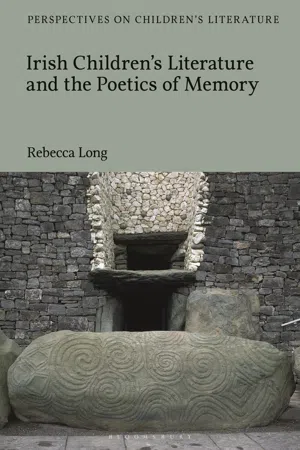
Irish Children’s Literature and the Poetics of Memory
About this book
Focusing on the mythological narratives that influence Irish children's literature, this book examines the connections between landscape, time and identity, positing that myth and the language of myth offer authors and readers the opportunity to engage with Ireland's culture and heritage. It explores the recurring patterns of Irish mythological narratives that influence literature produced for children in Ireland between the nineteenth and the twenty-first centuries. A selection of children's books published between 1892, when there was an escalation of the cultural pursuit of Irish independence and 2016, which marked the centenary of the Easter 1916 rebellion against English rule, are discussed with the aim of demonstrating the development of a pattern of retrieving, re-telling, remembering and re-imagining myths in Irish children's literature. In doing so, it examines the reciprocity that exists between imagination, memory, and childhood experiences in this body of work.
Trusted by 375,005 students
Access to over 1.5 million titles for a fair monthly price.
Study more efficiently using our study tools.
Information
Chapter 1
Retrieving: Standish O’Grady, Eleanor Hull, Augusta Gregory
The Celtic Revival: Cultural movement and cultural context
The Celtic Revival was a new departure in Irish cultural nationalism, a literary renaissance that began in earnest in Ireland in the late nineteenth century (Wilson Foster ix).1 It can be described as a collection of diverse movements, each striving to engage with Ireland’s cultural traditions and ancient pasts through myriad viewpoints and literary experiments. It is in no way surprising that tensions between these movements emerged regarding differing concepts of Irish selfhood, from notions of ‘essence and origins’ to a sense of identity ‘based on lived and shared experience’ (Watson Politics and Poetics 2) in a landscape negotiated on physical and metaphorical levels. As a series of cultural projects focusing on reconnecting the Irish nation with its ancient heritage and on re-envisioning its mythical past, the Revival and its cultural effects changed the Irish people’s perception of themselves (McMahon 4), despite an endemic lack of unity among the Revivalists driving it.2 It influenced representations of Ireland in contemporary literature, and in Irish literature for children produced in the English language in its wake.
The patterns of retelling that permeate Irish children’s literature in English in the twentieth and twenty-first centuries have been largely inherited from the acts of narrative reimagination that characterized the Revival. In other words, the Revival movement provided a model of retelling that was taken up and further adapted by authors writing for children in its aftermath. The recurring mythological narratives that are retold and reimagined across this literature constitute a heritage of imagination. The texts examined in this chapter are ‘products of their age’ (Kiberd 4) to be viewed in relation to one another, and in relation to texts in English for children produced in Ireland in the decades that followed the Revival. If, as W. B. Yeats said, ‘the arts lie dreaming of what is to come’ (Literary Ideals 72), then the retelling of these mythological narratives simultaneously looked back to the pasts of Ireland out of which they emerged, and to the future, the shape of which they would influence.
This chapter brings a focus to bear on the patterns of mythological retrieval prevalent in the early part of the Celtic Revival, between 1892 and 1909, by analysing three retellings of the myth of Cuchulainn: Standish O’Grady’s The Coming of Cuculain (1894), Augusta Gregory’s Cuchulain of Muirthemne (1902) and Eleanor Hull’s Cuchulain the Hound of Ulster (1909). These specific texts are chosen for consideration precisely because they can be considered to be representative of the aims of the Revival as expressed in literary texts that influenced narratives produced for children, with a particular focus on the use of childhood as a preparatory stage for citizenship. The cultural and imaginative effects of the Revival, and the aim of its central writers, to restore Ireland to a sense of its lost heritage and to retrieve mythological narratives out of that heritage, influence the production of literature in English for children in Ireland in its wake, a body of texts that is dominated by mythological narratives. O’Grady’s and Gregory’s texts, while not written specifically for a child audience, were part of the cultural discourse about citizenship and duty that influenced children’s culture and literature at the time. Together with Hull’s version of the myth of Cuchulainn, retold specifically for children, these texts are representative of the ways in which mythological narratives and heroic figures were used to engage child readers in the wider Revival movement.
The works of Revivalist authors such as Standish O’Grady, Eleanor Hull, Augusta Gregory, George William Russell, W. B. Yeats and others produced images of cultural and mythological heritage that permeated the contemporary literary and cultural spheres of Irish society, facilitating a dialogue about imaginative inheritance which in turn influenced literature produced in English for Irish children in the decades that followed.3 The Revival, and the processes of retrieval and reimagination that gave the movement its dynamic momentum, becomes a starting point for the patterns of recurring mythological narratives that pervade Irish children’s literature in the twentieth and twenty-first centuries. Authors such as O’Grady, Hull and Gregory retrieved mythological narratives out of the past in order to restore them back into cultural discourse so that the act of retrieving becomes one of the defining actions of the Revival movement, particularly in the context of literature produced for and consumed by children.
Towards the end of the nineteenth century in Ireland, one of the fundamental aims of that Revival movement, as propounded by organizations such as the Pan Celtic Society (1888), the Gaelic League (1893) and the Irish Literary Theatre Society (1893), was ‘to preserve the cultural individuality of the … nation’ (Hutchinson 1) by precipitating a return to the history and mythology that constituted the distinctive imaginative heritage of the Irish people. In essence, by presenting what was retrieved out of the nation’s past to the nation’s people, the cultural nationalist movement would achieve a revival of Ireland’s national character. Defined or conceived of ‘in terms of myths of common origins, distinctive cultural characteristics, and attachments to specific territorial homelands’ the idea of the nation has existed ‘from time immemorial’ (3). The culture of a nation is thus constituted by these myths, characteristics and attachments, an imaginative heritage shaped and defined by experiences of time, myth, landscape and selfhood, articulated in literature and artistic expression. Cultural nationalism, then, in the context of the Revival, was a nation-building endeavour, where the foundations for that nation were to be found in the past, because nationalism, as Ernest Gellner writes, ‘constructs and transforms a folk culture into a high culture’ seeking an affirmation and validation of ‘a state of its own’ (xxviii).
The objectives of the Gaelic League at this time were Revivalist as opposed to political in nature, and the organization was seeking the spiritual and cultural regeneration and restoration of the nation, by promoting and facilitating ‘a return to its creative source in the evolving Gaelic civilisation of its recent past’ (Hutchinson 116). As early as the sixteenth century, Ireland was associated with the notion of a periphery, and with the older vestiges of a primordial ‘ “Celtic” language’ (Leerssen 7). The works of Celticists such as Ernest Renan and Matthew Arnold evoked journeys outwards ‘in which one leaves the present and the quotidian pace of temporal progress’ and ‘moves out of time, into the past or into some mythical or primordial timelessness’ (Hutchinson 116). Celtic mythology was and is associated with the past, just as the landscapes of Ireland were and are associated with the evocation of that past.
The Revivalists were arguing that this ancient culture had inspired the Irish people for countless generations. For them, looking forward was explicitly connected to the act of looking back, and to acts of recovery and retrieval. It is testimony to the diverse nature of the Revivalist movement, however, that we find ‘rival versions of the national idea represented by separate linguistic and literary movements’ (119). The former was concerned with a cultural and social revival based on the restoration of the Irish language itself. The latter was striving to create a singular and distinctive ‘Anglo-Irish nation’ (119) by producing a national literature in English, the foundations of which would be built on the legends and idioms of the disappearing Irish language. I want to focus on the latter stream of the Revival, and on the project of retrieval and retelling that was pursued in the name of such a national literature, where nothing less than a new departure in narrative technique would be demanded so that a ‘new united nation synthesizing [sic] the Gaelic and English heritages’ (120) might come into being. In the vision of leading Revivalist figures such as Yeats, Gregory and others, we find the template for the patterns of reimagination that influence Irish children’s literature in English in the twentieth and twenty-first centuries.
The Celtic Revival was thus a revival in which genres were recreated, reclaimed and reimagined. The diverse streams within the movement of the Revival facilitated a communion between tradition and innovation that had hitherto seemed impossible (Schleifer 3). Within the larger Celtic Revival, the Anglo-Irish Literary Revival sought to create a new medium in the cultural life of Ireland, a hybrid language based on the emerging vernacular of the Irish people – ‘an English rich with Irish idioms and rhythms’ (Hutchinson 128) that could be used to articulate a new literature that would simultaneously recall a Celtic heritage and would look forward to an enlightened future. In order to ‘preserve and thereby redeem an authentic Irish … culture’ (Castle 41), the mythological narratives associated with Ireland’s cultural heritage needed to be retrieved and retold.
Representation is one of the central practices through which culture is produced, and culture itself is concerned ‘with the production and exchange of meanings’ (Hall Representation 2). Culture is about shared meanings, and for meanings to be shared and exchanged, members of a culture must have access to a common language. This is because language is one of the media through which ‘thoughts, ideas, and feelings are represented in a culture’ (1). Representation through language is central, therefore, to the processes through which meaning is produced in a culture.4 Language occupies a crucial role in the production and exchange of meaning because it functions as a representational system. If it is to allow members of a culture to perceive and understand the world in similar ways, those members must also ‘share sets of concepts, images and ideas’ (4). So, culture is concerned with the production and exchange of meanings, not just between individual members and groups in a society at a particular moment but across different time periods through cultural texts and artefacts. Meaning is produced when we ‘weave narratives, stories – and fantasies’ (4) around the cultural rituals and practices that structure our lives, and if those narratives remain accessible, they can continue to produce meaning for new generations of a particular culture.
Members of the same culture must share and understand the same symbolic language. Within their individual projects, the writers of the Celtic Revival were contemporaneously seeking to create a new set of symbols and images through which to retrieve the lost mythological and cultural heritage of the Irish people and restore it back into the contemporary present. They were seeking a narrative language that would allow them to simultaneously remember the past and imagine the future. They were trying to create, through retelling, what F. M. Barnard terms ‘symbolic forms of life’ (185). The movement towards the retelling and re-purposing of mythological narratives that developed during the Revival was, essentially, an ‘invented tradition’, a set of culturally reformative practices through which these writers sought to retrieve and restore a sense of Ireland’s lost heritage by establishing a ‘continuity with the past’ (Hobsbawm 1). The Revivalist project, then, was a process of ‘formalization and ritualization’ [sic] (4) of Irish cultural and mythological heritage, through retelling and reimagination. In this context, Ireland’s cultural heritage became a narrative, or a series of narratives, and a way of ‘thinking and talking about communities … in space and time’ (Gillman 21) connected by shared practices, rituals, experiences and memories.
Cultural memory: Images and rituals
Memory allows an individual to sustain a distinctive identity, not only through processing acts of recollection but also through interacting with and making meaning from memory images. It follows then that communities and societies also use memory to sustain and perpetuate distinctive, collective identities. Through memory and memory images, a society, or a nation, can maintain and transmit a sense of its collective identity to future generations (Boyer 9). Narratives that contain memory images can fulfil this function, especially narratives that are mythological in nature, and that encapsulate aspects of a nation’s cultural heritage. These narratives not only facilitate what Boyer calls ‘the collective construction of a common past’ (9) but also the retrieval and reclamation of a common past previously deemed to be lost. Boyer also argues that memory is constructive. This implies that memory is a creative force, as well as a recreative or reconstructive one. This is why any causal account of social identities (11), or any causal account of the prevalence of reimagined mythological narratives in Irish children’s literature since the Revival, should include individual or narrative processes of representations of the past. The ideas of ‘time present and time past’ become, through narratives that retrieve and retell cultural and mythological heritage, ‘time future’ (Eliot 13).
The impulse to remember and to retell that informed so much of the imaginative fiction produced during the Revival was also an undertaking not to forget what had been recalled. A pattern was formed from the desire to remember and the perceived duty not to forget. While the Cultural Revival as a movement provided a creative space in Ireland within which engagement with mythological narratives and cultural heritage became connected to the rejuvenation of national identity, the notion of looking back in order to retell ancient stories was already a familiar one in Britain, especially in relation to the Arthurian cycle. Thomas Mallory’s Le Morte d’Arthur was first published by William Caxton in 1485 and became the foundational text for many interpretations of the Arthurian myth, not least Tennyson’s The Idylls of the King from 1859, which retold the entire myth for a Victorian audience, and Sidney Lanier’s The Boy’s King Arthur from 1880, a text specifically edited and retold for a child readership. The Irish Revival project was always infused with a sense of what had been lost out of the nation’s cultural memory. The attempt to retrieve or at the least recreate that material necessarily involved a negotiation of Ireland’s colonial past and present and its contemporary position in relation to British control. In contrast, the Matter of Britain, the narratives of Arthur’s myth, was preserved through centuries and always available to be retold and reinterpreted. T. H. White’s The Once and Future King from 1958 uses the Arthurian cycle to examine and satirize the contemporary political climate and the state of education in Britain. For Irish authors working within the Revival project, retelling was always connected to creating and recreating a national identity and a national mythological past. For British authors working with the Matter of Britain, this national past was always already established because the Matter of Britain had never been lost or forgotten.
But memory can also be understood within the context of the Platonic idea of anamnesis, the belief that ‘when knowledge comes to be present … it is recollection’ (Phaedo 21). Knowledge and memory then are connected by the act of recollection, by the remembering of that which was and is already known.5 If recollection involves the retrieval of memory-images from the past, then retrieval is also ‘the repossession of truth’ (Scanlan 11), be that truth cultural or mythic in nature. John Scanlan writes that the memory that seems to reappear from the past as recollection (and he deems this reappearance to be involuntary, and places it in opposition to the ‘willed efforts of remembering’) intervenes in the present ‘as a kind of mythic temporality’ (9–10) constituting a time outside of time. The creative projects of the Revival, and the acts of retelling and repurposing its writers engaged in, accessed this mythic temporality, precisely because the retelling and repurposing of mythological narratives brought the ancient pasts of Ireland into its present. The projects of the Revival were arguably concerned with cultural and mythological memories, or memory-narratives and memory-images, which are not only remembered but deliberately and consciously retrieved and reclaimed as well. The retrieval of such memories or images revealed a mythic connection between the pasts of Ireland and its contemporary present, as envisaged by the Revivalist writers. Memory also acts ‘as an awareness of the distance between the past and the present’ (116). The Revivalists, in attempting to retrieve and retell the narratives of Ireland’s mythological past, wrote into this distance. So, the images of the past that were retrieved, especially in the specific context of the Revival, are ‘remembered, narrated, and … woven into the fabric’ (Assmann Moses 14) of the contemporary present of Ireland.
If the past is refracted through the present, then heritage, or the cultural and mythological inheritance of Ireland’s people in this case, must involve an engagement with the past within the present. Objects, images and narratives from the past are brought back into view through recollection. Such objects and images must be engaged with imaginatively to ‘reveal their hieroglyphic potential’ (Scanlan 52). Hieroglyph is a Greek word meaning sacred writing,6 yet hieroglyphic images are just that, images. So, with the phrase ‘hieroglyphic potential’, Scanlan is arguably referring to the capacity for objects, images and narratives to hold multiple meanings, and to generate multiple meanings. If we think of the past in terms of images that are at once distant, yet accessible to us through memory (56), then the past itself is accessible through memory, and through the meaning we can generate from memory-images.
So, these images are, by their very nature, dialectic...
Table of contents
- Cover
- Half-title Page
- Dedication Page
- Title Page
- Contents
- Introduction
- Chapter 1 Retrieving: Standish O’Grady, Eleanor Hull, Augusta Gregory
- Chapter 2 Retelling: Alice Dease, Ella Young, Violet Russell, Padraic Colum, James Stephens
- Chapter 3 Remembering: Patricia Lynch, Una Kelly, Eilís Dillon, J. S. Andrews
- Chapter 4 Reimagining: Pat O’shea, Orla Melling, Jim O’leary, Kate Thompson, Siobhan Dowd
- Conclusion: Darragh Martin, Peadar Ó’Guilín
- Notes
- Works Cited
- Index
- Copyright Page
Frequently asked questions
Yes, you can cancel anytime from the Subscription tab in your account settings on the Perlego website. Your subscription will stay active until the end of your current billing period. Learn how to cancel your subscription
No, books cannot be downloaded as external files, such as PDFs, for use outside of Perlego. However, you can download books within the Perlego app for offline reading on mobile or tablet. Learn how to download books offline
Perlego offers two plans: Essential and Complete
- Essential is ideal for learners and professionals who enjoy exploring a wide range of subjects. Access the Essential Library with 800,000+ trusted titles and best-sellers across business, personal growth, and the humanities. Includes unlimited reading time and Standard Read Aloud voice.
- Complete: Perfect for advanced learners and researchers needing full, unrestricted access. Unlock 1.5M+ books across hundreds of subjects, including academic and specialized titles. The Complete Plan also includes advanced features like Premium Read Aloud and Research Assistant.
We are an online textbook subscription service, where you can get access to an entire online library for less than the price of a single book per month. With over 1.5 million books across 990+ topics, we’ve got you covered! Learn about our mission
Look out for the read-aloud symbol on your next book to see if you can listen to it. The read-aloud tool reads text aloud for you, highlighting the text as it is being read. You can pause it, speed it up and slow it down. Learn more about Read Aloud
Yes! You can use the Perlego app on both iOS and Android devices to read anytime, anywhere — even offline. Perfect for commutes or when you’re on the go.
Please note we cannot support devices running on iOS 13 and Android 7 or earlier. Learn more about using the app
Please note we cannot support devices running on iOS 13 and Android 7 or earlier. Learn more about using the app
Yes, you can access Irish Children’s Literature and the Poetics of Memory by Rebecca Long, Lisa Sainsbury in PDF and/or ePUB format, as well as other popular books in Literature & English Literary Criticism. We have over 1.5 million books available in our catalogue for you to explore.