Through moments of social protest, policy debate, and popular mobilization, this book follows the campaign for economic democracy and the fight for full employment in the United States. Starting in the 1930s, Dennis explores its intellectual and philosophical underpinnings, the class struggle that determined the fate of legislation and the role of left-wing civil rights activists in its revival.
Demonstrating how the campaign for full employment intersected with movements for women's liberation and civil rights, it explores how social groups and oppressed minorities interpreted and appropriated the promise of full employment. For many, full employment provided an indispensable path to racial and gender emancipation. In this book, Dennis uncovers the class dimensions and the resistance to full employment in the US. He demonstrates how the recurring debates over full employment consistently exposed the contradictions inherent in a capitalist society and challenged the assertion that an allegedly free enterprise system automatically generated employment for all.
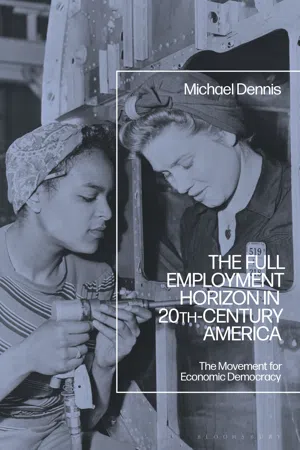
eBook - ePub
The Full Employment Horizon in 20th-Century America
The Movement for Economic Democracy
- 296 pages
- English
- ePUB (mobile friendly)
- Available on iOS & Android
eBook - ePub
The Full Employment Horizon in 20th-Century America
The Movement for Economic Democracy
About this book
Trusted by 375,005 students
Access to over 1.5 million titles for a fair monthly price.
Study more efficiently using our study tools.
Information
1
The Horizon of Possibility: The Great Depression and the Idea of Full Employment
If the central paradox of the American experience is the persistence of racial inequality in a nation predicated on the idea of freedom, its corollary is the existence of want amid plenty. That contradiction was never more evident than in the 1930s. Despite the social and political reforms championed during the Progressive Era, it was only in the crisis of the Great Depression that American commentators, economists, and social critics began to grasp that economic planning could banish the ravages of the business cycle.
This sense of possibility emerged out of the struggle to explain how a society capable of generating abundance now faced economic calamity. In the aftermath of the great crash, liberal intellectuals at journals such as The New Republic and The Nation began shifting from cultural criticism to an analysis of modern capitalism itself. In doing so, they joined social critics such as Felix Frankfurter, Rexford Tugwell, Lewis Mumford, and Charles Beard, each of whom had advanced the progressive analysis of industrial capitalism in the 1920s.
New Republic editor George Soule proved critical to this movement. In the desperate days of 1930, he argued that rapid technological advancement had created a situation in which the ability of manufacturers to produce had far outstripped the capacity of existing markets to consume what was relentlessly rolling off the assembly lines. Beginning in 1923, the wages of industrial labor steadily fell behind rising productivity. That translated into reduced demand for consumer goods. At the same time, the prices of consumer goods failed to decline sufficiently to sustain aggregate demand. In Soule’s estimation, this was a house of cards built on installment buying, a fleeting construction boom, and an exploding automobile industry which consumers could no longer afford to sustain. The failure to raise wages or salaries would spell a chronic period of stagnation. Familiar though Soule’s insights would become in the 1930s, his observations would provide the seedbed for full employment thought.1
This seedbed would be cultivated by economists and journalists throughout the 1930s. Stuart Chase, who also wrote for the New Republic, believed that the nation faced a transition from a political economy rooted in scarcity to one founded on abundance. Americans were beginning to recognize the contradiction between productive capabilities and the profit system. The “operating plant has been constructed primarily in the vendibility frame,” Chase argued, “to sell either its output or itself at a pecuniary profit. Its vendibility has been measured and remeasured on the ledgers of banks, the balance sheets of great corporations, the tickers of stock exchanges. Its serviceability is unmeasured and unknown.”2 If one theme would come to dominate the imagination of full employment proponents, it was the notion that modern productive capabilities could be liberated from the calculating grasp of “vendibility” and utilized to distribute abundance more equitably. As Soule observed in his 1935 A Planned Economy, “It is now commonplace to speak of the absurd contrast between ‘overproduction’… and the fact that many persons are in want. This fact sets the stage for our effort.”3
In this conviction, journalists like Soule and Chase joined professional economists like Rexford Tugwell in exploring the idea that the economic dynamo of modern industrial capitalism required the expansion of consumption.4 Engaging in this analysis, a widening band of intellectuals regenerated the idea of economic planning that had been so endemic to Progressive Era thought. Shaped by Lester Frank Ward, Herbert Croly, Thorstein Veblen, and others, the progressive impulse toward greater social efficiency provided the foundation for economic during the Great Depression.5
In the 1930s, institutional economists struggling with the problem of technological and structural employment joined a group of left-leaning intellectuals in supporting a planned approach to stimulating consumer demand. This line of thinking appealed to the belief common among left-liberal intellectuals that capitalism had not only failed to deliver on the promise of success through hard work, but had also been proven to be wasteful, reckless, and destructive.6 Even though some intellectuals more famously turned toward communism to substitute for what seemed like a failed capitalist experiment, their search for political meaning echoed economic planners like George Soule and Stuart Chase.7
While Soule, Chase, and Tugwell appreciated greater economic rationality, they proposed solutions to the crisis that would drastically alter the mechanisms of capitalist accumulation. For a nation clawing its way out of the Depression, economic planners turned to the promise of full employment as an avenue toward a fundamentally different kind of society. Instead of a society in which productive capabilities stood idle for lack of market demand, Stuart Chase celebrated the “economy of abundance,” which “promises presently to socialize the bulk of commercial and industrial property [original italics].” This was no mere formula for fiscal tinkering. Having arrived at the stage at which technological capabilities had apparently solved the perennial problem of generating enough, Chase was convinced that American society was prepared to challenge the entitlements to private property that stood in the way of survival. “If the bulk of the owners have no use for it,” he argued, then “the community has. Without its regular operation, the community must starve or freeze.”8 Amid the wreckage and human suffering of the Great Depression, Chase was untangling the central puzzle of modern industry: its capacity to generate consumer goods on a massive scale while routinely plunging the society on which it depended into the icy waters of insecurity.
At the core of Chase’s analysis was a critique of market economics itself. “The function of capitalism is not to supply people with things which they want.” Instead, it was to produce consumer goods in sufficient quantity in exchange for revenues that would absorb the cost of production, pay off the interest, and ensure a tidy profit. Echoing the famous analysis of economist Karl Polanyi, who argued that, under capitalism, primitive markets embedded in the fabric of their societies had developed into anti-social instruments of private accumulation that legitimized acquisitive individualism, Chase posited an elemental antagonism between free market capitalism and the public good.9 “Markets are not made by human need,” he warned. “The ten million unemployed in this country today would gladly take a volume of goods which would make factory wheels hum. The factory wheels are silent because the unemployed have no money.”10
Contrary to the notion that modern business had created the conditions in which people could fulfil their wildest consumer dreams, Stuart proposed the sobering assessment that the modern market was designed to sustain private enterprise. It was not “a place where people want things” since increasing the money supply threatened inflation. Instead, it was a “place where people who have money are able to buy things.” Any effort to provide direct financial assistance to consumers threatened the precarious system built by capitalism and would be vigorously resisted by bankers and financiers alike. “It is more feared—see almost any American editorials in 1933—than the loss of markets.”11
As Chase pointed beyond technological change to the market economy itself, he underlined the powerful countermovement against market logic that had gained traction in American policymaking circles. Writing in 1934, nothing impressed him more than the National Recovery Act, which provided for collective bargaining but also legislated maximum hours and minimum wages. The measure did not simply aim to increase purchasing power but announce “in effect that labor was not a commodity. In prescribing maximum hours and minimum wages, [Roosevelt] took it clear out of the vendibility system.” The measure addressed the central problem facing workers: the over-supply of labor at a moment of quickly contracting demand. “Wheat can be burned, cotton plowed under,” Chase wryly observed; “the unemployed are not disposed of so easily.” What mattered was not the minimal impact of the National Industrial Recovery Act on the problem of decommodifying labor. Instead, it was the fact that “the principle has been laid down [original italics],” the precedent established, that workers should not sell themselves to the lowest bidder in exchange for their livelihoods.12 While crafting a case for economic planning in the maelstrom of the Depression, Chase unwittingly harkened back to a lineage of progressive labor thinkers that included Orestes Brownson, George McNeil, Eugene Debs, and John Ryan. Each had questioned the capacity of capitalism to protect human dignity. The dilemma that Chase sought to elucidate in 1934 was the same with which labor activist George McNeil had wrestled in 1887. “The problem of today as of yesterday and to-morrow,” he wrote to those who had just witnessed the exhilarating Eight-Hour Movement the year before, “is how to establish equity between men.” If McNeil’s language reflected the typical gendered assumptions of the era, it also resonated with the sense that the American movement was part of a worldwide movement for democratic justice. “The laborer who is forced to sell his day’s labor to-day, or starve tomorrow, is not in equitable relations with the employer, who can wait to buy labor until starvation fixes the rates of wages and hours of time.”13 Chase’s analysis emerged out of the peculiar circumstances of the 1930s, but it belonged to a long and rich tradition of critiquing the contradiction between capitalism and the vaunted American principle of equality. At its foundation, the search for full employment continued this tradition.
In 1937, a collection of leading thinkers and scholars that included political scientist Harold Lasswell, philosopher Sidney Hook, anthropologist Margaret Mead, and economist Wesley Clair Mitchell revived the discussion of economic planning. In a symposium titled Planned Society: Yesterday, Today, and Tomorrow, the contributors posited an overarching theme: that the system of laissez-faire, competitive capitalism had amassed considerable fortunes and forwarded modernization even while it had produced a trail of destruction. More than this, it constituted an historical anachronism, one that was incompatible with the needs of a complex and interdependent society.14
Lewis Mumford captured the idea that defined so much of the left-wing thought of the era: the self-regulating marketplace of capitalist lore was a myth. According to Mumford, this notion of a “self-equilibrating” economy had only served to justify blithe indifference to the social consequences of industrial capitalism. If the pursuit of untrammeled self-interest invariably satisfied the widest range of human needs, why question its methods? Yet this “theology,” as Mumford described it, was a “superstition and its practical results were disastrous.” In fact, the “waste of natural resources, the unbalance of regional life, the mis-building of cities, the pauperization of labor, the duplication of effort, the recurrent jars and wrenches in the economic organizations themselves—all these characteristics of industrial society during the last century showed that order was something less than providential.” In Mumford’s estimation, the expansion of industrial capitalism in the globe had only produced growing instability, monopoly concentration, and the threat of totalitarianism in Europe.15
Critically, Mumford had captured the extent to which business had become the arbiter of what passed for social order. This was exactly the scenario which Polanyi had detailed in The Great Transformation: a society subordinated to the caprices of private enterprise, one in which community bonds and needs are submerged under the roiling seas of competitive capitalism. For Mumford, however, there was no “double movement” against the imperatives of capital formation and profitability. The Depression had exposed just how fragile this interdependent society built around the requirements of private enterprise had become.16 What Mumford and the contributors to Planned Society hoped to foster was the conviction that social democratic reform could contain the destructive forces of unfettered capitalism and avoid the dangers inherent in administrative centralization.
The recession of 1937 reignited interest in subordinating the market economy to social needs. As cuts to job creation programs such as the Works Progress Administration thrust the United States back into economic crisis, proponents of economic planning began to focus greater attention on the idea of guaranteed employment. Those working on Roosevelt’s National Planning Commission began to formalize what historian Patrick Reagan describes as a “moderate version of compensatory spending policy,” which would achieve greater coherence in the run up to war between 1939 and 1941.17
Together with independent economists and intellectuals, the authors of Planned Society established the broad outlines for a maximum production policy. Few considered it a panacea for Depression. Instead, measures to achieve full employment intersected with efforts to establish a minimum level of social security and to regu...
Table of contents
- Cover
- Halftitle Page
- Title Page
- Dedication Page
- Table of Contents
- Acknowledgments
- Introduction: Political Struggle and the Promise of Full Employment
- 1 The Horizon of Possibility: The Great Depression and the Idea of Full Employment
- 2 The Expanding Horizon of Full Employment: Thought and Activism in the 1940s
- 3 A War against Want: Senator James E. Murray and the Political Campaign for Full Employment
- 4 The People’s Struggle for Full Employment in the Aftermath of War
- 5 Out of Rebellion and into the Morass: Full Employment in the Postwar Years
- 6 “The Day of Structural Economic Reform Is Not Over:” The Full Employment Revival, 1960–1973
- 7 The Vitality of the Improbable: The Campaign for a Job Guarantee and the Radical Possibilities of Full Employment in the 1970s
- 8 Regeneration and Stasis: An Idea in Search of a Movement
- Conclusion
- Bibliography
- Index
- Imprint
Frequently asked questions
Yes, you can cancel anytime from the Subscription tab in your account settings on the Perlego website. Your subscription will stay active until the end of your current billing period. Learn how to cancel your subscription
No, books cannot be downloaded as external files, such as PDFs, for use outside of Perlego. However, you can download books within the Perlego app for offline reading on mobile or tablet. Learn how to download books offline
Perlego offers two plans: Essential and Complete
- Essential is ideal for learners and professionals who enjoy exploring a wide range of subjects. Access the Essential Library with 800,000+ trusted titles and best-sellers across business, personal growth, and the humanities. Includes unlimited reading time and Standard Read Aloud voice.
- Complete: Perfect for advanced learners and researchers needing full, unrestricted access. Unlock 1.5M+ books across hundreds of subjects, including academic and specialized titles. The Complete Plan also includes advanced features like Premium Read Aloud and Research Assistant.
We are an online textbook subscription service, where you can get access to an entire online library for less than the price of a single book per month. With over 1.5 million books across 990+ topics, we’ve got you covered! Learn about our mission
Look out for the read-aloud symbol on your next book to see if you can listen to it. The read-aloud tool reads text aloud for you, highlighting the text as it is being read. You can pause it, speed it up and slow it down. Learn more about Read Aloud
Yes! You can use the Perlego app on both iOS and Android devices to read anytime, anywhere — even offline. Perfect for commutes or when you’re on the go.
Please note we cannot support devices running on iOS 13 and Android 7 or earlier. Learn more about using the app
Please note we cannot support devices running on iOS 13 and Android 7 or earlier. Learn more about using the app
Yes, you can access The Full Employment Horizon in 20th-Century America by Michael Dennis in PDF and/or ePUB format, as well as other popular books in History & Economic History. We have over 1.5 million books available in our catalogue for you to explore.