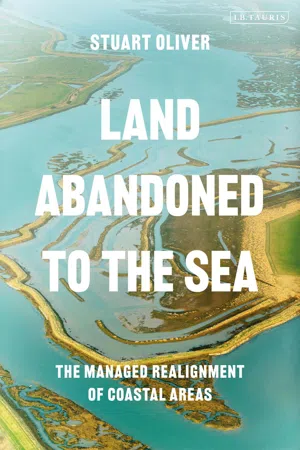
Significant changes are affecting coastlines around the world due to economic pressures and climate change. This book addresses the social, cultural and political context of the process of managed coastal realignment, the strategic abandonment of the coast, as a means of coping with these changes.
With a specific focus on the Blackwater Estuary in Essex, Stuart Oliver analyses the cultural and social implications of managed retreat and proposes managed realignment as a practical way in which society can rethink itself, addressing the new realities of the environment and a move towards developing a more sustainable relationship with it.
- 216 pages
- English
- ePUB (mobile friendly)
- Available on iOS & Android
eBook - ePub
About this book
Trusted by 375,005 students
Access to over 1.5 million titles for a fair monthly price.
Study more efficiently using our study tools.
Information
1
Managed realignment and its context
This chapter
This chapter explains what managed realignment is and what is the environmental and social context in which it originated and in which it developed. The chapter begins with an introduction to the contemporary coast as a site of change and to the crisis the coast is undergoing. It then introduces managed realignment: what it is, why its ‘managed’ element matters and why it is important. The chapter then looks at the nature of the contemporary coast and its management. Finally, it considers the nature of the British coast and the issues of flood defence and coastal management that are related to it.
Introduction: The coast
A spectre is haunting the British coast – the spectre of abandonment. Rising seas, decaying seawalls, the slow decay of the old coastal infrastructure, all suggest a crisis at the coast. Managed realignment is one possible resolution for some of those now-vulnerable sites, an alternative to decay. While realignment is just one of many processes of contemporary coastal management – and by no means the most common one – the need for realignment, what realignment threatens and what realignment offers cannot be ignored.
The end of the twentieth century was a time of change and crisis. Unprecedented environmental change combined with an associated social and personal crisis that affected the whole of Western society, not the least Britain. The environment was changing as a result of out-of-control disruption to its key processes; society was changing in response to a globalized revolution in the production and consumption of goods and services. And people were changing too, with a growing individualization that went together with and developed alongside the spread of an often-fractious antagonism to traditional authority. Together, the combination of those phenomena has made a new world over the past half century, one in which people and society are struggling to revise and re-form not just the way they relate to each other but also the demands they make on the environment. Managed realignment is both a symptom of that change and an element in it.
Along the coast, the solid sea walls of the past have (at least in part) begun to melt into air. The tattered borders between land and sea that this has left, the patient and painstaking negotiation of the future landscape between stakeholder groups, the aching want for the return to a lost past: all these are ways that managed realignment points to the future. Its role looks set to become more important still in the future as people and society struggle to cope with irresistible and potentially catastrophic environmental change. In this important role realignment may provide a pragmatic way of dealing with a changed coast of course but perhaps its greatest significance is that it also embodies a way of thinking that suggests and may require a new relationship with the natural world.
The crisis on the coast
The coast is undergoing change that is as rapid as in historical times it is unprecedented. Currently in Britain, about 1,800 km of the coast is experiencing erosion – of which about a quarter is eroding at the accelerated rate of 10 cm a year or above – and an estimated 740 properties are now deemed at risk from coastal erosion over the next twenty years.1
Behind this threat is climate change, which is happening and happening quickly. According to the recent review by Benjamin Lieberman and Elizabeth Gordon,2 climate data and modelling together show with overwhelming likelihood a future of ‘pronounced and accelerating change’ for global warming. So far, this has amounted to a worldwide temperature increase of about 0.8ºC but the rate of change appears to have been accelerating in the first two decades of the current century.3 The most recent predictions of the Intergovernmental Panel on Climate Change (IPCC) suggest that by 2100, while a Greenhouse Gas Reduction scenario for global emissions would lead to an increase of 1.0ºC, a Greenhouse Gas Stabilization scenario would produce an increase of 1.8ºC and a Business as Usual scenario an increase of 3.7ºC.4
With climate change, the level of the seas is rising. The IPCC suggests that by 2100 a Greenhouse Gas Reduction scenario would lead to a sealevel rise of 0.40 m, a Greenhouse Gas Stabilization scenario to a rise of 0.47 m and a Business as Usual scenario a rise of 0.63 m. These substantial changes have significant implications for the future of the coast, leaving it likely to be eaten into by rising seas and eroded by more aggressive wave action. Were the future global temperature to rise by as much as 4ºC – and assuming the level of the sea would then rise by between 0.5 m and 2.0 m5 – there would be a loss across the world of between 877,000 km2 and 1,789,000 km2 of land, which would lead to the forced relocation of between 72 million and 187 million people.6 In northern and western Europe the effects would be severe, requiring the relocation of between approaching 1 million and 15 million people.
Those figures and the attendant problems associated with them seem likely to have a proportional affect on Britain. Absolute sealevel around the coast has been rising by an average of 1.4 mm a year since 19017 and around 3,000 km of the coast (that is 17 per cent of it) has come to be subject to erosion.8 Current projections indicate that by 2100 the sea will rise by around 50 cm but could rise by as much as 80 cm. On that basis, the Climate Change Risk Assessment calculated that while there are currently 560,000 properties and 900,000 people exposed to flooding and coastal erosion, those figures would likely increase (allowing for population growth) to between 980,000 and 1.5 million properties and 800,000 and 4.1 million people by the 2080s. More specifically, erosion is likely to cause growing losses of land and property at the coast – of between 6,500 and 10,000 ha of agricultural land by the 2080s and with the number of residential properties at risk likely to rise from the current 3,500 to 58,800 by 2105.9
Contemporary society takes the threat of climate change and the threat to the coast seriously – at least it claims to do so. The response has been a greatly increased attention in the British political system to the issue of the environment.10 While the left, the centre and even to some extent the right have embraced the cause of the environment with some enthusiasm, the intractable nature of the problems presented by the current environmental crisis leaves many environmental problems more awkward to resolve than is convenient. The current approach is set out in the government’s most recent major statement, the twenty-five-year plan A Green Future,11 which ‘calls for an approach to agriculture, forestry, land use and fishing that puts the environment first’.12 Of course, to ‘call for’ falls some way short of promising – and the world of the 2040s is very comfortably past the current electoral cycle – but it would seem churlish to doubt the sincerity of hope expressed. In practice, while an expressed intention to act is deemed responsible, practical change has proved hard to achieve. There has been some progress in dealing with the problems already making themselves evident on the coast though – and one manifestation of that has been the implementation of the programme of managed realignment.
Managed realignment
Managed realignment, the subject of this book, is a technique of coastal management for dealing with the problems of sealevel rise and redundant protective infrastructure. Invented in the 1990s, it represents a challenge to society’s presumption that the natural world is subordinate and individuals’ hopes that the wild be kept at bay.
What is managed realignment?
Managed realignment is a coastal management technique likely to become increasingly important on the coast in this warming, threatened world. Realignment grew out of the conditions of the late-twentieth century: a world beset by environmental change, a society shaped by anxiety. It is the term commonly used for the deliberate, organized breaking down of existing sea walls carried out to let water flow back in: the managed abandonment of coastal land to the sea, the letting go of old coastal defences and the land they protected in order to move back to a new, sustainably defendable line.
Like any other phenomenon in contemporary culture, the environmental and social context of managed realignment’s development has shaped how it has come to be understood and how it has come to be described. In this process, there has arisen a degree of difference between the use of the term in the United States and in Britain. In the United States the term has sometimes come to be used for an evacuation of occupied sections of the coast, a particularly influential description of the technique there, meaning ‘the application of coastal zone management and mitigation tools designed to move existing development out of the path of eroding coastlines and coastal hazards’.13 Conversely (and more importantly for this book’s discussion) in Britain the term has mainly had a more restricted application to the organized, highly regulated abandonment of the existing shoreline, carried out with the intention of creating a more sustainable coast. So, according to the Parliamentary Office of Science and Technology14 it is ‘the deliberate breaching of hard defences, or not renewing defences when they reach the end of their expected life, to allow the coastline to move inland’, its principal objectives being ‘to create more intertidal habitats to provide a range of benefits, including buffering wave energy and reducing hard defence costs’.
As a technique of managing the coast, managed realignment is markedly, perhaps radically, different from those practised before. From the nineteenth century until the late twentieth century the British coast came to be subject to an increasingly assertive control in response to what R. W. G. Carter described as a perceived need to ‘“fix” the shoreline’.15 Yet by the late twentieth century that approach had come to be supplemented – and to an increasing extent replaced – by a move to ‘manage’ the coast that was based on an ethos attempting to integrate coastal processes with social needs. Realignment is a technique that has grown out of that ethos and is firmly influenced by it. Currently implemented on 1.8 per cent of the English coast, optimistic projections suggest realignment’s use might be extended to as much as 16 per cent of the coast by 2105.16
This book explores the development and use of managed realignment – in particular on the estuary of the river Blackwater in Essex, where it was first practised – and uses these events to tell an important story: one about the state that our environment is in – and how it might be remade in the future.
Why ‘managed realignment’?
In its relatively short life, managed realignment has been called by a variety of names. Each name, each reappearance, has clothed different interpretations of its changing role in coastal change: ‘set back’, ‘managed retreat’ or even (in the Netherlands) ‘de-poldering’.17 All have been used.18 At first, following its invention, realignment was usually known as ‘managed retreat’. ‘Setback’ has its origins in American coastal planning, where it indicated the moving back of settlement from the coast, though it has only rarely been used in recent years. ‘De-poldering’ clearly suggests the abandonment of land previously enclosed within polders.
The origin of the former term ‘managed retreat’ appears to be in the call for ‘strategic retreat’ from the shoreline made at the Second Skidaway Conference on the coast, held in the United States in 1985.19 It was used to describe a planning practice of setting development back from the fixed line of an eroding coast or forcing the abandonment of coastal sites. That usage continued largely uncontested into the 1990s. The replacement term of ‘managed realignment’ emerged in the early 2000s, its origins apparently in the work of Peter French. So, when Pia Windland discussed managed retreat in The Encyclopedia of Geography in 2004 she acknowledged it ‘has now largely been superseded by the preferred phrase “managed realignment”’20; similarly, in the following year, while William Neal and his co-writers still used ‘managed retreat’ they noted the practice had also come to be ‘known as managed realignment’.21 In Britain at least the use of ‘managed realignment’ has been driven by an official preference behind which seems to have been pragmatic calculation22 – above all because of the difficult connotations of the term ‘retreat’ which opponents have come to seize on.23 The decisive moment in the adoption of ‘managed realignment’ was its use by Defra in their 2005 policy document Making Space for Water24 after which change proved unavoidable.25
For a technique of coastal management that would in any case have been difficult to ‘sell’ to a sceptical population, the connotations of ‘managed retreat’ proved provocatively distasteful. The acknowledgement was made only a few years after the term was coined that it unavoidably suggested ‘a deliberate avoidance of conflict’26 and that recognition continues, with the recent suggestion that ‘retreat sounds like defeat’.27 The use of ‘retreat’, with its associations of loss, draws on a military metaphor that has come to actively shape the historic understanding of the human relationship with the sea and has been ‘central to understanding sea defences’.28 Th...
Table of contents
- Cover
- Halftitle Page
- Title Page
- Dedication Page
- Contents
- List of illustrations
- Introduction
- 1 Managed realignment and its context
- 2 Invention
- 3 Politics
- 4 Geography
- 5 The sites of managed realignment
- 6 The reception of managed realignment
- 7 Conclusions
- Notes
- Bibliography
- Index
- Imprint
Frequently asked questions
Yes, you can cancel anytime from the Subscription tab in your account settings on the Perlego website. Your subscription will stay active until the end of your current billing period. Learn how to cancel your subscription
No, books cannot be downloaded as external files, such as PDFs, for use outside of Perlego. However, you can download books within the Perlego app for offline reading on mobile or tablet. Learn how to download books offline
Perlego offers two plans: Essential and Complete
- Essential is ideal for learners and professionals who enjoy exploring a wide range of subjects. Access the Essential Library with 800,000+ trusted titles and best-sellers across business, personal growth, and the humanities. Includes unlimited reading time and Standard Read Aloud voice.
- Complete: Perfect for advanced learners and researchers needing full, unrestricted access. Unlock 1.5M+ books across hundreds of subjects, including academic and specialized titles. The Complete Plan also includes advanced features like Premium Read Aloud and Research Assistant.
We are an online textbook subscription service, where you can get access to an entire online library for less than the price of a single book per month. With over 1.5 million books across 990+ topics, we’ve got you covered! Learn about our mission
Look out for the read-aloud symbol on your next book to see if you can listen to it. The read-aloud tool reads text aloud for you, highlighting the text as it is being read. You can pause it, speed it up and slow it down. Learn more about Read Aloud
Yes! You can use the Perlego app on both iOS and Android devices to read anytime, anywhere — even offline. Perfect for commutes or when you’re on the go.
Please note we cannot support devices running on iOS 13 and Android 7 or earlier. Learn more about using the app
Please note we cannot support devices running on iOS 13 and Android 7 or earlier. Learn more about using the app
Yes, you can access Land Abandoned to the Sea by Stuart Oliver in PDF and/or ePUB format, as well as other popular books in Physical Sciences & Geography. We have over 1.5 million books available in our catalogue for you to explore.