This book focuses on how sign language ideologies influence, manifest in, and are challenged by communicative practices. Sign languages are minority languages using the visual-gestural and tactile modalities, whose affordances are very different from those of spoken languages using the auditory-oral modality.
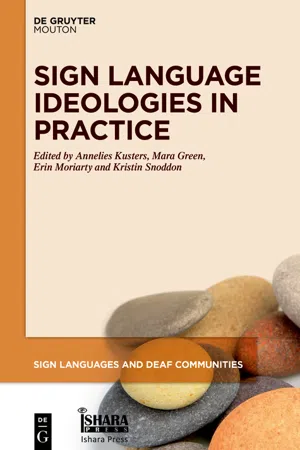
eBook - ePub
Sign Language Ideologies in Practice
- 362 pages
- English
- ePUB (mobile friendly)
- Available on iOS & Android
eBook - ePub
Sign Language Ideologies in Practice
About this book
Information
Part I: Sign language ideologies: Setting the scene
Interrogating sign language ideologies in the Saskatchewan deaf community: An autoethnography
Joanne Weber
1 Introduction
This paper provides an autoethnographic account of my late acquisition of American Sign Language (ASL) in the context of diminished access to native ASL signers due to the closure of the RJD Provincial School for the Deaf in 1991. I will focus on selected periods of intense ASL acquisition and language ideological conflicts which propelled me into an translanguaging orientation (Garcia, Otheguy, & Reid, 2015). My adherence to bilingual frameworks for language learning (ASL and English), built upon monolingual language ideologies (Garcia, 2009; Canagarajah, 2013) over a 27 year period, distorted my understanding of my own second-language acquisition.
2 Background
I am a deaf convert to the deaf community (Bechter, 2008). I was educated solely in inclusive education environments and obtained degrees at Canadian universities. As an adult previously acculturated into the hearing world, fully fluent in spoken and print English, my exposure to ASL began upon entering the Saskatchewan deaf community as a young adult. Learning ASL at this stage was also motivated by a search of a new way of life that would afford acceptance, social engagement, and belonging, all of which were not always available in the hearing world (Bechter, 2008; Kusters, 2017). At the same time, in recognition of the oppressive educational practices I had endured during my own schooling, I was committed to empowering deaf students and to becoming a positive role model for deaf students (Kusters, 2017). As a teacher of deaf adolescents, I exercise an intergenerational responsibility toward deaf students which is characterized by a sense of urgency in removing barriers impeding deaf students’ learning (Bechter, 2008; Kusters, 2017). I did not want future deaf students to suffer the isolation, alienation, and disengagement I had experienced while immersed in mainstream education environments (Weber, 2013).
3 Theory
I will present the ways in which my ideological views of sign language acquisition skewed my view of my own practices and the spaces afforded through my work and relationships within the deaf community in Saskatchewan. In doing so, I consider theories of bilingualism to interpret my own evolution of sign language ideologies toward translanguaging practices. Bilingualism in the form of double monolingualism subscribes to the co-existence of two autonomous bounded language systems instead of attending to children’s actual bilingual practices (Garcia, 2009). Proponents of minority languages within minoritized communities often serve as gatekeepers, attempting to protect and revitalize their languages and linguistic practices (Garcia, Otheguy, & Reid, 2015). Snoddon (2016) notes a similar linguistic prescriptivism within the deaf community in their attempts to revitalize ASL as used with deaf children and youth. Double monolingualism is a hegemonic construct stemming from language practices in education milieus that hierarchize languages according to their relevance and importance on a global scale (Canagarajah, 2013; Garcia, 2009).
Challenging this construct, Garcia, Otheguy, & Reid (2015) propose a definition of translanguaging which serves to disrupt “socially constructed language hierarchies that are responsible for the suppression of languages of many minoritized peoples” (Garcia, Otheguy, & Reid, 2015, p. 283). This definition of translanguaging enables the “deployment of a speaker’s full linguistic repertoire without regard for watchful adherence to the socially and politically defined boundaries of named (and usually national and state) languages” (Garcia, Otheguy, & Reid, 2015, p. 283). Instead of referring to social and linguistic constructs as the building blocks of language acquisition, the speaker’s unique, personal mental grammar employed in interaction with other people is used within translanguaging contexts (Garcia, Otheguy, & Reid, 2015). Negotiation of meanings between individuals involves the mixing, switching and combining of diverse semiotic resources such as print, material objects in the environment, gestures and presupposes the desire to achieve clear communication between all parties (Canagarajah, 2013). This paper is a reflection on my own sign language practices and ideologies and how I came to eventually embrace translanguaging in my work with deaf people during three intensive language acquisition periods.
4 Methodology
I present an interpretive autoethnography which seeks to evoke emotions, feelings and perceptions which dominated my efforts to embrace certain sign language ideologies (Denzin, 2014). The validity concerning interpretive autoethnography is contingent upon my credibility as a “writer-performer-observer” who can write stories that are “true, coherent, believable and connects the reader to the writer’s world” (Denzin, 2014, p. 70) Like O’Connell (2017), a deaf scholar who uses autobiographical writing to reflect on his upbringing, I use selections from The Deaf House (Weber, 2013) which features my own story growing up as a deaf child in a small rural community, becoming a teacher of the deaf, my life in the Saskatchewan deaf community, and teaching adolescent deaf students (Weber, 2013). The Deaf House is a creative non-fiction work which includes autobiographical details gleaned from at least 20 personal journals (dating from 1987), photographs, art works, travel diaries, personal archives and interviews with family members. In this chapter, I apply an ethnographer’s lens to analyze these excerpts from The Deaf House along with journal entries I had written over a 27-year period pertaining to sign language practices and ideologies.
Since the examination of language ideologies must be coupled with an examination of language practices (Kusters A. , 2014), I describe three distinct stages of sign language practices which evolved into a translanguaging orientation (Garcia, Otheguy, & Reid, 2015). I use current theorizing on translanguaging to examine the sign language ideologies I adopted throughout these periods and how they have changed over time (Canagarajah, 2013; Garcia, 2009; Garcia, Otheguy, & Reid, 2015).
5 Stage 1: Early monolingual bilingualism: Some autobiographical reflections
Raised in a small town, I developed the ability to speak fluent English with available functional hearing. I always wanted to teach but my parents, who were teachers, discouraged me because I didn’t have enough hearing to manage a classroom of hearing students. The possibility of teaching deaf children opened up when I started to learn sign language.
As a young adult, I became enthralled with American Sign Language (ASL) and did my preservice teaching at the provincial school for the deaf. There, I sat
in a steady stream of signs, catching a phrase here, puzzling over a swoop or a long flight to the right or left, observing how the tongue clicks as the hands travel across the chest. I sit in a shallow riverbed of signs, watching streams of signs form rivulets around my legs and arms. There’s no intervention from anyone, no practice, no exaggerated attempts to explain the meaning of signs I have not seen in class.After a few months, I realize that everything about the Deaf and sign is all about circles. They sit in circles, their hands move from the chest up to the left side of the head, up to the forehead and down to the chin, and then down to the chest again, or the signing is in figure eights, horizontal, vertical, against the chest, away from the head, down to the waist even: a flight of bees and hummingbirds touching down flower to flower.The meanings begin to slide together like a nearly-completed jigsaw puzzle. The syntax of sign knits itself into my brain, to the point where I can sign without difficulty: “Want coffee you?”I now understand that the circles are shapes and paths made by classifiers, a series of handshapes that can represent various actions and motions. The Deaf grab the visual space in front of their bodies and make three dimensional models, representations of complex actions with even an index finger. Timidly, I enter into the frenzy of hands slapping, swooping, twisting, sliding, lifting my head in agreement, nodding my understanding, and smiling when a joke is finished. It is as though a sheer curtain lifts before my eyes, the Deaf, who were once shadowy figures behind the curtain, begin to take on colour, shape, and form, (Weber, The Deaf House, 2013, pp. 197-198).
Upon completion of the preservice requirement toward obtaining a bachelor’s degree in education, I decided to attend Gallaudet University in 1987 to obtain a master’s degree in deaf education. Our cohort did not include any native ASL signing teacher candidates. Consequently, I spent most of my time with hearing, hard of hearing and speaking adults who were in Education, Counselling and Linguistics departments. All of us deaf candidates had graduated from mainstreamed schools. We moved amongst the undergraduate students whose flingers were flying in the cafeteria, on the football field, in the Ely Centre, at the Abbey. We did not fit in with those who had attended residential schools for the deaf yet we tried to pick up ASL through limited contact with students. Daily, we congregated, sharing the ASL vocabulary, phrases and metaphors and deaf cultural tidbits. We used our voices while signing at the same time. We were adult deaf converts (Bechter, 2008), monolinguals using English to acquire ASL and feeling our way through a newfound cultural milieu. As we did not have the social and cultural benefits of being acculturated at an early age, we developed a pidgin sign English (PSE), that is, the production of ASL signs in English word order without attending to the grammatical features of ASL.
I was not prepared for the emotional upheaval upon entry to Gallaudet University. Subsequent journal entries indicated a feeling of falling into an abyss that seemed to exist between the hearing world I had left behind and the deaf world of Gallaudet. In the struggle to accept my own deafness and to grapple with the primacy of English as the superior language (Canagarajah, 2013), I gradually understood that English to me, was the language of the intellect, individual achievement, accolades and awards in recognition of my ability to approximate hearing English speakers. In other words, I had used English to fashion a public persona. Sign language, on the other hand, belonged to my private self in which I could explore my true emotions and ask difficult questions:
Who would give me an award for being deaf? For not being able to speak properly? For not being able to sound normal? For talking too loud? Who is going to applaud me? (Weber, Gallaudet University Journal, October 10, 1987).
Despite my initial contact with the deaf community in Saskatoon and the early euphoria at having discovered a deaf identity, I felt overwhelmed with resentment and exhaustion at having to struggle all over again in the arduous process of learning another language again without sustained access in my classes (this time from Gallaudet University which was supposed to be a linguistic and cultural hotbed of ASL and deaf culture). Moreover, my initial resentment about the academic requirements of my program and at not being acculturated into the deaf community prior to Gallaudet brought on an avalanche of other feelings:
I felt a keen sense of betrayal. I feel betrayed by my body, my parents, and the health and educational system. I felt like I was about to be engulfed or even gobbled up. I felt like I was going to be annihilated over and over again (Weber, Gallaudet University Journal Entr...
Table of contents
- Title Page
- Copyright
- Contents
- Introduction – Sign language ideologies: Practices and politics
- Part I: Sign language ideologies: Setting the scene
- Part II: Sign language ideologies in teaching
- Part III: Sign language and literacy ideologies
- Part IV: Sign language Ideologies in language planning and policy
- Part V: Conclusion – Ideology, authority, and power
- Language Index
- Subject Index
Trusted by 375,005 students
Access to over 1.5 million titles for a fair monthly price.
Study more efficiently using our study tools.
Frequently asked questions
Yes, you can cancel anytime from the Subscription tab in your account settings on the Perlego website. Your subscription will stay active until the end of your current billing period. Learn how to cancel your subscription
No, books cannot be downloaded as external files, such as PDFs, for use outside of Perlego. However, you can download books within the Perlego app for offline reading on mobile or tablet. Learn how to download books offline
Perlego offers two plans: Essential and Complete
- Essential is ideal for learners and professionals who enjoy exploring a wide range of subjects. Access the Essential Library with 800,000+ trusted titles and best-sellers across business, personal growth, and the humanities. Includes unlimited reading time and Standard Read Aloud voice.
- Complete: Perfect for advanced learners and researchers needing full, unrestricted access. Unlock 1.5M+ books across hundreds of subjects, including academic and specialized titles. The Complete Plan also includes advanced features like Premium Read Aloud and Research Assistant.
We are an online textbook subscription service, where you can get access to an entire online library for less than the price of a single book per month. With over 1.5 million books across 990+ topics, we’ve got you covered! Learn about our mission
Look out for the read-aloud symbol on your next book to see if you can listen to it. The read-aloud tool reads text aloud for you, highlighting the text as it is being read. You can pause it, speed it up and slow it down. Learn more about Read Aloud
Yes! You can use the Perlego app on both iOS and Android devices to read anytime, anywhere — even offline. Perfect for commutes or when you’re on the go.
Please note we cannot support devices running on iOS 13 and Android 7 or earlier. Learn more about using the app
Please note we cannot support devices running on iOS 13 and Android 7 or earlier. Learn more about using the app
Yes, you can access Sign Language Ideologies in Practice by Annelies Kusters, Mara Green, Erin Moriarty, Kristin Snoddon, Annelies Kusters,Mara Green,Erin Moriarty,Kristin Snoddon in PDF and/or ePUB format, as well as other popular books in Languages & Linguistics & Linguistics. We have over 1.5 million books available in our catalogue for you to explore.