Sport is everything, but never solely sport. The commodification of human pleasure in or about many sports led to an increased political interest and dimension with regard to the major leagues and their stars. Corruption and scandals increased, while the human being in sports was and still is very often exploited or mistreated. These problems often relate to the political dimension as well. Consequently, it seems very promising and necessary alike to take a closer look at the interrelation of sports and politics. The present volume addresses this interrelation from different angles, when talking about issues like racism, gender inequality, or classism.
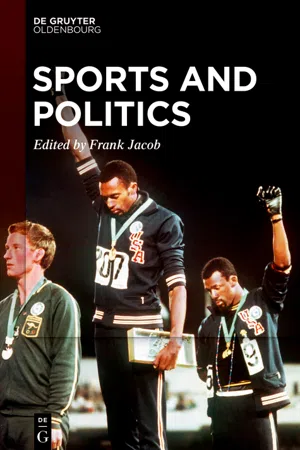
eBook - ePub
Sports and Politics
Commodification, Capitalist Exploitation, and Political Agency
- 195 pages
- English
- ePUB (mobile friendly)
- Available on iOS & Android
eBook - ePub
About this book
Information
1 Sports, Politics, and Capitalism or: The Immoral Corruption of a Human Pleasure
Frank Jacob
Sports are anything but simply sports. Sports represent the human ambition of achievement, the regional or national pride in this achievement, the display of female or male capacities, as well as the fulfillment of a dream to be recognized for. After his protest against racial inequalities and injustices in the US during football games, as well as later in a Nike commercial after the end of his sports career due to his activism, Colin Kaepernick, the former NFL (National Football League) quarterback of the San Francisco 49ers, declared, while highlighting what a dream is worth, that people should “Believe in something. Even if it means to sacrifice everything.”1 While it was a way for him to continue his protest against the social deficits of and discrimination against the weak, e.g. African American victims of police violence, Nike was able to use the advertisement to increase its sales by 31%.2 Capitalist interest might have determined Nike’s decision to work with Kaepernick for the advertisement spot, as much as the quarterback might have matched the company’s slogan, “Just do it,” quite well. Whatever the interest might have been, the presented case already shows how closely sports and capitalism, especially due to the commodification of the first, are related to each other, and it was the capitalization of sports that turned the original ideals that the latter ones might have represented once into commodifications, including those active in professional sports as well.
Sports clubs were commodified in such a way that they now rather represent wealth than anything else, while they sell a feeling of community to the fans that is close to a religious cult.3 Real Madrid, as the American scholar Stefan Szymanski argues, “is the closest thing in the world to football royalty” and the “most valuable football ‘franchise’ in the world.”4 Broadcast rights are related to income, which is spent on the recruitment of new players, who then secure sporting success and an increased share of broadcast rights when these are renewed. Of course, players in the top teams and the top leagues, be it soccer, football, basketball or any other sport, are well paid – if they are male – but the countless rank and file of players who will never reach the top level are exploited while trying to get there and are forgotten relatively quickly, once they have failed to do so. In some regions of the world, a career in professional sport still seems to be the only way out of a life determined by poverty and sorrow, while dubious scouts and managers, as well as colleges, are able to tempt promising talents with high numbers. The exploitation strategies in place are, in addition, also very often accompanied by classism, racism, and gender biases.5
Due to the latter issue, women still struggle to be fully accepted in professional sports,6 not to mention their rights for equal pay that are rarely matched, while broadcasting companies and others make a lot of money when millions of fans watch women’s sports on television or in sports stadiums around the world.7 Yet barriers for women, not only to gain equality but even to get access to the world of professional sports, are created by myths that, according to former swimmer and activist Donna de Varona, still seem to dominate the minds of so many:
- Participating in sport will make women unfeminine.
- Participating in elite sport will harm women’s reproductive organs and will result in the inability to produce children.
- Women do not need to learn about the lessons of life on the playing fields of sport, but men do.
- Women will never be accepted as real athletes because they are not as strong, fast and muscular as men are.
- Women athletes will never be as popular as male athletes; therefore, they will not attract audiences large enough to make women’s sport financially profitable and viable.
- Women are not as interested in sport as men are; therefore, opportunities should not be wasted on them.8
The last three arguments in particular will continue to stimulate the exploitation of female athletes until they are accepted as equals by society as a whole, which is why Megan Rapinoe and other members of the US Women’s Soccer Team decided to fight for their rights and sued the US Soccer Federation.9
Exploitation in the world of sports not only affects the athletes, however, but also the fans, who are supposed to finance their team or star of choice by buying not only tickets, but also merchandise and other forms of related products.10 The stadium nevertheless provides a last refuge for those otherwise uprooted, where they hope to find authenticity and a community they can attach themselves to.11 Regardless of the reality of such feelings and their existent or imagined value, it is the fans who pay the price for the commodification of sports, be it due to higher ticket prices or due to the money spent on all kinds of club- or team-related goods. Capitalism, however, goes even further than this. The ways in which sports lead to exploitation are manifold.
Activists have criticized “poor labour standards in the factories, cottage industries, and home-based workshops”12 of sub-contractors for Nike and other sports companies, and the import and sales of sports-related commodities, like soccer balls, creates a surplus for capitalist companies, while their workers have to produce and live in precarious situations. Workers are also exploited when the stadiums for the Olympic Games, World Cups in soccer, or other sports events need to be built as fast as possible, often to be used only for a short period of time.13 The Olympic Games in particular, which the American scholar, activist, and former athlete Jules Boykoff calls a form of “celebration capitalism,”14 combine the different forms of exploitation named so far. The cities that host the Olympics – no matter if it is the summer or winter games – are also often exploited. The host cites, often built with taxpayers’ money, are left unpopulated after a few weeks of use, while the city’s finances are forced to deal with debts for years.15
Since sports events represent many options for capitalist investment and exploitation, they also become a political issue. The present volume is particularly interested in this relationship, i.e. how sports are shaped by politics, whose representatives at the national or local levels are involved in diverse roles when it comes to the organization of sports as such in general, and related issues like corruption, racism, and gender-related issues. The focus of the volume is first pointing to historical continuities of political corruption with regard to sports, as analyzed by Steven A. Riess, Tom Heenan, and Thomas Aiello, as well as second to contemporary issues related to several levels of exploitation in sports that are made possible by political intervention or non-intervention, often stimulated by the wish to not damage capitalist interests of politicians and investors alike. The contributions of the present volume are divided into three sections that focus on different levels of exploitation and interrelations between sports and politics. The first section will deal with the interrelationship of sports, politics, and corruption. Well-known US sports historian Steven A. Riess provides a discussion of historical cases of corruption in racing sports in Chicago. He will analyze the Paul Powell shoebox scandal and the bribery of Otto Kerner to emphasize how the bribery of politicians in the US was responsible for internal developments within the racing sports of that metropolis in Illinois. That such interrelations between sports and political corruption are not exclusive American phenomena will be shown by Tom Heenan, whose contribution will explain how and why Melbourne was turned into the “Great Australian Sting,” one of the sports capitals of the world. The chapter will highlight how politicians were responsible for the development of Melbourne into a sports center while exploiting public funds and ignoring the rights of the city’s population.
The second section then focuses on the question of racism within sports and how politics reacted to it, or even created these issues in the first place, ignoring the exclusion of ethnic groups due to racist stereotypes and prejudices. A long durée approach by Thomas Aiello will focus on the triad of tennis, class, and race in New Orleans between 1876 and 1976. While looking particularly at New Orleans, this chapter highlights the relations between tennis and racial identity in the American South, and also explains the extent to which tennis was related to local politics. It is, therefore, a regional case study, which nevertheless must be seen as being embedded in the larger picture of US sports in general. Nicole Hirschfelder will then look at political activism within sports and show how the media represents athletes with an activist agenda. The case of Colin Kaepernick and other athletes who participate in th...
Table of contents
- Title Page
- Copyright
- Contents
- 1 Sports, Politics, and Capitalism or: The Immoral Corruption of a Human Pleasure
- Section I: Sports, Politics, and Corruption
- Section II: Sports, Politics, and Racism
- Section III: Sports, Politics, Sexual Abuse and Homophobia
- Index
Trusted by 375,005 students
Access to over 1.5 million titles for a fair monthly price.
Study more efficiently using our study tools.
Frequently asked questions
Yes, you can cancel anytime from the Subscription tab in your account settings on the Perlego website. Your subscription will stay active until the end of your current billing period. Learn how to cancel your subscription
No, books cannot be downloaded as external files, such as PDFs, for use outside of Perlego. However, you can download books within the Perlego app for offline reading on mobile or tablet. Learn how to download books offline
Perlego offers two plans: Essential and Complete
- Essential is ideal for learners and professionals who enjoy exploring a wide range of subjects. Access the Essential Library with 800,000+ trusted titles and best-sellers across business, personal growth, and the humanities. Includes unlimited reading time and Standard Read Aloud voice.
- Complete: Perfect for advanced learners and researchers needing full, unrestricted access. Unlock 1.5M+ books across hundreds of subjects, including academic and specialized titles. The Complete Plan also includes advanced features like Premium Read Aloud and Research Assistant.
We are an online textbook subscription service, where you can get access to an entire online library for less than the price of a single book per month. With over 1.5 million books across 990+ topics, we’ve got you covered! Learn about our mission
Look out for the read-aloud symbol on your next book to see if you can listen to it. The read-aloud tool reads text aloud for you, highlighting the text as it is being read. You can pause it, speed it up and slow it down. Learn more about Read Aloud
Yes! You can use the Perlego app on both iOS and Android devices to read anytime, anywhere — even offline. Perfect for commutes or when you’re on the go.
Please note we cannot support devices running on iOS 13 and Android 7 or earlier. Learn more about using the app
Please note we cannot support devices running on iOS 13 and Android 7 or earlier. Learn more about using the app
Yes, you can access Sports and Politics by Frank Jacob in PDF and/or ePUB format, as well as other popular books in History & Modern History. We have over 1.5 million books available in our catalogue for you to explore.