This is one of the few books on the market dealing with offshoring of professional services, a dynamic phenomenon of high relevance in the global economy. The market for offshore services is worth more than 1 trillion dollars annually and employs millions of people. Global offshoring of services has been recently undergoing a profound transformation due to automation and robotisation of tasks. It can be associated with the increased codifi cation of knowledge, commoditisation of services and advancement in technology. The global perspective has been supplemented by a detailed analysis of offshoring in Central and Eastern Europe. It witnesses a dynamic growth of foreign direct investment (FDI) in professional services, resulting in capital and knowledge transfers.
This books is a result of a holistic approach and an interdisciplinary research. It is enriched with conclusions from meetings with representatives of: authorities responsible for attracting FDI; associations of offshoring fi rms; and enterprises operating in professional services. It was also a result of numerous discussions with scholars during academic conferences and research seminars.
1 Past developments and recent trends in offshoring of white-collar services
1.1 Offshoring and offshorability
Offshoring adds the international context to sourcing decisions of firms. International sourcing is defined as “the total or partial movement of business functions (core or support business functions) currently performed in-house or currently domestically sourced by the resident enterprise to either non-affiliated (external suppliers) or affiliated enterprises located abroad” (Eurostat, 2019).
There is no commonly accepted definition of offshoring, what makes systematic statistical analyses very difficult. The issue is even more evident for service offshoring, where the support of private research institutions enriches understanding of the industry and its economic impact (United States Government Accountability Office, 2004). A very simple definition of offshoring of services describes it as “the transnational relocation or dispersion of service related activities that had previously been performed in the home country” (Doh, Bunyaratavej, & Hahn, 2009, p. 926). Jensen, Larsen, and Pedersen (2013, p. 315) also use a similar approach to define offshoring as “the relocation of organizational tasks and services to foreign locations”.
Statements that offshoring means moving activities from high-cost countries to low-cost ones, or from highly developed to less developed countries are no longer justified. Nevertheless, the common characteristics of the offshoring destinations has been a certain level of underdevelopment. It was the case for the Caribbean or Ireland, especially in the beginning of the interest in offshoring. The basic motive of the cost arbitrage was supported by the financial incentives and loose legal framework in host countries. The evidence from US offshoring firms confirms that the propensity of firms to source from a foreign supplier falls with the rising rigidity in the host country labour market (Kohler & Kukharskyy, 2019). Indeed, in many cases the cost-cutting motivation was dominating, however over the course of time the determinants, forms and outcomes of offshoring evolve significantly.
According to the evidence, the lower difference in wages between a home and host economies supports the decision about offshoring (Bunyaratavej, Hahn, & Doh, 2013). Moreover, they found that a higher level of education and cultural proximity were positively correlated with the decision on offshoring. There are not only factors related to the attractiveness of the foreign locations. Home market conditions may be crucial in the decision regarding offshoring in the first place. Rigid labour market conditions in a country of origin are one of the key factors in the decision regarding offshoring (Weng & Peng, 2018).
Offshoring has been considered as a process distinctive to foreign direct investment (FDI). In general, when a firm establishes a foreign subsidiary to serve a foreign market, it is considered as FDI. But when a company establishes a foreign subsidiary to deliver goods or services to home country, this is considered as offshoring. However, with respect to services such relations are far from being clear as processes are relocated from a home country, but then delivered to multiple countries or even globally. Frequently there is a hybrid solution when an office in a host country delivers some services for the purposes of production units in the same economy, but the rest is exported to third countries.
Therefore, it is more proper to treat offshoring as a part of FDI. Offshoring is a type of FDI when there is a relocation of activities from a home economy. FDI in this context is a broader statistical measure. It encompasses the transfer of capital from one enterprise in a home economy to another enterprise abroad. Thus the main role assigned to the foreign unit is irrelevant. To sum up, the notion of offshoring should be used in the context of FDI when a firm organises sourcing on international scale, including home and host economies.
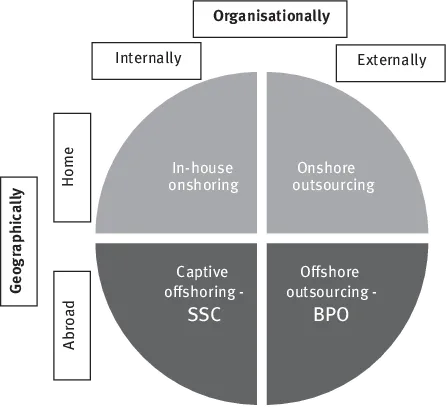
In order to start the analysis of offshoring it is necessary to put it in the broader context of sourcing decisions by firms (Figure 1). There are four basic options of arranging sourcing with respect to geographical and organisational execution of tasks. A firm can decide about conducting processes inside an organisation or outside its boundaries. It is the question of whether to outsource processes to external providers. The second decision is whether to execute processes in a home economy or source them from abroad. The focus of this book rather on the geographical context of sourcing while the organisational form is of a secondary importance.
Figure 1: Organisational and geographical array of sourcing options (source: own elaboration).
Indeed, the economic and business literature has not been fully precise when it comes to disentangling offshoring and outsourcing. They have been sometimes treated as synonyms of sourcing from abroad. For example, Feenstra and Hanson (1996, p. 1) understand outsourcing as “the import of intermediate inputs by domestic firms”. However, they are distinctive processes that relate to geographic (offshoring) and firm (outsourcing) boundaries (Massini & Miozzo, 2012). Even more important is the distinction from economics point of view. Outsourcing to an external partner in the same economy does not have an impact on the balance of payment and international trade position of an economy. It also does not mean the loss of jobs to another economy and other changes in the job market. Therefore in this book, the notion outsourcing, unless otherwise stated, means offshore outsourcing. It is also named offsourcing (Zorska, 2007).
From the business services perspective, the four sourcing options are not considered idiosyncratically. They are rather treated as ingredients of a business strategy. Nevertheless, the ratio between particular elements has neither been equal nor constant. Indeed, especially in recent decades the focus has been rather on the activities conducted abroad. Less attention has been paid to whether the activities are conducted within the boundaries of a firm or delegated to an external provider.
When the organisational forms of execution of white-collar services are considered, there are two basic options: a foreign shared services centre (SSC) – captive offshoring, and business process outsourcing (BPO) – offshore outsourcing. In this book, unless clearly indicated, offshoring of white-collar jobs means both captive offshoring and offshore outsourcing. There are also sections devoted to the distinction between the two modes. Anyway, there has been the same denominator – service activities provided from abroad.
Next to the notion of offshoring comes the issue of types of activities, which can be relocated abroad. “Offshorability” of services depends on their nature. Services are divided into two categories: personally-delivered and impersonally delivered (Blinder, 2007). The former category needs to be delivered in face-to-face contacts, for example, a high-class surgeon has to be present next to a patient during an operation. The latter category, thanks to electronic means of communication, can be delivered to any place in the world, for example, computer programing. Anyway, due to the advancement in the technology such division or at least approach to some tasks may be modified. The example might be some tests conducted on remote surgeon operations. On top of that comes the commoditisation of services. It means that the provision of services became less personal and less unique solutions are provided. In this way, the final solution for a client is a result of putting different and predefined modules together.
The other approach to offshorability of services is based on the possibility of computerisation. Tasks requiring the analytical thinking were divided into routine and non-routine ones (Autor, Levy, & Murnane, 2003). The former category can be easily executed by machines, which can make it faster, cheaper and without errors. Thus, such services are also easy to be offshored. However recently, the category of tasks that can be processed by computers should decrease their offshorability. If they can be executed by a computer, it should be of less importance where it is done. Unfortunately the picture is not that straightforward. Even though computers can be “employed” in developed countries, there is still necessity to “train” the computers, what is frequently done by cheaper brainpower in locations such as India or CEE.
The non-routine tasks are more difficult to offshore as they require vast amount of contextual knowledge and are frequently of discrete nature. However, a certain level of standardisation of the cognitive tasks makes them good candidates for offshoring. Indeed, such tasks are supposed to be offshored to economies offering abundant brainpower in attractive prices.
There have been extensive developments and improvements in delivering services. It means that new categories of services have been created and it is feasible to deliver them over large distances. More importantly, the managerial approach to services has also changed. In fact, service activities inside firms have evolved from discretionary type towards well-structured processes, which are in turn more susceptible to offshoring. We can conclude the better the service processes are organised within an organisation, the easier is to offshore them.
The recent evidence suggests the modularity of white-collar services (Mol & Brandl, 2018). It means that a business process can be divided into modules, which can be executed onshore or offshore. Such fragmentation of business activities reduces their complexity and make them more prone to be offshored. The knowledge-intensive services tend to change their structure as service production became more modular and less dependent on interactions between a provider and a client (Brandl, 2019). Such changes put services into a new context of commoditisation and mass production. From this perspective, the offshoring may be a self-reinforcing process (Brandl, Mol, & Petersen, 2017).
However, implementing the modularity of business services is never frictionless or cost-free (Spring, Araujo, & Mason, 2013). Firms have to learn how to organise the provision of services using smaller modules, what is particularly difficult in the international environment. Additional issues in the modularity are dynamic changes in the service provisions, what make the learning process more difficult and requires constant adjustments.
1.2 Five waves of business services offshoring
Offshoring of services, especially those of higher knowledge content, is a phenomenon much younger in the global economy than offshoring of manufacturing operations. First companies moved their production to lower cost destinations already in 1960s. This trends was supported by decreasing barriers to trade in manufactured goods. Actually, the merchandise trade was the first area of international trade, which was the subject to multilateral trade agreements under General Agreement on Tariffs and Trade (GATT) and later World Trade Organisation (WTO). The decrease in trade barriers and possibility to fragment the production processes led to international configuration of supply chains. Manufacturing hubs in Asia contributed greatly to the rise of offshoring of manufacturing operations and became the “factory of the world”.
Offshoring of physical goods had profound changes on source and host economies and is still a hot political topic in relations between developed and developing economies. There have been even proposals to reinvent manufacturing in many developed economies in order to balance the dependence on the service sector and to boost innovativeness of economies (for example, in the UK, where the economy is highly reliant on services, especially those internationally tradable). Less pronounced, but of high significance are the developments in offshoring of business support services. It was a result of the increase in international trade, application of technology to services, and special distribution of production processes (Wilson, 1995).
The history of offshoring of white-collar services is both associated with the structural change within economies (that is transfer of employees and value added from one sector to another), but more importantly it is the results of the evolution of services themselves.
The tertiarisation of economies means that services create the main portion of economic activities, while primary sector (e.g. agriculture or mining) and secondary sector (manufacturing) record much lower shares. The dominant role of services have been witnessed in many developed economies for decades. Recently, however, also the emerging economies and those considered as manufacturing hubs report similar values. In year 2013 the share of services in the domestic product in Asia exceeded 50% for the first time in history (Klimek, 2017).
The role of services, frequently measured as a share of employment in services, share of services exports in total exports and share of services in GDP, increased in major developed economies in the period 2000–2014 (Kundu & Lahiri, 2015). However, the aver...
Table of contents
Title Page
Copyright
Contents
Acknowledgement
Introduction
1 Past developments and recent trends in offshoring of white-collar services
2 Conceptualisation of advanced business services and offshoring
3 Theory of offshoring of advanced business services
4 Business perspective on offshoring of white-collar jobs
5 New trends in advanced business services
6 Global perspective on advanced business services
7 Host country perspective – focus on Central and Eastern European economies
8 Policy implications
Index
Trusted by 375,005 students
Access to over 1.5 million titles for a fair monthly price.
Study more efficiently using our study tools.
Frequently asked questions
Yes, you can cancel anytime from the Subscription tab in your account settings on the Perlego website. Your subscription will stay active until the end of your current billing period. Learn how to cancel your subscription
No, books cannot be downloaded as external files, such as PDFs, for use outside of Perlego. However, you can download books within the Perlego app for offline reading on mobile or tablet. Learn how to download books offline
Perlego offers two plans: Essential and Complete
Essential is ideal for learners and professionals who enjoy exploring a wide range of subjects. Access the Essential Library with 800,000+ trusted titles and best-sellers across business, personal growth, and the humanities. Includes unlimited reading time and Standard Read Aloud voice.
Complete: Perfect for advanced learners and researchers needing full, unrestricted access. Unlock 1.5M+ books across hundreds of subjects, including academic and specialized titles. The Complete Plan also includes advanced features like Premium Read Aloud and Research Assistant.
Both plans are available with monthly, semester, or annual billing cycles.
We are an online textbook subscription service, where you can get access to an entire online library for less than the price of a single book per month. With over 1.5 million books across 990+ topics, we’ve got you covered! Learn about our mission
Look out for the read-aloud symbol on your next book to see if you can listen to it. The read-aloud tool reads text aloud for you, highlighting the text as it is being read. You can pause it, speed it up and slow it down. Learn more about Read Aloud
Yes! You can use the Perlego app on both iOS and Android devices to read anytime, anywhere — even offline. Perfect for commutes or when you’re on the go. Please note we cannot support devices running on iOS 13 and Android 7 or earlier. Learn more about using the app
Yes, you can access Offshoring of white-collar services by Artur Klimek in PDF and/or ePUB format, as well as other popular books in Business & Management. We have over 1.5 million books available in our catalogue for you to explore.