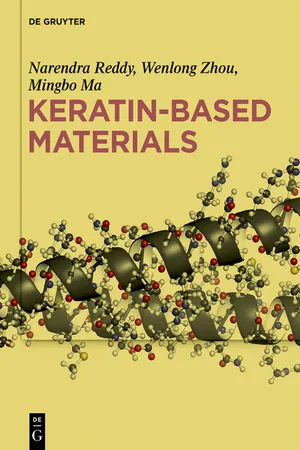
The book introduces readers to the unique aspects of keratin and opportunities to develop various bioproducts and biomaterials from keratins. It discusses the structure, properties and specific applications of keratins extracted from different sources. Applications include keratins as absorbents, reinforcements or matrices for composites, hydrogels and fibres.
- 241 pages
- English
- ePUB (mobile friendly)
- Available on iOS & Android
eBook - ePub
Keratin-based Materials
About this book
Information
Chapter 1 Introduction to keratin
Keratin is one of the most common protein biopolymers found in nature. There are several sources and types of keratin but it has been suggested that keratin from human and bovine sources are similar with respect to charge, size and immunoreactivity. Based on their distinct structure and properties, keratins have been classified as soft and hard keratins. Soft keratins are those found as intermediate filaments (IFs) in the epithelia and arranged in loosely packed bundles and responsible for the mechanical resilience of the epithelial cells. Hard keratins are those found in ordered arrays in matrix of cysteine rich proteins in hairs, nails, claws and beaks and contribute to the tough structure of epidermal appendages (Rouse, 2010; Thibaut, 2003). Keratin exists in mammals, reptiles and birds and fishes as many parts of the body including hoof, horn, fur, wool, skin, quill, feathers, beaks and slime (McKittrick, 2012). Keratin broadly refers to the insoluble proteins found in the IFs which form a major portion of the cytoplasmic epithelia and epidermal appendage structures such as hair, wool, horns and nails. Few keratins are found only in the epithelial cells and are characterized by unique physiochemical properties and their primary function is to protect the epithelial cells from mechanical and nonmechanical stresses that could cause cell death (Coulombe, 2002). Additional functions of keratins include cell signaling, stress response and apoptosis. Although keratin is commonly considered to be a single substance, it is a mixture of proteins and enzymes. Other characteristics of keratin include indigestibility to pepsin or trypsin and also to dilute acids, alkalis, water and organic solvents. Keratins are also generally insoluble in salt solutions but can be made soluble in the presence of urea and other denaturing agents.
Based on their structure, keratins can also be classified as α-keratin or β-keratin. The α-keratin is fibrillar in nature and is composed of helical structure with the micofibrils embedded in an amorphous keratin matrix and aligned along the fiber axis. These amorphous regions have higher sulfur content with considerable amounts of disulfide bonds from the cysteine residues whereas the microfibrillar proteins having relatively low sulfur content are mostly made from hydrogen bonding which are responsible for determining the secondary structure of the proteins (Duer, 2003). α-Keratins can be further classified as the low sulfur containing α-keratins (40–60 kDa) (about 50%–60%) and high sulfur matrix proteins (10–25 kDa). α-Keratins in filament form provide toughness to the hair fibers whereas the α-keratins in matrix proteins provide adhesiveness to cortical cells. Unlike the α-keratins, the β-keratins are synthesized in the form of hard structures (claws and beaks) and are produced in the epidermis of skin appendages (Toni, 2007). β-Keratins have low solubility, have molecular weights between 10 and 25 kDa and are characterized by a distinct X-ray diffraction pattern. Since they form the outer layers, β-keratins have excellent chemical resistance and mechanical strength (Valle, 2010). Filaments in β-keratins have β sheet content that repeats every 3–4 nm and structurally highly resistant compared to α-keratins (Toni, 2007; Valle, 2010). However, the molecular and functional relationship between α- and β-keratins is not clearly understood.
Stru...
Table of contents
- Title Page
- Copyright
- Contents
- Chapter 1 Introduction to keratin
- Chapter 2 Extraction of keratin
- Chapter 3 Applications of keratin hydrolysates
- Chapter 4 Films/membranes from keratin and their applications
- Chapter 5 Keratin made into gels
- Chapter 6 Keratin for environmental remediation
- Chapter 7 Biocomposites
- Chapter 8 Fibers from keratin
- Chapter 9 Keratin micro/nanoparticles
- Chapter 10 Miscellaneous applications of keratin
- Index
Trusted by 375,005 students
Access to over 1.5 million titles for a fair monthly price.
Study more efficiently using our study tools.
Frequently asked questions
Yes, you can cancel anytime from the Subscription tab in your account settings on the Perlego website. Your subscription will stay active until the end of your current billing period. Learn how to cancel your subscription
No, books cannot be downloaded as external files, such as PDFs, for use outside of Perlego. However, you can download books within the Perlego app for offline reading on mobile or tablet. Learn how to download books offline
Perlego offers two plans: Essential and Complete
- Essential is ideal for learners and professionals who enjoy exploring a wide range of subjects. Access the Essential Library with 800,000+ trusted titles and best-sellers across business, personal growth, and the humanities. Includes unlimited reading time and Standard Read Aloud voice.
- Complete: Perfect for advanced learners and researchers needing full, unrestricted access. Unlock 1.5M+ books across hundreds of subjects, including academic and specialized titles. The Complete Plan also includes advanced features like Premium Read Aloud and Research Assistant.
We are an online textbook subscription service, where you can get access to an entire online library for less than the price of a single book per month. With over 1.5 million books across 990+ topics, we’ve got you covered! Learn about our mission
Look out for the read-aloud symbol on your next book to see if you can listen to it. The read-aloud tool reads text aloud for you, highlighting the text as it is being read. You can pause it, speed it up and slow it down. Learn more about Read Aloud
Yes! You can use the Perlego app on both iOS and Android devices to read anytime, anywhere — even offline. Perfect for commutes or when you’re on the go.
Please note we cannot support devices running on iOS 13 and Android 7 or earlier. Learn more about using the app
Please note we cannot support devices running on iOS 13 and Android 7 or earlier. Learn more about using the app
Yes, you can access Keratin-based Materials by Narendra Reddy,Wenlong Zhou,Mingbo Ma in PDF and/or ePUB format, as well as other popular books in Biological Sciences & Biotechnology. We have over 1.5 million books available in our catalogue for you to explore.