Maths in Chemistry
eBook - ePub

Maths in Chemistry

Numerical Methods for Physical and Analytical Chemistry

  1. 196 pages
  2. English
  3. ePUB (mobile friendly)
  4. Available on iOS & Android
eBook - ePub

Maths in Chemistry

Numerical Methods for Physical and Analytical Chemistry

About this book

Numerical methods are the mathematical procedures that approximate the solution of complex mathematical problems into much simpler form and which find a wide variety of use while solving complex Physical Chemistry problems. This book aims to aide in understanding of such numerical methods including solving complex differential equations and numerical differentiation & integration. Moreover it also explains various statistical tests used in Analytical Chemistry for data analysis. The author has tried to include as many example from Chemistry problems for a better understanding of the methods.

Frequently asked questions

Yes, you can cancel anytime from the Subscription tab in your account settings on the Perlego website. Your subscription will stay active until the end of your current billing period. Learn how to cancel your subscription.
At the moment all of our mobile-responsive ePub books are available to download via the app. Most of our PDFs are also available to download and we're working on making the final remaining ones downloadable now. Learn more here.
Perlego offers two plans: Essential and Complete
  • Essential is ideal for learners and professionals who enjoy exploring a wide range of subjects. Access the Essential Library with 800,000+ trusted titles and best-sellers across business, personal growth, and the humanities. Includes unlimited reading time and Standard Read Aloud voice.
  • Complete: Perfect for advanced learners and researchers needing full, unrestricted access. Unlock 1.4M+ books across hundreds of subjects, including academic and specialized titles. The Complete Plan also includes advanced features like Premium Read Aloud and Research Assistant.
Both plans are available with monthly, semester, or annual billing cycles.
We are an online textbook subscription service, where you can get access to an entire online library for less than the price of a single book per month. With over 1 million books across 1000+ topics, we’ve got you covered! Learn more here.
Look out for the read-aloud symbol on your next book to see if you can listen to it. The read-aloud tool reads text aloud for you, highlighting the text as it is being read. You can pause it, speed it up and slow it down. Learn more here.
Yes! You can use the Perlego app on both iOS or Android devices to read anytime, anywhere — even offline. Perfect for commutes or when you’re on the go.
Please note we cannot support devices running on iOS 13 and Android 7 or earlier. Learn more about using the app.
Yes, you can access Maths in Chemistry by Prerna Bansal in PDF and/or ePUB format, as well as other popular books in Physical Sciences & Applied Mathematics. We have over one million books available in our catalogue for you to explore.

Information

Publisher
De Gruyter
Year
2020
eBook ISBN
9783110695489

Chapter 1 Units and measurements

1.1 Introduction

In science, especially physical chemistry, quite a lot of measurements are involved. A physical quantity holds a great importance. A physical quantity is the product of two quantities, that is, a unit and a number. While measuring any parameter in physical chemistry, number itself is not relevant unless it is hooked to a unit. For instance, 6 metre has the number ā€œ6ā€ and unit ā€œmetreā€. Also, while correlating two physical quantities, constant and variables are involved. A constant is a physical quantity that has a fixed value, for example, Planck’s constant (h = 6.626Ɨ10āˆ’34 J s) and Avogadro’s constant (NA = 6.023Ɨ1023 molāˆ’1). A variable, on the other hand, is a quantity that can have any permissible values based on some other quantities for which the given variable is a function, for example, p is a function of V, T, n, that is,
(1.1)p=nRT/V
where p can be represented as p=f(V,T,n).
Further, the variables are classified as dependent and independent variables. In the earlier example, since p is a function of V, T and n, p is a dependent variable while the rest are independent variables.

1.2 Basic arithmetic operations

A physical quantity is often the result of correlation of other physical quantities that are related by mathematical operators. To do so, basic arithmetic operations are performed on these quantities. We are all familiar with basic mathematical operations: addition, subtraction, multiplication and division. In this section, we will simply sum up the basics learned so far (Table 1.1).
Table 1.1:Mathematical operations.
Operation Expression Ordering
Addition A+B A+B=B+A
Subtraction Aāˆ’B Aāˆ’B≠Bāˆ’A
Multiplication AƗBor A.BorAB AƗB=BƗA
Division AĆ·BorAB AB≠BA
Some of the equations used in physical chemistry involving these operations are listed below:
(1.2)Idealgasequation:pV=nRT
(1.3)Hendersonāˆ’Hasselbalchequation:pH=pKa+log(acid/salt)
(1.4)Einsteinequation:E=mc2
(1.5)Nernstequation:E=E0āˆ’(RT/nF)logQ
(1.6)Onsagerequation:∧=∧0āˆ’bc
(1.7)Arrheniusequation:k=Aexp(āˆ’Ea/RT)

1.3 Hierarchy of operations

Before performing arithm...
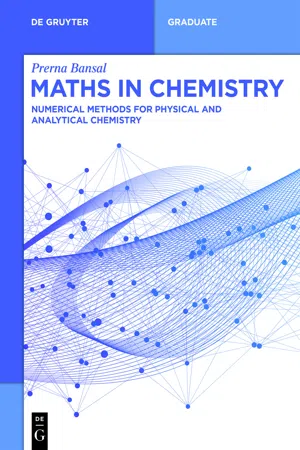
Table of contents

  1. Title Page
  2. Copyright
  3. Contents
  4. Acknowledgement
  5. Chapter 1 Units and measurements
  6. Chapter 2 Uncertainties and errors
  7. Chapter 3 Some mathematical functions
  8. Chapter 4 Descriptive statistics
  9. Chapter 5 Numerical curve fitting
  10. Chapter 6 Numerical integration
  11. Chapter 7 Differential equations
  12. Chapter 8 Numerical differentiation
  13. Chapter 9 Numerical root-finding methods
  14. Index