This book provides a broad overview how extremophiles can be used in biotechnology, including for the production and degradation of compounds. It reviews various recent discoveries and applications related to a large variety of extremophiles, considering both prokaryotes as well as eukaryotes.
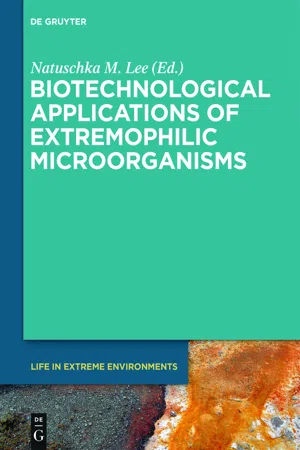
- 424 pages
- English
- ePUB (mobile friendly)
- Available on iOS & Android
eBook - ePub
Biotechnological Applications of Extremophilic Microorganisms
About this book
Information
Subtopic
EcologyIndex
Biological Sciences1 Extremophiles: a promising source of novel natural products
Hatti-Kaul Rajni
Abouhmad Adel
1.1 Tapping the potential of extremophiles for diverse bioactive compounds
Extremophiles, the microorganisms inhabiting different extreme environments characterized by high or low temperature, high or low pH, high salt concentration, high pressure, high radiation, etc. or combinations thereof, have developed unique strategies for adapting and thriving in such environments. Studies on extremophiles have been pursued with great interest to determine the mechanisms of adaptation and also as an important source of useful products including enzymes, polymers, compatible solutes, etc. During the last 20–30 years, attention has been directed toward search for novel bioactive compounds produced by extremophiles, which most likely are playing a role in controlling microbial population in the respective ecological niches and are also promising candidates for applications in foods and healthcare. Secondary metabolites produced by microbes have long been a major source of natural products for drug development. Toward the end of the last century, however, high rates of rediscovery of bioactive products from nature prompted a shift to high-throughput screening programs based on molecular targets and combinatorial chemistry, which has unfortunately not led to major discoveries of novel products, and the trend is now to build focused libraries around the chemical scaffolds of natural products. An urgent need for new molecules that could potentially replace the present-day antibiotics, which are becoming ineffective due to the resistance developed by the pathogens, has served as an important driver for the increasing efforts on mining the unexplored ecological niches for bioactive compounds.
The importance of extremophiles, the “non-mesophilic” microorganisms from diverse environments, as a unique source of novel antibacterial, antifungal, and antitumor molecules cannot be overlooked, as evidenced by the increasing number of publications, including reviews and books, especially during the past decade [1–4] and also the number of drugs already developed or under development (primarily from marine sources) [3, 5]. The traditional route of discovering novel products from extremophiles by isolation of microbes and screening for the desired bioactivity has its limitations. Besides missing a major fraction of the unculturable organisms, cultivation of extremophiles under laboratory conditions can be slow and cumbersome due to their extremely slow growth and limited quantities of the active molecules produced for further evaluation. Moreover, the need for extreme environmental conditions required for their growth may require special design or material of the equipment suitable for cultivation. These challenges are now being addressed by the possibility to sequence whole genomes of organisms and metagenomes in an environmental sample as well as bioinformatics and analytical technologies.
The aim of this chapter is to provide a glimpse of the diversity of bioactive molecules produced by extremophilic microorganisms in different environments and also the impact of the latest technological advances on speeding up the discovery process. Environments with extremes of temperature, pH, and salinity are represented in this chapter. The marine habitats are dealt with separately, as they are a combination of high salinity with extreme temperatures and variable acidity and pressure and most importantly have been a source of a larger number of unique metabolites with novel bioactivity than that obtained from terrestrial microorganisms [3].
1.2 Thermophiles
Thermophiles, the microbes inhabiting hot environments, are the group that caught the initial interest of the research community and triggered the exploration of the fascinating area of extremophiles. Thermophilic (growing at temperatures of 50–79°C) and hyperthermophilic (growing at 80°C and above) microbes have been isolated from diverse high-temperature environments around the world like hot springs, volcanoes, deep oil wells, deep sea hydrothermal vents, compost heaps, etc. Eubacteria and Archaea are the common microorganisms found, while fungal and algal species are limited in number in such environments. Thermophiles differ from other microorganisms in having novel structures, such as thermostable enzymes, polysaccharides with repeating branched oligosaccharide units, lipids with isoprenoid chains (with 15, 20, 25, or 40 carbons rather than straight chain) and with ether linked glycerol or polyols, modified polar glyco- and phospholipids, isoprenoid quinones, polyamines and modified nucleosides that play a role in stabilizing DNA, and osmolytes (e.g. mannosylglycerate) for protection of biological macromolecules and cells [1, 6–8]. The primary application of thermophiles in industrial biotechnology has been as an important source of enzymes that could be used in reactions and processes requiring high temperatures, e.g. for DNA amplification in polymerase chain reaction, biomass pretreatment for production of biofuels and chemicals, and biocatalysis for chemical transformations for pharmaceutical and fine chemical industries ...
Table of contents
- Title Page
- Copyright
- Contents
- 1 Extremophiles: a promising source of novel natural products
- 2 The extremophilic pharmacy: drug discovery at the limits of life
- 3 Metabolic engineering of thermophilic bacteria for production of biotechnologically interesting compounds
- 4 Extremozymes: from discovery to novel bio-products
- 5 The compatible solute ectoine: protection mechanisms, strain development, and industrial production
- 6 Thermophilic photosynthesis-based microbial communities – energy production and conversion
- 7 Photosynthesis at high latitudes – adaptation of photosynthetic microorganisms to Nordic climates
- 8 Roles of extremophiles in the bioremediation of polycyclic aromatic hydrocarbon contaminated soil environment
- 9 Bioremediative potential of bacteria in cold desert environments
- 10 Subsurface extremophiles and nuclear waste storage
- 11 Metal bioleaching: fundamentals and geobiotechnical application of aerobic and anaerobic acidophiles
- 12 Cyanobacterium-based technologies in space and on Earth
- 13 The biotechnological potential of yeast under extreme conditions
- 14 Biotechnological potential of tardigrades
- Subject Index
Trusted by 375,005 students
Access to over 1.5 million titles for a fair monthly price.
Study more efficiently using our study tools.
Frequently asked questions
Yes, you can cancel anytime from the Subscription tab in your account settings on the Perlego website. Your subscription will stay active until the end of your current billing period. Learn how to cancel your subscription
No, books cannot be downloaded as external files, such as PDFs, for use outside of Perlego. However, you can download books within the Perlego app for offline reading on mobile or tablet. Learn how to download books offline
Perlego offers two plans: Essential and Complete
- Essential is ideal for learners and professionals who enjoy exploring a wide range of subjects. Access the Essential Library with 800,000+ trusted titles and best-sellers across business, personal growth, and the humanities. Includes unlimited reading time and Standard Read Aloud voice.
- Complete: Perfect for advanced learners and researchers needing full, unrestricted access. Unlock 1.5M+ books across hundreds of subjects, including academic and specialized titles. The Complete Plan also includes advanced features like Premium Read Aloud and Research Assistant.
We are an online textbook subscription service, where you can get access to an entire online library for less than the price of a single book per month. With over 1.5 million books across 990+ topics, we’ve got you covered! Learn about our mission
Look out for the read-aloud symbol on your next book to see if you can listen to it. The read-aloud tool reads text aloud for you, highlighting the text as it is being read. You can pause it, speed it up and slow it down. Learn more about Read Aloud
Yes! You can use the Perlego app on both iOS and Android devices to read anytime, anywhere — even offline. Perfect for commutes or when you’re on the go.
Please note we cannot support devices running on iOS 13 and Android 7 or earlier. Learn more about using the app
Please note we cannot support devices running on iOS 13 and Android 7 or earlier. Learn more about using the app
Yes, you can access Biotechnological Applications of Extremophilic Microorganisms by Natuschka M. Lee in PDF and/or ePUB format, as well as other popular books in Biological Sciences & Ecology. We have over 1.5 million books available in our catalogue for you to explore.