eBook - ePub
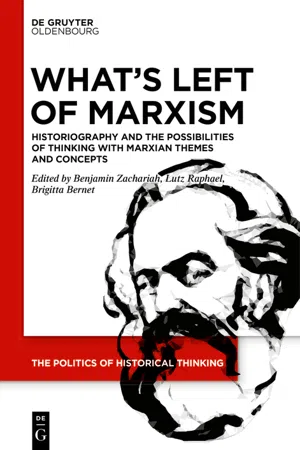
What’s Left of Marxism
Historiography and the Possibilities of Thinking with Marxian Themes and Concepts
- 352 pages
- English
- ePUB (mobile friendly)
- Available on iOS & Android
eBook - ePub
What’s Left of Marxism
Historiography and the Possibilities of Thinking with Marxian Themes and Concepts
About this book
No detailed description available for "What's Left of Marxism".
Information
Publisher
De Gruyter OldenbourgYear
2020Print ISBN
9783110992595
9783110677621
Edition
1eBook ISBN
9783110677799
Part One: Marxism and the Intellectual Production of History
Smoke from the Volcanoes of Marxism?
Jakob Tanner
Multifarious Theoretical and Political Debates
In the 1984 introduction to his Theory of Social Systems, the sociologist Niklas Luhmann painted an evocative picture of flying at a high level of abstraction over a “rather thick cloud cover” which offered occasional “glimpses of a land below”, including “a larger stretch of landscape with the extinct volcanoes of Marxism”.1 It was, however, premature to draw the conclusion that the magma of these Marxist volcanoes had petrified. For sure there have been no major eruptions for some time. But anyone testing with the probes of conceptual history or the history of knowledge can soon see that beneath the sedimentary layers the Marxist lava has never been settled. The question remains whether these volcanoes will soon erupt again.
Marx is out – Marx is in. Looking back, it is noticeable how often theoretical and political debate turned away from Karl Marx and pronounced him ‘defunct’, only to turn back to him with surprising intensity and often in unexpected contexts.2 This is an ambivalent finding. On one hand, in spite of its being shaken to the core by the end of the Cold War and the implosion of the Eastern Bloc, the ‘Marxist–Leninist’ ideology has proven capable of remarkable continuity in some places, especially in the People’s Republic of China. This kind of power-saturated state Marxism is theoretically frozen and further intellectual eruptions are not to be expected.
On the other hand, the task of ‘re-reading’ Capital – Karl Marx's main work from 1867 – has become more attractive.3 Capitalism’s vulnerability to crisis, persistent exploitation within global hierarchies and the worsening environmental crisis are all factors that have bolstered theoretical approaches that draw on issues discussed by Marx. Close links are seen between social inequality and the exploitation of the natural world. Historians such as Timothy Mitchell and Andreas Malm have created models which demonstrate the connection between fossil fuels, industrial economic growth and capitalist regime of exploitation, not only from an economic perspective but also from a political point of view.4 The philosopher Kohei Saito assumes that Marx not only casually addressed the capitalist overexploitation and degradation of natural resources, but also placed them at the very centre of his theory of accumulation. In fact, Marx drew an analogy between the exploitation of nature and the exploitation of labour. Towards the end of his life, he tried to prove that capital accumulation had natural limits.5
These and further considerations mean that approaches to Marxist theory have become more differentiated and that the notion of capital and the concept of capitalism has become increasingly complex.6 It is not easy to keep track of all the different strands, but then Marxism has never been famous for being easy. Any attempts to use Marx as the basis for a theoretically integrated global total history or even to develop any coherent analytical perspective have repeatedly failed for the simple reason that Marx intended his work to be polarising and broadly based rather than consensual and one-dimensional. It begins with the fact that Marx himself never wanted to be a ‘Marxist’.7 Within the Marxist community, both in internal debates and when countering critics of Marx, there is an enormously wide range of interpretations.
Looking back, historically various reception strands can be identified. The first, emerging in the 1890s, is social democracy with its mobilising self-assurance by means of a ‘historical materialism’ suitable for the masses. After 1917, this was both rivalled by and co-existed with Marxism–Leninism, which became state official and was followed by Stalinism and Maoism. Although the various critical politico-economic analyses of capitalism and imperialism still interact with these ideologies, they provided new and distinct lines of reasoning. The works of Rudolf Hilferding, Finance Capital8, and Rosa Luxemburg, The Accumulation of Capital9, acted as important catalysts here. At the same time came the development of ‘Western Marxism’10, represented since the 1920s by the ‘critical theory’ of the University of Frankfurt Institute for Social Research. In the post-war period, its epicentre shifted to France where at the beginning of the 1960s an esoteric theoretical language served to advance a comprehensive synthesis of structuralism, psychoanalysis and Marxism. More down-to-earth critics such as Edward P. Thompson rejected these attempts, calling them an ‘orrery of errors’ and later the ‘poverty of theory’.11
In the early 1960s, Marxism was at its epistemological zenith. For all its many facets and inner rivalries, the theory of Marxism in all its shapes and forms was part of an overall process of questioning and self-reflection within society. In 1960, Jean-Paul Sartre in his Critique of Dialectical Reason claimed that Marxism was the untransgressable horizon of all thought. For him, this was not tantamount to certainty of knowledge. He rather was stretching the metaphor of a common boat sailing on the high seas of ignorance.12 In emphasising this, he turned himself against the determinists among the Marxists, convinced that liberty was no more than the realisation of necessity, purported to be in possession of a scientific compass which would guide them to the far shores of Communism. Sartre, however, had broken with the French Communist Party in 1956 and insisted that liberty itself should be put on the rowing bench. By 1965, Marxism seemed to have aligned itself to structuralism. The stage on which the renewal of Marxism was being played out was dominated by Louis Althusser’s For Marx and the anthology Reading Capital (with Etienne Balibar, Jaques Rancière and others).13 Writing about this period in his History of Structuralism, François Dosse noted: “Marx became the interface of all research, a veritable common denominator in the social sciences.”14
However, after the annus mirabilis 196615 Marxism was plunged into a crisis. Sartre’s unattainable horizon was shattered. Dialectics, based on the interaction of antagonistic forces, was pushed onto the back foot by a mode of thought oriented towards the never-ending play of differences. Criticism of the Hegel–Marx continuum was itself varied and reached from the structuralism of Claude Lévi-Strauss and Roland Barthes through structural–functional approaches and the interpretive analytics of Michel Foucault to the post-modern perspective of François Lyotard. Nevertheless, this did not spell the end of engagement with Marxism. On the contrary, both with and alongside this anti-dialectic challenge, a broad spectrum of Marxisms prospered. Besides the revival of a dull ‘state- monopoly capitalism’ there was also a renaissance of more sophisticated Marxist theories. Significant examples are the crisis theories of ‘late capitalism’16, the new gender history studies of the rise of housework in capitalism,17 and the diagnosis of a ‘crisis of state planning’ and of the transition to a ‘crisis of the state’ and to ‘empire’.18
In 1976, as one of a team of authors, I also published in the ‘critical tradition’ of the theory of capital accumulation and crisis.19 The book dealt with the economic crisis of 1974 – 1975 and was entitled Crisis – Accident or a Consequence of Capitalism?. In it we tried to use ‘a Marxist perspective’ to explain the prosperity of the trente glorieuses (‘glorious thirties’) between 1945 and 1973 and the subsequent economic setback. It was intended as an introduction, particularly for use in political education offered by trade unions. At the same time, its aim was similar to that of many other authors of the time20, namely, to find a mathematical expression for Marx’s law of the tendency of the rate of profit to fall and to prove it empirically. From the point of view of its foundation on the labour theory of value, this endeavour can barely withstand retrospective evaluation. By contrast, its critique of capitalism and its analysis of the dynamics of crisis within capitalist economic and social systems seem more compelling than ever.
Up to the mid-1970s, Marx was everywhere. Anyone who went to university to study humanities or social sciences in a western European country at the beginning of the 1970s was immediately introduced to fields of theory which were unmistakably shaped by Marxist theories. Looking at the whole spectrum of historical research from the Annales historians, social history and ‘world-systems analysis’, the history of everyday life, cultural history and microhistory, right through to gender history, historical anthropology and postcolonial studies, the history of knowledge and important perspectives in environmental history, it can be seen that the most important theoretical innovations in the study of history and cultural theory can only be explained in the context of Marx – whether for or against him – even if Marx himself is sometimes conspicuous by his absence.21
Images of Marx and the ‘Marx Effect’
However, Marx is generally not absent but ever-present, even if only as a stereotyped reference. As such he is reduced to several specific roles. The sociologist Wolfgang Essbach recently identified four stereotyped images of Marx: the “radical journalist” around 1850, the “intellectual socialist and leader of the international labour movement” around 1870, the “founder of historical materialism” around 1900 and “the theorist of the revolution” in the mid-1920s.22 Essbach points out that these four figures prevent the recourse to an authentic Marx. The search for what he really meant by what he wrote only engender...
Table of contents
- Title Page
- Copyright
- Contents
- Introduction
- Part One: Marxism and the Intellectual Production of History
- Part Two: Marxism and the Pre-Modern Worlds of the Near East and North Africa
- Part Three: Marxism and the Beginnings of Western Capitalism
- Part Four: Marxism and the Study of the Contemporary World
- Biographical Notes
- Index
Trusted by 375,005 students
Access to over 1.5 million titles for a fair monthly price.
Study more efficiently using our study tools.
Frequently asked questions
Yes, you can cancel anytime from the Subscription tab in your account settings on the Perlego website. Your subscription will stay active until the end of your current billing period. Learn how to cancel your subscription
No, books cannot be downloaded as external files, such as PDFs, for use outside of Perlego. However, you can download books within the Perlego app for offline reading on mobile or tablet. Learn how to download books offline
Perlego offers two plans: Essential and Complete
- Essential is ideal for learners and professionals who enjoy exploring a wide range of subjects. Access the Essential Library with 800,000+ trusted titles and best-sellers across business, personal growth, and the humanities. Includes unlimited reading time and Standard Read Aloud voice.
- Complete: Perfect for advanced learners and researchers needing full, unrestricted access. Unlock 1.5M+ books across hundreds of subjects, including academic and specialized titles. The Complete Plan also includes advanced features like Premium Read Aloud and Research Assistant.
We are an online textbook subscription service, where you can get access to an entire online library for less than the price of a single book per month. With over 1.5 million books across 990+ topics, we’ve got you covered! Learn about our mission
Look out for the read-aloud symbol on your next book to see if you can listen to it. The read-aloud tool reads text aloud for you, highlighting the text as it is being read. You can pause it, speed it up and slow it down. Learn more about Read Aloud
Yes! You can use the Perlego app on both iOS and Android devices to read anytime, anywhere — even offline. Perfect for commutes or when you’re on the go.
Please note we cannot support devices running on iOS 13 and Android 7 or earlier. Learn more about using the app
Please note we cannot support devices running on iOS 13 and Android 7 or earlier. Learn more about using the app
Yes, you can access What’s Left of Marxism by Benjamin Zachariah, Lutz Raphael, Brigitta Bernet, Benjamin Zachariah,Lutz Raphael,Brigitta Bernet in PDF and/or ePUB format, as well as other popular books in History & Historiography. We have over 1.5 million books available in our catalogue for you to explore.