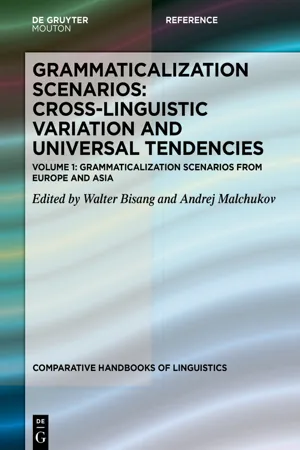
This volume intends to fill the gap in the grammaticalization studies setting as its goal the systematic description of grammaticalization processes in genealogically and structurally diverse languages. To address the problem of the limitations of the secondary sources for grammaticalization studies, the editors rely on sketches of grammaticalization phenomena from experts in individual languages guided by a typological questionnaire.
eBook - ePub
Grammaticalization Scenarios from Europe and Asia
- 670 pages
- English
- ePUB (mobile friendly)
- Available on iOS & Android
eBook - ePub
Grammaticalization Scenarios from Europe and Asia
About this book
Information
1 Position paper: Universal and areal patterns in grammaticalization
Prof. Dr. Walter Bisang
Johannes Gutenberg-Universität Mainz, Mainz, Germany
Apl. Prof. Andrej Malchukov
Johannes Gutenberg Universität, Mainz, Germany
the Mainz Grammaticalization Project team Iris Rieder Linlin Sun Marvin Martiny Svenja Luel
1 Introduction
1.1 Theoretical preliminaries: accomplishments and open questions in grammaticalization research
Skipping early forerunners like A. W. von Schlegel (1818), studies on grammaticalization started out from Meillet (1912) and Kuryłowicz (1965) and were later associated with the work of prominent researchers like Joan Bybee, Talmy Givón, Bernd Heine and Christian Lehmann. Its definition in terms of a lexical item that develops into a grammatical morpheme or from a less grammatical into a more grammatical marker can be seen by now as a classical approach to the phenomenon. In the course of time, research on grammaticalization has become one of the most successful research paradigms introduced in 20th century linguistics. Milestones of grammaticalization research include, among others, such work as Lehmann’s (1995) Thoughts on grammaticalization, Heine, Claudi, and Hünnemeyer’s (1991) Grammaticalization. A conceptual framework, Bybee, Pagliuca, and Perkins’s (1994) The evolution of grammar, and Heine and Kuteva’s (2002) World lexicon of grammaticalization. Even critical voices like Newmeyer (1998, 2001), Campbell and Janda (2001) and others did not discourage research in this field, 1 which currently numbers in the thousands of publications (cf. the monumental Handbook of Grammaticalization by Narrog and Heine [2011] for a state-of-the-art survey of research on grammaticalization). Yet, in spite of its obvious success, some important aspects remain controversial and are in need of further study. Most importantly, it still remains unclear to what extent grammaticalization is subject to cross-linguistic and areal variation. Our project approaches these issues by a systematic quantitative analysis on the basis of data collected from 29 leading experts on different languages and language families across the world. For that purpose, it will focus on source concepts and paths of grammaticalization, on the one hand, and scenarios of grammaticalization as they are defined by the interaction of different parameters and aspects of areality, on the other hand (on the notion of ‘scenario of grammaticalization’, also cf. Bisang and Malchukov [2017]). As will become clear in the course of this introductory chapter, we understand our project as a pilot project whose further development will depend on a considerable extension of our data base and most likely also on various aspects of methodology (refinement of the questionnaire and, with increasing availability of data, statistical methods).
The work of Lehmann, Heine and colleagues and Bybee and colleagues is a starting point of prime importance for our research. According to Lehmann, “grammaticalization of a linguistic sign is a process in which it loses in autonomy by becoming subject to constraints of the linguistic system” (Lehmann 2004: 155). Lehmann (1995) further introduced grammaticalization parameters for assessing the autonomy of the linguistic sign, which will be crucial for the eight parameters used in our project (cf. section 3.1 and chapter 2). The original version of Lehmann’s grammaticalization parameters is reproduced in Table 1:
Tab. 1Lehmann’s grammaticalization parameters (Lehmann 2002b: 132).
| Axis/Parameter | Paradigmatic | Syntagmatic |
| Weight | Integrity | Structural Scope |
| Cohesion | Paradigmaticity | Bondedness |
| Variability | Paradigmatic Variability | Syntagmatic Variability |
As is clear from Table 1, Lehmann conceives grammaticalization as a reductive process which manifests itself in the reduction of Weight (semantic and phonetic integrity), increased Cohesion and decreased Variability in paradigmatic and syntagmatic dimensions. Even though this approach, which is sometimes labelled ‘reduction-based approach to grammaticalization’ (Cuyckens 2018), has not remained unchallenged 2 and other authors have suggested somewhat different parameters later, 3 Lehmann has developed one of the conceptually most coherent models of how grammaticalization is reflected in linguistic structure. Moreover, he also provided important suggestions – both in published work (Lehmann 2015: 171–173) and in personal communication with our group – of how to operationalize various parameters in a way which makes quantification and cross-linguistic comparison possible (cf. questionnaire in chapter 2).
The work of Heine and colleagues is of particular relevance for our project because of its findings on grammaticalization paths as they are compiled in the groundbreaking World lexicon of grammaticalization (Heine and Kuteva 2002). This work can be seen as a follow-up and radical extension of Heine and Reh (1984), which documents phenomena of reanalysis and paths of grammaticalization in African languages. We chose a sample of 30 source concepts of grammaticalization from (Heine and Kuteva 2002) for the assessment of typologically widespread and rare paths and their potential areality. Another field of interest that our project shares with Heine and colleagues is areality. While their work is mainly concerned with the way in which grammaticalization operates in situations of language contact (contact-induced grammaticalization; cf. Heine and Kuteva [2005, 2006]), our interest in areality is more focused on how cont...
Table of contents
- Title Page
- Copyright
- Contents
- 1 Position paper: Universal and areal patterns in grammaticalization
- 2 Measuring Grammaticalization: A questionnaire
- 3 Grammaticalization in the Germanic languages
- 4 Mechanisms and paths of grammaticalization and reanalysis in Romance
- 5 Grammaticalization in Slavic
- 6 Grammaticalization in Lezgic (East Caucasian)
- 7 Grammaticalization in Uralic as viewed from a general Eurasian perspective
- 8 Grammaticalization in Ewen (North-Tungusic) in a comparative perspective
- 9 Areal features in Yeniseian grammaticalization
- 10 Grammaticalization and reanalysis in Iranian
- 11 Grammaticalization in standard Hindi/Urdu and Hindi dialects
- 12 Grammaticalization in Japhug
- 13 Grammaticalization in Korean
- 14 Grammaticalization changes in Chinese
- Subject Index
- Index
Trusted by 375,005 students
Access to over 1.5 million titles for a fair monthly price.
Study more efficiently using our study tools.
Frequently asked questions
Yes, you can cancel anytime from the Subscription tab in your account settings on the Perlego website. Your subscription will stay active until the end of your current billing period. Learn how to cancel your subscription
No, books cannot be downloaded as external files, such as PDFs, for use outside of Perlego. However, you can download books within the Perlego app for offline reading on mobile or tablet. Learn how to download books offline
We are an online textbook subscription service, where you can get access to an entire online library for less than the price of a single book per month. With over 1.5 million books across 990+ topics, we’ve got you covered! Learn about our mission
Look out for the read-aloud symbol on your next book to see if you can listen to it. The read-aloud tool reads text aloud for you, highlighting the text as it is being read. You can pause it, speed it up and slow it down. Learn more about Read Aloud
Yes! You can use the Perlego app on both iOS and Android devices to read anytime, anywhere — even offline. Perfect for commutes or when you’re on the go.
Please note we cannot support devices running on iOS 13 and Android 7 or earlier. Learn more about using the app
Please note we cannot support devices running on iOS 13 and Android 7 or earlier. Learn more about using the app
Yes, you can access Grammaticalization Scenarios from Europe and Asia by Walter Bisang, Andrej Malchukov, Walter Bisang,Andrej Malchukov in PDF and/or ePUB format, as well as other popular books in Languages & Linguistics & Historical & Comparative Linguistics. We have over 1.5 million books available in our catalogue for you to explore.