Die Reihe Europäisch-Jüdische Studien repräsentiert die international vernetzte Kompetenz des »Moses Mendelssohn Zentrums für europäisch-jüdische Studien« (MMZ). Der interdisziplinäre Charakter der Reihe, die in Kooperation mit dem Selma Stern Zentrum für Jüdische Studien Berlin-Brandenburg herausgegeben wird, zielt insbesondere auf geschichts-, geistes- und kulturwissenschaftliche Ansätze sowie auf intellektuelle, politische, literarische und religiöse Grundfragen, die jüdisches Leben und Denken in der Vergangenheit beeinflusst haben und noch heute inspirieren. Mit ihren Publikationen weiß sich das MMZ der über 250jährigen Tradition der von Moses Mendelssohn begründeten Jüdischen Aufklärung und der Wissenschaft des Judentums verpflichtet.
eBook - ePub
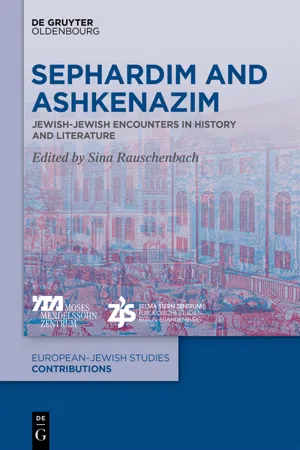
Sephardim and Ashkenazim
Jewish-Jewish Encounters in History and Literature
- 275 pages
- English
- ePUB (mobile friendly)
- Available on iOS & Android
eBook - ePub
About this book
Information
1 Sephardim and Ashkenazim
A Research Survey and a Research Agenda
Sina Rauschenbach
Note: Parts of this introduction are based on my essay “Sephardim und Aschkenasim,” in Handbuch Jüdische Studien, ed. Christina von Braun and Micha Brumlik (Cologne: Böhlau 2017), 111 – 24. Susanne Härtel and Tirtsah Levie Bernfeld have read the final draft and contributed illuminating insights. I am grateful for their collaboration and help.
Some fifty years ago, in The Earth is the Lord’s, Abraham Joshua Heschel wrote one of the most beautiful and provocative descriptions of what he called “the Sephardic way” and “the Ashkenazic way.”1 According to Heschel, Sephardic and Ashkenazic traditions were marked by profound and essential differences. Tho differences concerned, among other issues, the relationship of the groups to their respective surroundings, their inner hierarchies, their scholarly and intellectual preferences, and their general approaches toward life and religion. Heschel concluded that “a difference of form rather than a divergence of content”2 distinguished Sephardic from Ashkenazic culture. This difference, he wrote:
[M]ight be more accurately expressed as a distinction between a static form, in which the spontaneous is subjected to strictness and abstract order, and a dynamic form, which does not compel the content to conform to what is already established. The dynamic form is attained by subtler and more direct means. Room is left for the outburst, for the surprise, for the instantaneous.3
Since the publication of The Earth is the Lord’s, scholars have both agreed with or contradicted Heschel,4 but few have offered new comparisons between Sephardic and Ashkenazic cultures.5 What might be interpreted as a fear of essentializing group identities is also a relict of two worlds that have often been separated. Differences between “the Sephardic way” and “the Ashkenazic way” (in the words of Heschel) seemed to impact on scholarship and research agendas. For a long time, Sephardic and Ashkenazic Judaism have been studied separately. Scholars have devoted their works either to the histories and cultures of Iberian Jews or to those of their French, German, and Eastern European counterparts. The language barriers that separated Sephardic and Ashkenazic Jews also separated the respected researchers who had to deal with the sources. Scholars who have approached the subject as a unity have only found a few followers, and their studies have remained as outstanding as they are rare.6
It is only in recent times that more scholars have begun to bridge the Sephardic-Ashkenazic divide and address questions of Sephardic-Ashkenazic relationships, perceptions, and influences. Since the beginning of the millennium, a number of new studies have approached the subject from different perspectives. The following survey does not encompass all the contributions that have been made to the field. Rather, it is meant to indicate developments and foci that have attracted the attention of researchers and provide suggestions for further studies.
A Research Survey
Scholars concerned with Jewish history and thought have long insisted on the fundamentally different experience of medieval Jews on the Iberian Peninsula and their coreligionists north of the Pyrenees. Notwithstanding the fact that medieval encounters between the two groups were limited and generally restricted to individuals moving from one context to the other, the absoluteness of the earlier distinction has recently been challenged. Among the most important studies are those by David Nirenberg and Jonathan Elukin. Whereas the former describes Iberian convivencia as “a constructive relationship between conflict and coexistence,”7 the latter questions the Iberian singularity of convivencia and draws our attention to similar conditions of “living together, living apart” in medieval Ashkenaz.8 Nirenberg also suggests that researchers look beyond the natural frontiers of the Pyrenees and emphasizes the similarity of experiences of the Jews of the northern Iberian Peninsula and the Jews of Provence.9
Scholars have also questioned the decisive impact of the respective Muslim and/or Christian contexts on tradition and cultural change in medieval Sephardic and Ashkenazic communities. One famous example relates to the distinction between Sephardic polygamy and Ashkenazic monogamy after the publication of R. Gershom Meor ha-Golah’s famous decision from around 1000. Whereas some scholars emphasized the adaptation of Jewish migrants from Sephardic and Ashkenazic background to the respective Muslim or Christian contexts of their destinations,10 others used the example of the Iberian frontier zone to argue that Iberian Jews did not necessarily change their polygamous practices when their communities transitioned from Muslim to Christian rule.11
Finally, scholars now reject the suitability of common notions of group identities and the general use of the term “Sephardic” for Iberian Jews in pre-expulsion contexts and times. Important contributions have been penned by Jonathan Ray, who questions the existence of one transregional Sephardic identity prior to 1492 and makes a case for the gradual emergence of a Sephardic Diaspora afterward.12 Ray’s approach to (the) Sephardic Diaspora/s has been influenced by historians who study Ashkenazic identity constructions in the context of Benedict Anderson’s Imagined Communities and new approaches to nineteenth-century nationalisms.13 Especially noteworthy is the work of Joseph Davis, who proposes three different models of Ashkenazic identity building in the late sixteenth century based on geography, ethnicity, or individual choice.14 He posits the notion of “individual choice” in reference to the respective synagogues where Jews chose to pray or the halakhic codex they decided to follow. Considering halakhah, he elaborates on the “Ashkenization” of Joseph Karo’s Shulhan Arukh in sixteenth-century Cracow by Moshe Isserles. As we know from studies by Israel Ta-Shema, Karo’s Beit Yosef and Shulhan Arukh were deeply influenced by Karo’s preference for Sephardic decisors, even though he himself continuously reiterated his wish to create a halakhic compendium beyond Jewish-Jewish differences and divides.15
A detailed historical-critical study of Isserles’s changes and their interpretation in light of Sephardic-Ashkenazic differences is still a desideratum, but the importance of the issue has long been recognized and has encouraged scholars to study Karo’s and Isserles’s predecessors with a similar approach. Of special significance are recent contributions regarding the works of Asher ben Yehiel and Yaakov ben Asher, who used their personal migration and intercultural experiences to bridge halakhic differences and propose steps toward a unified halakhah for Sephardic and Ashkenazic Jews in thirteenth- and fourteenth-century Castile. Interestingly, however, doubt has recently been cast on the extent of Asher ben Yehiel’s success in promoting Ashkenazic learning in Sepharad. Scholars have argued that his attempts failed and that his son, Yaakov ben Asher, took this failure into account when he returned to a rather “Sephardically” oriented compromise between the two cultures, which was primordial for the later success of his Turim.16
Beyond the corpus of halakhic codices, exegetical, mystical, and polemical works representing different cultures of knowledge and thought ended up traveling between the Ashkenazic and Sephardic worlds and mingling with each other.17 With the early modern revolution of print and new possibilities for mobility and migration, texts and ideas circulated to a hitherto unknown degree and continued to figure as markers of difference and connectedness.18 Conscious of the tension between these two options but in opposition to classical studies highlighting Sephardic-Ashkenazic dichotomies in view of the Iberian Jewish traumas of 1492 – 1498, historians have recently tended to deconstruct binaries and focus on the possibilities of parallels and entanglements associated with early modern Sephardic and Ashkenazic experiences. As early as 1994, Mordechai Breuer has drawn our attention to mutual influences and parallel developments regarding the study of religion and philosophy, the organization of communities, and processes of social and economic stratification.19 Recently, Martin Jacobs and Carsten Wilke, among others, have contested Yosef Hayim Yerushalmi’s claim for a unique and decisively Sephardic tradition of early modern Jewish historiography.20 Others devoted studies to relativizing Gerson D. Cohen’s classical distinction between Sephardic and Ashkenazic messianism and eschatology.21 Again others questioned Cohen’s analysis of kiddush ha-Shem and a supposedly Sephardic tendency toward conversion vis-à-vis an Ashkenazic tendency toward martyrdom.22 These and similar studies all contribute to complicating Sephardic-Ashkenazic dichotomies and help to refine the relevant methodology from comparative approaches toward the study of entanglements. New approaches to cultures of reading and translation and their respective applications in the field of Jewish Stu...
Table of contents
- Title Page
- Copyright
- Contents
- 1 Sephardim and Ashkenazim A Research Survey and a Research Agenda
- 2 Ashkenazim and Sephardim before (and after) the Modern Age History, Historiography, and the Meaning of Jewish Communal Categories
- 3 Creating a Visual Repertoire for the Late Medieval Haggadah
- 4 Early Modern Messianism between Ashkenazim and Sephardim
- 5 “All of the Differing Opinions of the Poskim, No One Fails to Appear” The Use of Ashkenazic Works in R. Joseph Karo’s Beit Yosef
- 6 Confluent and Conflictual Traditions in the Lagoon Ashkenazic and Sephardic Tombstones in Venice from the Sixteenth to the Eighteenth Century
- 7 Joining the Fight for Freedom Redemption of Captives and the Portuguese Jews of Seventeenth-Century Amsterdam
- 8 Kabbalah and Cosmopolitanism in Early Modern Amsterdam The Sephardic and Ashkenazic Producers of Sefer Raziel ha-Malakh (1701)
- 9 Vienna A Cultural Contact Zone between Sephardim and Ashkenazim
- 10 Max Nordau’s View on Sephardic Judaism and the Emergence of Political Zionism
- About the Authors
- Index of Names
Trusted by 375,005 students
Access to over 1.5 million titles for a fair monthly price.
Study more efficiently using our study tools.
Frequently asked questions
Yes, you can cancel anytime from the Subscription tab in your account settings on the Perlego website. Your subscription will stay active until the end of your current billing period. Learn how to cancel your subscription
No, books cannot be downloaded as external files, such as PDFs, for use outside of Perlego. However, you can download books within the Perlego app for offline reading on mobile or tablet. Learn how to download books offline
Perlego offers two plans: Essential and Complete
- Essential is ideal for learners and professionals who enjoy exploring a wide range of subjects. Access the Essential Library with 800,000+ trusted titles and best-sellers across business, personal growth, and the humanities. Includes unlimited reading time and Standard Read Aloud voice.
- Complete: Perfect for advanced learners and researchers needing full, unrestricted access. Unlock 1.5M+ books across hundreds of subjects, including academic and specialized titles. The Complete Plan also includes advanced features like Premium Read Aloud and Research Assistant.
We are an online textbook subscription service, where you can get access to an entire online library for less than the price of a single book per month. With over 1.5 million books across 990+ topics, we’ve got you covered! Learn about our mission
Look out for the read-aloud symbol on your next book to see if you can listen to it. The read-aloud tool reads text aloud for you, highlighting the text as it is being read. You can pause it, speed it up and slow it down. Learn more about Read Aloud
Yes! You can use the Perlego app on both iOS and Android devices to read anytime, anywhere — even offline. Perfect for commutes or when you’re on the go.
Please note we cannot support devices running on iOS 13 and Android 7 or earlier. Learn more about using the app
Please note we cannot support devices running on iOS 13 and Android 7 or earlier. Learn more about using the app
Yes, you can access Sephardim and Ashkenazim by Sina Rauschenbach in PDF and/or ePUB format, as well as other popular books in History & Jewish Theology. We have over 1.5 million books available in our catalogue for you to explore.