eBook - ePub
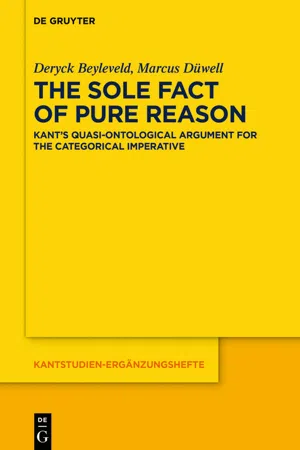
The Sole Fact of Pure Reason
Kant’s Quasi-Ontological Argument for the Categorical Imperative
- 237 pages
- English
- ePUB (mobile friendly)
- Available on iOS & Android
eBook - ePub
The Sole Fact of Pure Reason
Kant’s Quasi-Ontological Argument for the Categorical Imperative
About this book
No detailed description available for "The Sole Fact of Pure Reason".
Information
Chapter One Introduction – Setting the Scene
Preliminary Remarks
According to Immanuel Kant, the Groundwork of the Metaphysics of Morals (GMM)1 is ‘nothing more than the search for and establishment of the supreme principle of morality’ (AK 4:392). He refers to this principle as ‘the moral lawz’, ‘the categorical imperative’, or as ‘the fundamental law of pure practical reason’,2 for which he provides several formulae, including that which is widely known as the Formula of Universal Law (FUL):
[A]ct only in accordance with that maxim through which you can at the same time will that it become a universal law.3(GMM AK 4:421)
Kant’s moral theory deals with the following main questions:
- If a categorical imperative exists, what is its nature and content?
- Is it possible for a categorical imperative to exist?
- Does a categorical imperative exist?
- Given an affirmative answer to C, what must human agents believe about the nature of the world and their own existence?
- What rules does the categorical imperative (the FUL) require and permit human agents to adopt in the circumstances and conditions of real life?
A, B, and C are the main concerns of GMM and Chapter I of Book One of CPrR (with CPuR and CPoJ also contributing to Kant’s answers to B and C). Aspects of D are involved in his answers to A, B and C, from which further implications are drawn mainly in the rest of CPrR, the final sections of CPoJ, Religion, and Anthropology. E is the primary concern of MoM (although some illustrations are provided in GMM, CPrR, and elsewhere).
This book is about Kant’s views on C, which derive from his answers to A and B. Its concern is not with their validity, but with what they are, about which there is considerable scholarly disagreement, much of which revolves around whether or not he holds the same views in GMM and CPrR. We maintain that Kant gives or presupposes the same answers to A and B, and the same affirmative answer to C and justification for it in both GMM and CPrR. Furthermore, we contend that, in order to appreciate this and understand how he justifies his answer to C, it is necessary to place his justification of the categorical imperative in the context of his critical philosophy as a whole, in which it is particularly important to understand what his methodology for justifying an a priori synthetic practical proposition is, for that is how Kant consistently describes the categorical imperative. In relation to this, we maintain two things. First, interpretations of Kant’s justification of the categorical imperative that view it as an argument from human agential self-understanding in both GMM and CPrR are on the right lines, but only the constructions of Onora O’Neill (esp. 1989) and that of Kenneth Westphal (e.g., 2016) – which largely follows O’Neill – interpret human agential self-understanding in terms of what Kant designates as the three maxims of the ‘sensus communis’ in CPoJ (AK 5:293–294), which is vital. Secondly, the relation between Kant’s answer to C and those aspects of his views on D that concern the existence of God and human immortality reveals what he means when he says that ‘the moral law’ is given to human agents as the sole fact of pure reason in CPrR (AK 5:31), and also explains why he does not also designate ‘the moral law’ ‘the sole fact of pure reason’ in GMM. However, only one other commentator who views Kant’s justification as an argument from human agential self-understanding makes this connection – Michael Wolff (2015).
In this chapter, we first provide a brief overview of extant interpretations of Kant’s views on the status and justification of the categorical imperative to identify the range of questions that these interpretations raise. Secondly, we introduce some features of our account that must be understood to locate our construction in relation to its competitors. Thirdly, we state what we consider Kant does in order to justify the categorical imperative, which is preliminary to our presentation of how we think he does this in Chapter Two. Fourthly, we reveal how we intend to defend our construction. In the process, we spell out in some detail the most widely accepted set of constructions, which we call ‘the widely accepted view’ (the WAV), which we will have already introduced; provide reasons for operating on a defeasible default presumption that the WAV is mistaken; and use this as a basis for identifying a select group of rival interpretations that also reject the WAV that will require various degrees of special attention in defending our construction. Finally, we outline what we will do in the remaining chapters of this book.
A Brief Overview of Interpretations
Dieter Henrich (1960) and Karl Ameriks (1981) provide the most influential versions of the WAV.4 Briefly stated, according to all versions of the WAV, in GMM, Kant argues that the existence of the categorical imperative is shown to be rationally undeniable by a ‘transcendental deduction’. However, by the time he writes CPrR three years later, he has decided that this argument is unsound. Instead, CPrR portrays the categorical imperative as ‘the fact of reason’,5 thereby
- rejecting both the possibility of, and the necessity for, a transcendental deduction of the categorical imperative; and
- reversing the cognitive relation between being bound by the moral law/categorical imperative and having free will that he argued for in GMM.
Regarding (2): GMM contends that human agents necessarily presuppose that they have free will; that having free will and being bound by the moral law are reciprocal concepts; thus, that human agents necessarily presuppose that they are bound by the moral law as the categorical imperative (AK 4:446–448). On the other hand, CPrR states that the moral law is the ratio cognoscendi of free will (AK 5:4 fn), which is to say that agents know that they have free will only because they already know that they are bound by the moral law, not the other way around.
As for the moral law, it is given to human agents as the fact of reason (AK 5:31). Commentators who accept the WAV provide different accounts of what Kant means when he says this and of the consequent cognitive status that he thinks any belief that there is a categorical imperative possesses. They also differ in their assessment of the success of what they take to be this new justification of the categorical imperative, most holding that, while the argument of GMM is very problematic, the argument of CPrR is worse. One exception to this is Henry E. Allison (1990), who considers that CPrR not only improves on GMM but is reasonably successful, and we will consider his construction in Chapter Five.
We think that the WAV is mistaken; and we are not alone in opposing it. Early gainsayers include Lewis White Beck (1960a and 1960b), Michael H. McCarthy (1982), and Onora O’Neill (1989, 2002), and there are signs that the tide of opinion is beginning to turn against it. This is indicated (in different ways) by the contributions of Klaus Steigleder (2002, 2006), Michael Wolff (2009, 2015), Pauline Kleingeld (2010), Heiko Puls (2014), Owen Ware (2017), and Jochen Bojanowski (2017).6 All of the latter six scholars, with the exception of Kleingeld, hold that Kant argues, in both GMM and CPrR, that the moral law is the ratio cognoscendi of free will, free will the ratio essendi of the moral law.7 All bar Bojanowski, including Kleingeld, hold that there is justificatory methodological continuity between the two works, but not all agree on what Kant’s justificatory methodology is. Puls and Ware claim that Kant does not attempt to establish that acceptance of the categorical imperative is rationally necessary for all agents in either work, merely (on different grounds) that it is rationally necessary only for those agents who are already morally committed in both works. Against this, Steigleder, Wolff, and Kleingeld maintain that Kant persistently employs a transcendental deduction to establish the rational necessity of acceptance of the categorical imperative for all human agents. On the other hand, although Bojanowski considers that Kant persistently holds that acceptance of the categorical imperative is rationally necessary for all human agents, he claims that CPrR dispenses with a transcendental deduction to demonstrate this.
If this is a bit difficult to take in, more detail will be provided about all nine of these non-WAV constructions and the WAV later. We draw attention to these views now merely to show that various questions raised by Kant’s views on the justification of a categorical imperative are still open to debate. These questions include the following:
- What does Kant understand by a transcendental deduction/justification of a categorical imperative?
- Does he think that a deduction/justification is possible/necessary?
- What cognitive status does he assign to the FUL?
- Does he provide substantially different answers to these questions in GMM and CPrR?
Implicated in these questions (as we have already intimated) is another question, which is particularly relevant for this book: namely, ‘What does Kant think is the relationship between the categorical imperative being established as an a priori synthetic practical proposition and its being given as the sole fact of pure reason’?
Some Explanatory Briefing for Our Construction
Later in this chapter, we position our own construction in relation to those we have indicated. However, it rests on some theses about Kant’s views on these questions that we need to give some indication of in order to be able to state clearly, even for mere positioning purposes, what it is.
First, we hold that Kant’s view on justification in philosophy generally is based on the claim that all statements that take an object (i.e., which have a referent) are made by a thinking subject.8 Philosophy consists of critical self-reflection on judgments and the possibility of making them, and the questions that Kant poses for his critical project are derived from his view that there are essentially three different types of judgments (theoretical, practical, and aesthetic). This claim is not uncontroversial; but it is not novel, because it is shared by a number of contemporary scholars including David Bell (1987), Onora O’Neill (1989, 1992), Beatrice Longuenesse (1998), Klaus Steigleder (2002), Michael Wolff (2009, 2015), Wayne Waxman (2014, 2019), Rudolf Makkreel (2015), and Kenneth Westphal (esp. 2016). In a transcendental deduction, Kant is not interested exclusively in the semantic content of concepts in vacuo, and his claim that transcendental deductions validate a priori synthetic propositions is at odds with the doctrine (which informs much current analytic philosophy) that what can be known a priori can be ascertained only by understanding the semantic content of concepts in vacuo (see, e.g., Steigleder 2002, xiii). Kant is interested in the semantic content of concepts in a transcendental deduction; but his distinctive focus there is on understanding how concepts can/must be understood by beings able to think of themselves as able to make judgments in and about their thinking, believing, acting, and anything else that necessarily involves representation by an ‘I’. As such, his critical project does not derive its conclusions from taken for granted basic propositions, but is self-reflective in seeking constructions governed by the insistence that a proposition is only tenable if it is one that an embodied being, like a human being, can coherently think of him/her/itself as holding. The constitutive coherence sought in a transcendental deduction is neither the internal coherence of a proposition, nor coherence between propositions, but coherence between judgments made and the conditions of the judging human subject coherently being able to entert...
Table of contents
- Title Page
- Copyright
- Contents
- Chapter One Introduction – Setting the Scene
- Chapter Two Kant’s Argument for the Categorical Imperative Constructed
- Chapter Three A Priori Synthetic Practical Propositions as Strict Requirements of Human Agential Self-Understanding
- Chapter Four Kant’s Justification in the Context of His Critical Philosophy as a Whole
- Chapter Five The Moral Law as the Sole Fact of Pure Reason in CPrR
- Chapter Six The Moral Law as the Sole Fact of Pure Reason in GMM
- Chapter Seven Klaus Steigleder and Michael Wolff
- Chapter Eight Owen Ware
- Chapter Nine How Valid is Kant’s Argument?
- Subject Index
- Persons Index
Trusted by 375,005 students
Access to over 1.5 million titles for a fair monthly price.
Study more efficiently using our study tools.
Frequently asked questions
Yes, you can cancel anytime from the Subscription tab in your account settings on the Perlego website. Your subscription will stay active until the end of your current billing period. Learn how to cancel your subscription
No, books cannot be downloaded as external files, such as PDFs, for use outside of Perlego. However, you can download books within the Perlego app for offline reading on mobile or tablet. Learn how to download books offline
Perlego offers two plans: Essential and Complete
- Essential is ideal for learners and professionals who enjoy exploring a wide range of subjects. Access the Essential Library with 800,000+ trusted titles and best-sellers across business, personal growth, and the humanities. Includes unlimited reading time and Standard Read Aloud voice.
- Complete: Perfect for advanced learners and researchers needing full, unrestricted access. Unlock 1.5M+ books across hundreds of subjects, including academic and specialized titles. The Complete Plan also includes advanced features like Premium Read Aloud and Research Assistant.
We are an online textbook subscription service, where you can get access to an entire online library for less than the price of a single book per month. With over 1.5 million books across 990+ topics, we’ve got you covered! Learn about our mission
Look out for the read-aloud symbol on your next book to see if you can listen to it. The read-aloud tool reads text aloud for you, highlighting the text as it is being read. You can pause it, speed it up and slow it down. Learn more about Read Aloud
Yes! You can use the Perlego app on both iOS and Android devices to read anytime, anywhere — even offline. Perfect for commutes or when you’re on the go.
Please note we cannot support devices running on iOS 13 and Android 7 or earlier. Learn more about using the app
Please note we cannot support devices running on iOS 13 and Android 7 or earlier. Learn more about using the app
Yes, you can access The Sole Fact of Pure Reason by Deryck Beyleveld,Marcus Düwell in PDF and/or ePUB format, as well as other popular books in Philosophy & Modern Philosophy. We have over 1.5 million books available in our catalogue for you to explore.