This volume collects essays that approach notions of creating, maintaining, and crossing boundaries in the history of the English language. The concept of boundaries is variously defined within linguistics depending on the theoretical framework, from formal and theoretical perspectives to specific fields and more empirical, physical, and perceptual angles. The contributions to this volume do not take one particular theoretical or methodological approach but, instead, explore how examining various types of boundaries—linguistic, conceptual, analytical, generic, physical—helps us illuminate and account for historical use, variation, and change in English. In their exploration of various topics in the history of English, contributions ask a range of questions: what does it mean to set up boundaries between time periods? When do language varieties have distinct boundaries and when do they overlap? Where do language users draw up clausal, constructional, semantic, phonetic/phonological boundaries? Thus, the chapters explore not only how boundaries illustrate synchronic and diachronic features in the history of the English language but also what we can discover by questioning perceived or actual boundaries.
eBook - ePub
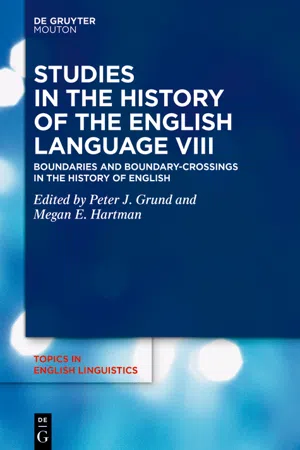
Studies in the History of the English Language VIII
Boundaries and Boundary-Crossings in the History of English
- 294 pages
- English
- ePUB (mobile friendly)
- Available on iOS & Android
eBook - ePub
Studies in the History of the English Language VIII
Boundaries and Boundary-Crossings in the History of English
About this book
Trusted by 375,005 students
Access to over 1.5 million titles for a fair monthly price.
Study more efficiently using our study tools.
Information
Section 1: Conceptual and methodological boundaries
1 Scale and mode in histories of English
Michael Adams
Department of English, Indiana University, Bloomington, IN, USA
1 Introduction
What do we mean when we talk about language “history”? Our dominant model privileges change in linguistic features and accounts for it over fairly long chronological arcs. For instance, one might examine the development of free adjuncts in English and Dutch for three centuries until they diverge in the nineteenth century (Fonteyn and Cuyckens 2015) or attempt to account for the phenomenon we call The Great Vowel Shift (see Giancarlo 2001). We focus on dates and periods even when we distrust such categories (see, e.g., Curzan 2012). We are less attentive, however, to change at either small scales or grand scales, and we rarely conceive of history on terms other than change, though there are alternatives. When we use the term history, we often seem to be talking about facts of the past and the knowledge to which they lead but not about modes of telling about the past – there’s very little historiography of language history. We might productively reconsider scales and modes of “history” in histories of the English language, that is, examine the generic boundaries of our historiography critically and then redraw the terms on which we write the history of English.
Social, political, and cultural history offer models of methods and narrative mostly absent from language history – their boundaries not only differ from those of English historical linguistics but reach beyond them in several directions, both of scope and variety. While a historian might write about England in 1603 CE (Lee 2003) – putatively everything worth knowing about England in that single year – we do not write histories of English in 1776 or 1901. While a historian might write about Mediterranean culture over millennia (Braudel [1966] 1972) – its economies and other mechanisms of exchange – we do not write about the linguistic markets of what are now England and the Netherlands over the millennia. At a radically different scale, we rarely write the history of yesterday’s English or the history of one person’s English, although, of course, sometimes we do (e.g., Tieken-Boon van Ostade 2011: 137–253, and 2014).
There is nothing wrong with the currently favored modes and scales – language history should be done in that fashion but not only nor even mostly in that fashion. There are several reasons to reconsider historical modes and scales. For instance, the current modes and scales appeal to professionals, but narrative engages a much wider audience, and we might introduce language history into the intellectual lives of educated people by means of it.1 It would be worth accounting for the English of a lifetime, at a human scale, in other words – to bring the language into the context of living and thus make what linguists know about it newly relevant to the inheritors of English and its history. Yet, for the professionals, history told in different modes and at different scales facilitates unexpected connections among language phenomena, as well as connections between language-internal history and cultural or “outer” history (see Millward 1988), the effective synthesis of which should figure significantly in a language historian’s work (and, for essentially the same reasons, in teaching of the history of English, for which, see Adams 2012).
2 Conventions
All writing depends on conventions of argument, structure, and style, which together constitute generic boundaries in professional discourse. Within an academic discipline, writing conventions tend to be formalized and specific. (Try to convince a linguist to capitalize words in article titles in a Reference section and you will elicit evidence of both qualities.) There is nothing wrong with disciplinary and even sub-disciplinary writing conventions. Indeed, they are to be expected, not just to promote efficiency in both production and reception – everyone knows what to expect – but because conventions define the social group of researchers in a particular field, that is, knowing and following the conventions are in-group activities that promote group identity and solidarity. Conventionally, you might expect me to cite work by John Swales (e.g., 1990) at this point, but anyone reading this chapter, I believe, will know from experience the truth of what I just wrote. Of course, we bend or break conventions regularly – traverse discourse boundaries – for all kinds of rhetorical reasons. As Devitt (2015: 51) has argued, “genres are grounded in shared communicative purposes and realized in particular linguistic utterances”, and, I would add, we need to promote “improvisation” (Devitt’s term) that challenges generic and stylistic conventions and expands the domains of disciplinary discourses.
Consider, for the sake of example, just one subdisciplinary template, that of historical sociolinguistics. The typical – and, yes, it could be said, stereotypical – article begins with a research question, followed by a literature review, perhaps, or a section on method or experimental design, another that presents data, one that analyzes the data, sometimes, when the disciplinary approach tips towards sociolinguistics, a too-short section titled “Discussion”, and a conclusion that points helpfully towards further research. Chapters in books often follow the same template. We employ it so often, not because it is habitual and mindless – although, of course, it can be either or both – but because it works well for us. It has certain virtues. For instance, it tends towards comparability of method and data such that research participates in a developing conversation on agreed intellectual and methodological terms, and it expects that researchers account for their data.2 Nevertheless, it also tends to homogenize historical scale and mode, even given Devitt’s (2015) point about the variety and individuality of performances with in a genre (see also Devitt, this volume).
Templates that generally govern the writing of historical linguistics reflect a disciplinary emphasis on linguistics and a tendency to interpret historical in its weakest sense (see Considine 2015). Here, I suggest that we should shift emphasis more often, so that historical linguists sometimes write more like historians than like linguists. In doing so, we would find ourselves not only following different conventions – history written by historians who aren’t also linguists has conventions, too – but in negotiating the respective shares of history and linguistics in any given case developing interesting idiosyncratic forms of historical linguistic writing. Here, I will present several models – from both history and linguistics – of historical writing that challenge our current disciplinary conventions, the conceptual boundaries we observe and reinforce in our disciplinary practice. Some of them are outside the mainstreams of both history and linguistics, though not far from the mainstreams, but I think their adventurous stances are more likely than history-as-usual to provoke thinking about historical scale and mode in our own linguistic historiography. I am not arguing to a conclusion, really, nor am I developing a typology of modes and scales in the writing of English historical linguistics. Instead, I am performing a heuristic exercise in historiography that I hope will lead to yet more imaginative practice of our discipline.
3 Varieties of scale and mode
One can write multi-volume histories of long periods, or large areas, or big events, or all three together, as in the decline and fall of the Roman Empire (Gibbon 1776). Or one can write shorter histories focused on social movements within much shorter timeframes –Hill’s The world turned upside down (1972) – or the history of one life – Hill’s God’s Englishman: Oliver Cromwell and the English Revolution (1970) – or historical episodes of quite short duration –Steil’s The Battle of Bretton Woods (2013). Indeed, one can write still shorter histories, in articles rather than books, and even in footnotes to articles and books not otherwise historical. Political and social history is written at many scales, and so we might ask whether language history can similarly scale large and small, as well as scaled as convention leads us to scale our histories. Obviously, too, history appears in many modes, from the fully narrative to the lexicographical, though, I will suggest, historical lexicography is an unexpectedly narrative genre. We can measure every work of history along lines of scale and mode, and the two almost necessarily intersect. Here follow examples of some scales and modes less familiar in language than in other types of history...
Table of contents
- Title Page
- Copyright
- Contents
- Introduction: Boundaries and boundary-crossings in the history of English
- Section 1: Conceptual and methodological boundaries
- Section 2: Linguistic boundaries
- Section 3: Language and language variety boundaries
- Index
Frequently asked questions
Yes, you can cancel anytime from the Subscription tab in your account settings on the Perlego website. Your subscription will stay active until the end of your current billing period. Learn how to cancel your subscription
No, books cannot be downloaded as external files, such as PDFs, for use outside of Perlego. However, you can download books within the Perlego app for offline reading on mobile or tablet. Learn how to download books offline
Perlego offers two plans: Essential and Complete
- Essential is ideal for learners and professionals who enjoy exploring a wide range of subjects. Access the Essential Library with 800,000+ trusted titles and best-sellers across business, personal growth, and the humanities. Includes unlimited reading time and Standard Read Aloud voice.
- Complete: Perfect for advanced learners and researchers needing full, unrestricted access. Unlock 1.5M+ books across hundreds of subjects, including academic and specialized titles. The Complete Plan also includes advanced features like Premium Read Aloud and Research Assistant.
We are an online textbook subscription service, where you can get access to an entire online library for less than the price of a single book per month. With over 1.5 million books across 990+ topics, we’ve got you covered! Learn about our mission
Look out for the read-aloud symbol on your next book to see if you can listen to it. The read-aloud tool reads text aloud for you, highlighting the text as it is being read. You can pause it, speed it up and slow it down. Learn more about Read Aloud
Yes! You can use the Perlego app on both iOS and Android devices to read anytime, anywhere — even offline. Perfect for commutes or when you’re on the go.
Please note we cannot support devices running on iOS 13 and Android 7 or earlier. Learn more about using the app
Please note we cannot support devices running on iOS 13 and Android 7 or earlier. Learn more about using the app
Yes, you can access Studies in the History of the English Language VIII by Peter Grund, Megan Hartman, Peter Grund,Megan Hartman in PDF and/or ePUB format, as well as other popular books in Languages & Linguistics & Linguistics. We have over 1.5 million books available in our catalogue for you to explore.