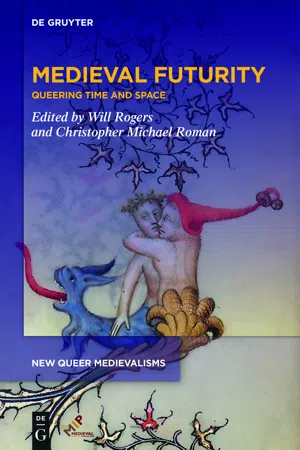
eBook - ePub
Medieval Futurity
Essays for the Future of a Queer Medieval Studies
- 235 pages
- English
- ePUB (mobile friendly)
- Available on iOS & Android
eBook - ePub
Medieval Futurity
Essays for the Future of a Queer Medieval Studies
About this book
This collection of essays asks contributors to take the capaciousness of the word "queer" to heart in order to think about what medieval queers would have looked like and how they may have existed on the margins and borders of dominant, normative sexuality and desire. The contributors work with recent trends in queer medieval studies, blending together modern concepts of sexuality and desire with the queer configurations of eroticism, desire, and materiality as they might have existed for medieval audiences.
Information
Subtopic
Literary CriticismIndex
HistoryPart I: Queer Latinities: Authorizing Same-Sex Desire
Chapter 1 Sexual Ethics in the Medieval Grammar Classroom
Michael Johnson
In trying to contextualize the famously extravagant grammatical metaphors in Alan of Lille’s De planctu Naturae, Jan Ziolkowski has argued that Alan and his peers were inheritors of an earlier medieval textual and pedagogical tradition that associated linguistic rectitude with moral rectitude, orthography with orthopraxy.1 This association stemmed, among other things, from the physical dimension of cathedral school grammar instruction where boys would have learned technologies of writing through an assiduous disciplining of body and mind. Indeed, in the iconography of Lady Grammar she is typically represented as a teacher, with whip or scourge in one hand and balm or ointment in the other, emphasizing grammar’s disciplinary and redemptive dimensions, respectively.2
However, if we jump roughly sixty years later into the early decades of the thirteenth century, we see that grammar becomes increasingly associated with sexual perversion. In Gautier de Coinci’s Miracles de Nostre Dame (ca. 1218), for example, the corrupt sodomites imagined to have overrun the Roman clergy are described as favoring the laws of grammar over those of Nature (“Il metent hic en toutes parz;/ La gramaire hic a hic acouple,/ Mais nature maudit la couple” [They are putting hic all over the place. Grammar might couple hic with hic but Nature curses that coupling]).3 Nearly a century later, Dante places Priscian into the circle of the sodomites in his Commedia, a decision Boccaccio claims was motivated by the widely acknowledged proclivity of grammarians toward sodomy.4 This apparent shift in the perceived ethical value of grammar raises a number of questions relevant to the history of sexuality in medieval Europe. Broadly, we might ask how the early medieval cultural association of grammar with moral rectitude gives way to an association with sexual perversion and moral turpitude in the later Middle Ages. But also, more narrowly, we might ask what specific role medieval grammatical education played in shaping conceptions of erotic desire. To what extent was the grammar classroom perceived as a desirous space, or a space for the disciplining of desire? I will suggest that twelfth-century developments in the theory and practice of Grammatica––from the emergence of speculative grammar to innovations in grammatical pedagogy made necessary by increased enrollments and an increasingly autonomous professoriate––are at the root of this dramatic shift in perceptions of grammar’s ethical value in regards to sexuality. By examining this shift, I believe we can gain insight into the role and evolution of sexual ethics in the medieval grammar classroom.
Introduction: Grammar’s Ambivalent Status
Alan of Lille’s use of grammatical terminology in his theological treatment of natural and unnatural desires is attached to a specific moment in the history of the nascent European university. And although De planctu Naturae is uniquely systematic in its deployment of grammatical metaphors, Alan was far from alone in his use of metalinguistic terminology from the trivium as a means of encoding questions of sex and gender. In the high Middle Ages, the language of Latin grammar became imbued with a powerful and deeply conflicted erotic aura to a degree unseen in any other period of European history. Poets and theologians of the period found grammar to be an endlessly rich source of concepts, structures, and metaphors with which to encode, reflect on, regulate, and even take pleasure in writing about sex.5 Erotic uses of grammar appear in all manner of writings during the period, to a variety of ends, and even, quite often, to opposing ends. On the one hand, grammar was a regulatory art, dedicated in every sense to the straight line (from the Greek γράμμα, “line of writing”), both in the sense that grammar students had to develop the manual mastery necessary to write correctly (orthography) and in the sense that linguistic rectitude was thought necessary to the cultivation of moral rectitude (orthopraxy). On the other hand, the discipline of grammar was also always potentially deviant, threatening to lead its practitioners away from the straight path of linguistic and, by extension, moral rectitude. The reasons behind this association of grammar with linguistic excess and deviance were complex and multiple. For one, the medieval grammar classroom was where young boys first encountered pagan literature in all its exuberant and puzzling alterity. Classical attitudes toward sexuality reflected in the Sex Auctores6 and the works of Ovid and Virgil (somewhat later in the grammar curriculum), combined with the difficulties in using literary, and thus often highly figural, language to teach elementary Latin, we must imagine, would have led grammatici to develop a conflicted erotic rapport with the grammar classroom.7 Beyond the erotic landscapes of pagan literature, however, even the non-literary aspects of grammar were permeated with a sense of eroticism and sin. Given that Latin was understood to be a post-Babelian language, its grammar was correspondingly imagined to mirror the fallenness of nature;8 that the word casus (grammatical case) is derived from the perfect passive participle of cadō (“I fall”) further cemented the association of grammar with fallen nature, as John Alford observed.9 Thus, in the imagination of a writer such as Alan of Lille, fallen grammar cannot help but generate sexual monstrosities such as the two-sexed heteroclite and the passive-in-appearance-but-active-in-meaning deponent, and harbors the constant threat of metaleptic, or insufficiently teleological, signification.
Grammar had long been harnessed in the service of regulating sexual ethics and in a way that was tied to the intensely homosocial and, in certain ways, homoerotic, atmosphere of the cathedral schools. However, as the discipline of grammar became imbued with dialectical reasoning and thus became more categorical and compartmentalized, its earlier association with the disciplining of desire in a homosocial environment became suspect. Moreover, speculative grammar’s tendency to ontologize grammatical categories informed and propelled the creation of new norms just as the Church began to intensify its regulation of sex and marriage.
Since the publication of John Boswell’s Christianity, Social Tolerance, and Homosexuality: Gay People in Western Europe from the Beginnings of the Christian Era to the Fourteenth Century and Mark Jordan’s The Invention of Sodomy in Christian Theology, a number of scholars interested in premodern sexuality have acknowledged the fact that medieval thinkers tended to view matters of sex and gender through a grammatical lens. However, aside from Ziolkowski’s (1985) Alan of Lille’s Grammar of Sex and, to a lesser extent, Cestaro’s (2003) Dante and the Grammar of the Nursing Body and Curry Woods’s (2010) Classroom Commentaries: Teaching the Poetria Nova across Medieval and Renaissance Europe, existing scholarship on the subject does not contextualize this phenomenon in relationship to pedagogical practice in the medieval grammar classroom, which would have been almost certainly a crucible for the emergence of this peculiar use of grammatical terminology and reasoning to describe and reflect on erotic desire and gender. Moreover, by focusing on the more concrete register of pedagogical practice instead of high grammatical theory, the historical shift in Grammatica’s status, from a discipline of orthopraxy to one associated with disordered desire and sodomy, comes into view with more clarity.
This essay therefore considers medieval grammar instruction from a few different angles and is organized around a series of pairings. I look first at the presence of the Altercatio Ganimedis et Helene, an erotic debate poem, in the context of its manuscript tradition, manuscripts that were likely produced and used in conjunction with grammar instruction. By situating it in its manuscript tradition, we are able to view the Altercatio as a product of the homosocial environment of the cathedral school where boys learned a certain disciplining of desire through their grammatical studies. However, by placing it into dialogue with Gilles de Corbeil and Gautier de Coinci, both of whom cite the Altercatio’s famous grammatical justification of same-sex desire, we also see how quickly the textual legacy of the grammar-as-orthopraxy tradition would become not only indecipherable to readers in the thirteenth century and beyond, but also suspect and perverse. The next section of the essay pairs John of Salisbury and Alan of Lille with Petrus Helias and Alexandre de Villedieu, respectively. John and Alan are both transitional figures, caught between the early medieval pedagogical grammar model and the emergent fields of speculative and modistic grammar, and both advocate for grammar instruction as a mode of disciplining desire. Petrus and Alexandre, on the other hand, represent innovations in grammar instruction that remove or bracket desire, in various ways, from the grammar classroom.
By placing these medieval intellectuals into dialogue with one another, the presence and concern with desire in the grammar classroom come into relief. For example, John of Salisbury and Petrus Helias are rarely, if ever, studied in relationship to the history of sexuality; nor are they examined for their reflections on desire.10 However, by considering John of Salisbury’s lament about the loss of an earlier generation’s pedagogical methods against the emergence of the summa as both cause and supplement to the loss John describes, the desirous homosociality of the early medieval grammar classroom comes into view with a degree of clarity that would be impossible looking at either of these thinkers alone. By pairing Alexandre de Villedieu with Alan of Lille, the cosmological stakes of setting De planctu Naturae in the grammar classroom bec...
Table of contents
- Title Page
- Copyright
- Contents
- Introduction: Clearly, Queerly: Toward a Medieval Queer Futurity
- Part I: Queer Latinities: Authorizing Same-Sex Desire
- Part II: French Kisses: Queer Romance
- Part III: Insular Queerness: English and the Nonnormative
- Epilogue: Opening Up Queerness
- Index
Trusted by 375,005 students
Access to over 1.5 million titles for a fair monthly price.
Study more efficiently using our study tools.
Frequently asked questions
Yes, you can cancel anytime from the Subscription tab in your account settings on the Perlego website. Your subscription will stay active until the end of your current billing period. Learn how to cancel your subscription
No, books cannot be downloaded as external files, such as PDFs, for use outside of Perlego. However, you can download books within the Perlego app for offline reading on mobile or tablet. Learn how to download books offline
Perlego offers two plans: Essential and Complete
- Essential is ideal for learners and professionals who enjoy exploring a wide range of subjects. Access the Essential Library with 800,000+ trusted titles and best-sellers across business, personal growth, and the humanities. Includes unlimited reading time and Standard Read Aloud voice.
- Complete: Perfect for advanced learners and researchers needing full, unrestricted access. Unlock 1.5M+ books across hundreds of subjects, including academic and specialized titles. The Complete Plan also includes advanced features like Premium Read Aloud and Research Assistant.
We are an online textbook subscription service, where you can get access to an entire online library for less than the price of a single book per month. With over 1.5 million books across 990+ topics, we’ve got you covered! Learn about our mission
Look out for the read-aloud symbol on your next book to see if you can listen to it. The read-aloud tool reads text aloud for you, highlighting the text as it is being read. You can pause it, speed it up and slow it down. Learn more about Read Aloud
Yes! You can use the Perlego app on both iOS and Android devices to read anytime, anywhere — even offline. Perfect for commutes or when you’re on the go.
Please note we cannot support devices running on iOS 13 and Android 7 or earlier. Learn more about using the app
Please note we cannot support devices running on iOS 13 and Android 7 or earlier. Learn more about using the app
Yes, you can access Medieval Futurity by Will Rogers,Christopher Michael Roman in PDF and/or ePUB format, as well as other popular books in History & Literary Criticism. We have over 1.5 million books available in our catalogue for you to explore.