Wasser ist eine globale Ressource für heutige Gesellschaften – Wasser war eine globale Ressource vormoderner Gesellschaften. Die manigfaltigen unterschiedlicher Wassersysteme für Prozesse der Urbanisierung und das urbane Leben in der Antike und dem Mittelalter ist bislang kaum erforscht. Die zahlreichen Beiträge dieses Bandes fragen nach der grundlegenden kulturellen Bedeutung von Wasser ( bzw. power of water) in der Stadt und Wasser für die Stadt aus unterschiedlichen Perspektiven. Symbolische, ästhetische oder kultische Aspekte werden ebenso thematisiert wie die Rolle von Wasser in Politik, Gesellschaft oder Wirtschaft und dem alltäglichen Handeln, aber auch in Stadtplanungsprozessen oder städtischen Teilräumen. Nicht zuletzt stellen die Gefahren von verschmutzten Wasser oder Überschwemmungen die städtische Gesellschaft vor Herausforderungen. Die Beiträge diesen Band lenken den Blick auf die komplexen und vielfältigen Beziehungen zwischen Wasser und Menschen. Das Sammelwerk präsentiert die Ergebnisse einer internationalen Tagung in Kiel 2018. Es wendet sich gleichermaßen an Leser aus den altertumskundlichen wie mediävistischen Fächern und darüberhinaus an alle Interessierten, die sich über die Vielfalt von Wassersystemen im Stadtraum der Antike und des Mittelalters informieren möchten.
eBook - ePub
The Power of Urban Water
Studies in Premodern Urbanism
- 280 pages
- English
- ePUB (mobile friendly)
- Available on iOS & Android
eBook - ePub
The Power of Urban Water
Studies in Premodern Urbanism
About this book
Information
Subtopic
History of Ancient ArtIndex
History1 Introduction
Urban Water
Dr. Annette Haug
Christian-Albrechts-Universität zu Kiel, Kiel, Deutschland
Prof. Dr. Ulrich Müller
Christian-Albrechts-Universität zu Kiel, Kiel, Deutschland
Urbanity constitutes a crucial form of settlement organization. Urban agglomerations can be described as social, economic, and cultural ‘hubs’ within dynamic networks. Today, half of humanity lives in cities and, within two decades, nearly 60 % of the world’s population will be urban dwellers. 1 However, even premodern, agricultural societies often follow a ‘centralized’ mode of dwelling.
The present volume takes a very specific perspective on the manifold aspects of urban agglomerations: It puts the aspect of urban water in its centre. Of the world’s total water supply, over 96 % is saline (seas and oceans), whereas of total freshwater, over 68 % is locked up in ice and glaciers. Another 30 % of freshwater is in the ground. Surface freshwater (lakes and rivers) make up only 1.2 % of earth’s water. 2 But water is essential to life; it is therefore hardly surprising that water is essential for the development of societies too and that a multitude of cultural practices have emerged to manage water as a resource – one could say that civilisations are built on water. 3 The importance of water and its management as a resource is underlined, for example, by the fact that, in 2019, the pre-modern water management system of the city of Augsburg was inscribed on the World Heritage List. 4
Water thus also constitutes a central factor of urbanity. ‘Water is the only universal urban resource that in this sense is a must and that can be controlled in this strict understanding of the word’. 5 Many crafts, trades and proto-industrial facilities need water: tanners or brewers, but also blacksmiths, potters, butchers or bakers. Water, however, is not only a crucial urban resource, it affects all aspects of urbanity. The hydrological conditions create a specific ‘embedding’ into a ‘natural’ environment from which arise specific health conditions, but also the availability and breeds of specific animal species and the cultivation of specific plants. These latter two aspects are key to specific urban diets. Furthermore, in many cities water is managed by specific infrastructural measures: aqueducts/pipes, fountains or cisterns for water supply, sewer canals for waste water, drainage systems. Besides such measures of water management, bridges and harbour installations (e. g. moles) are crucial for the infrastructural embedding of water into a built environment. Consequently, the presence or absence of rivers and the sea is key to urban practices and the perception and aesthetic quality of urban agglomerations. This holds true for daily routines, for specific (e. g. religious) rituals, for specific economies, but also for forms of trading (e. g. seafaring). As a consequence, not only the town itself, but also the surrounding countryside is dependent on water systems and the respective actions involved.
History of research
The history of research 6 reveals that studies on water within urban agglomerations have usually focused on specific aspects – be it the analysis of specific buildings or infrastructural measures connected to water (e. g. aqueducts, fountains, drainage systems, bridges, harbours, etc.), 7 urban facilities demanding water, such as baths or toilets, 8 the reconstruction of water as a medium of transport (e. g. fluvial networks or maritime networks), 9 water as a threat (e. g. floods) or medium of power, 10 the reconstruction of ‘water knowledge’ (e. g. the analysis of Frontinus’ work) 11 and water technologies, 12 the (industrial, economic, private) uses of urban water, 13 the pollution of water, 14 water as a cultural skill, 15 the sacred, political and social semantics of water infrastructures (e. g. fountains), 16 aesthetic aspects of waterscapes and water installations, 17 or the analysis of visual and textual representations of water monuments, harbours, and harbour cities. 18 On a more general level, several studies address the role of water in different urban formations – besides the conventional towns (e. g. civitates, municipia), Punic emporia or the emporia on the North and Baltic Seas, market places, palatia, or inland central places related to palatines or monasteries.
Some cross-sectional studies on the subject have also been published in recent years. 19 Most recently, Terje Tvedt and Terje Oestigaard have brought together many of these in a comprehensive analysis of ‘Water in History’ published in nine volumes between 2006 and 2016. It provides a diachronic historical and comparative perspective on the complex relationship between water and society. 20 One volume of this series deals with the issue of ‘Water and Urbanization’. 21 The study aims at understanding the relationship between water and the urban environment by differentiating three aspects: the natural waterscape, human modifications of the waterscape, and ideas and managerial concepts of water. 22 Consequently, this study follows a relatively technical understanding of the relation between water and urbanity.
Here, instead, we focus on the social and cultural production of urban spaces. One theoretical milestone for such an approach was developed by Henri Lefebvre. 23 He starts from the assumption that urban spaces are socially produced spaces. On this basis, he considers the experienced space (espace vecu), the perceived space (espace perçu), and the imagined space (espace conçu) to be mutually interdependent. 24 We refer to this concept, but we differentiate the categories more in detail and include further analytical constituents (Fig. 1): urban agency and urban perception, the architecturally and materially defined urban space, mental concepts of urbanity, material and immaterial resources, and environment. With a focus on urban water, this concept can be further specified.
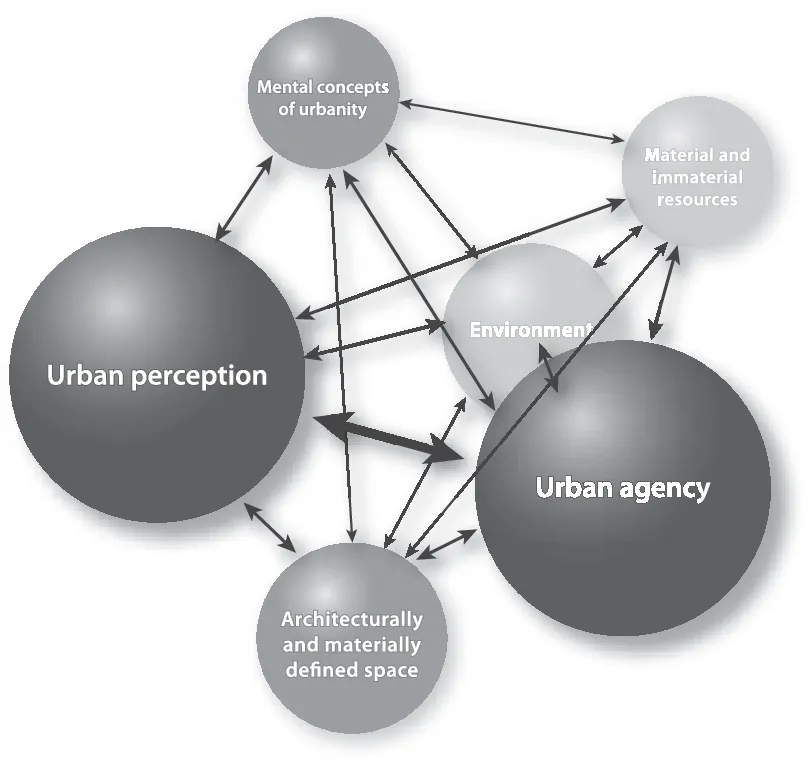
Fig. 1
1) Practices within urban agglomerations referring to water include a broad range of activities, including drinking and food preparation, specific forms of movement (shipping), productive activities involving water, hygiene and medical practices, leisure activities such as bathing, rituals such as baptism, and ceremonies. The following questions will be of importance: In what way does the presence or absence of water generate specific forms of urban agency? What effect does the practical (e. g. cultic, ceremonial, hygienic) relevance of water have on the architectural design of a city? How are specific water practices linked to mental concepts? What roles do different types of water practices (religious, political, economic, and artistic) play in the formation of urban ‘identities’?
2) Perceptions of urban agglomerations referring to their waterscapes are particularly important for harbour cities and cities located on rivers. As specific urban architectural forms (aqueducts, fountains, nymphaea) stage and aestheticise water elements, they shape the perception of ‘urban water’. The following questions will be of importance: How do ‘water cities’ (located on rivers, lakes or the sea) differ from other cities with respect to their ‘atmospheric’ qualities? What is the influence of the climate (arid/humid) on the perception of urban agglomerations? What are the sensual qualities of practices involving water?
3) A large range of architectural forms and infrastructural measures aim at the control, provision, removal, or staging of water. ‘Water architectures’ thus become prominent features of an urban setting. The following questions will be of importance: What kind of architectures result from the presence or absence of water? In what way does water and its related buildings and infrastructure have an influence on urban lifestyles (agency) and on urban design (perception)?
4) As the presence or absence of water is linked to urban practices, perceptions and architectural settings, it is thus also an important factor for the mental conceptualisation and imagining of cities. The following questions will be of importance...
Table of contents
- Title Page
- Copyright
- Contents
- 1 Introduction Urban Water
- 2 From Nature to Topography Water in the Cities of Roman Northern Italy
- 3 Fountains and the Ancient City Social Interactions, Practical Uses, and Pleasant Sights
- 4 Water, Social Space and Architecture at Selinous: the Case of the Urban Sanctuary
- 5 Fountains and Basins in Greek Sanctuaries On the Relationship Between Ritual Performance and Architecture
- 6 Water in Early Christian Ritual: Baptism and Baptisteries in Corinth
- 7 Aquatic Pasts & the Watery Present: Water and Memory in the Fora of Rome
- 8 Water and Decentring Urbanism in the Roman Period: Urban Materiality, Post-Humanism and Identity
- 9 Water and Urban Structures in the Narrative Worlds of Courtly Novels − Aesthetic and Symbolic Functions
- 10 Syracusan Water Networks in Antiquity
- 11 Meeting Water Needs as a Major Challenge in an Urban Context Examples from the Danube Region (1300–1600)
- 12 Ice Jams and their Impact on Urban Communities from a Long-term Perspective (Middle Ages to the 19th Century)
- 13 Medieval and Post-Medieval Urban Water Supply and Sanitation Archaeological Evidence from Göttingen and North German Towns
- 14 Harbourscapes Three Examples from Early to High Medieval Northern Europe
- 15 Human Impact on Hydrology Direct and Indirect Consequences of Medieval Urbanisation in Southern Germany
- 16 Water as an Economic Resource and as an Environmental Challenge Within the Urbanisation Process of the Rhine Valley in the 13th Century
Trusted by 375,005 students
Access to over 1.5 million titles for a fair monthly price.
Study more efficiently using our study tools.
Frequently asked questions
Yes, you can cancel anytime from the Subscription tab in your account settings on the Perlego website. Your subscription will stay active until the end of your current billing period. Learn how to cancel your subscription
No, books cannot be downloaded as external files, such as PDFs, for use outside of Perlego. However, you can download books within the Perlego app for offline reading on mobile or tablet. Learn how to download books offline
Perlego offers two plans: Essential and Complete
- Essential is ideal for learners and professionals who enjoy exploring a wide range of subjects. Access the Essential Library with 800,000+ trusted titles and best-sellers across business, personal growth, and the humanities. Includes unlimited reading time and Standard Read Aloud voice.
- Complete: Perfect for advanced learners and researchers needing full, unrestricted access. Unlock 1.5M+ books across hundreds of subjects, including academic and specialized titles. The Complete Plan also includes advanced features like Premium Read Aloud and Research Assistant.
We are an online textbook subscription service, where you can get access to an entire online library for less than the price of a single book per month. With over 1.5 million books across 990+ topics, we’ve got you covered! Learn about our mission
Look out for the read-aloud symbol on your next book to see if you can listen to it. The read-aloud tool reads text aloud for you, highlighting the text as it is being read. You can pause it, speed it up and slow it down. Learn more about Read Aloud
Yes! You can use the Perlego app on both iOS and Android devices to read anytime, anywhere — even offline. Perfect for commutes or when you’re on the go.
Please note we cannot support devices running on iOS 13 and Android 7 or earlier. Learn more about using the app
Please note we cannot support devices running on iOS 13 and Android 7 or earlier. Learn more about using the app
Yes, you can access The Power of Urban Water by Nicola Chiarenza, Annette Haug, Ulrich Müller, Nicola Chiarenza,Annette Haug,Ulrich Müller in PDF and/or ePUB format, as well as other popular books in History & History of Ancient Art. We have over 1.5 million books available in our catalogue for you to explore.