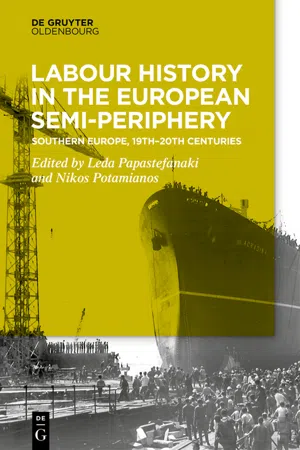
This collective volume aims at studying a variety of labour history themes in Southern Europe, and investigating the transformations of labour and labour relations that these areas underwent in the 19th and the 20th centuries. The subjects studied include industrial labour relations in Southern Europe; labour on the sea and in the shipyards of the Mediterranean; small enterprises and small land ownership in relation to labour; formal and informal labour; the tendency towards independent work and the role of culture; forms of labour management (from paternalistic policies to the provision of welfare capitalism); the importance of the institutional framework and the wider political context; and women's labour and gender relations.
eBook - ePub
Labour History in the Semi-periphery
Southern Europe, 19th-20th centuries
- 386 pages
- English
- ePUB (mobile friendly)
- Available on iOS & Android
eBook - ePub
Labour History in the Semi-periphery
Southern Europe, 19th-20th centuries
About this book
Information
Part I Small Business, Small Property and Labour
Chapter 1 Ownership and Labour in Rural Greece during the Nineteenth Century
Stavroula Verrarou
Abstract
Small ownership remains an essential element in the understanding of the nineteenth century Greek society. Yet, this view overlooks the extent of large property and its social implications, and also underestimates class division. As a result, wage-labour analysis was neglected. However, the study of the commercial agriculture and seasonal migration of thousands of workers suggests a different image of the “quiet” rural world. This study draws upon archival research of notary and private sources to track the rarely visible labour force in the agricultural sector. On one hand, hired labour was often disguised behind sharecropping agreements; on the other, the fragile social relations between workers and landowners were barely mentioned in the press.
The financial crisis at the end of the century heavily affected the large property reshaping the social map. Small ownership survived thanks to the immigrant remittances from abroad and substantially contributed to the nationalist ambitions of the Greek State. Henceforth, it would prevail over any alternative narrative about social structure.
Introduction
The historical perception on the structure of the Greek society has been formed through the prism of the universality of small ownership1 since the birth of the Greek State. According to a brief historical account, the peasants took advantage of the Greek Independence War (1821 – 1828) and occupied prior Muslim lands which they traditionally cultivated. These lands with the name “Nationals” passed on the possession of the Greek State in the aftermath of the War. The government, with the consent of the native elite, tolerated the occupation of the National Land. The land reform, following fifty years after the Revolution (1871), implemented the distribution of the National Land in small plots and, hence, impeded irrevocably the formation of big property. Thus, a society of petty-owners emerged.2
Apparently, in such a society, wage labour issues are of minor interest to the researchers of the nineteenth century. Hired labour is viewed strictly as a seasonal supplement to the family work, especially during the season of field preparation or that of harvest. On the other part, in the domain of big property, landowners showed their preference to the sharecropping system, denying direct exploitation and its benefits, namely the increase of control over the production. Even in the case of the large raisin vineyards, the widespread practice of sharecropping is not only interpreted as the triumph of the family work over wage labour but also as another proof of the small-farmer character of the rural society.3
These views are supported further by the general belief of no social unrest in the Greek countryside; however, close examination reveals many cases of social conflict in local level and shakes the myth of the ideal petty-owners society.4 For example, under the circumstances of political turbulence and anarchy during the period of Messovasileia (1862 – 1864), many peasants having disputed the contemporary state of affairs attempted to gain property rights on public or private land. On the other hand, original historical research has demonstrated that the local elites were not indifferent to land concentration, especially in the section of the cash-crop cultivation. In the light of new findings, Alexis Franghiadis disputed the peasant and small-property friendly character of the National Land distribution laws (1871). As he stated, “the Reform aimed to the liberalisation of the land market and the reinforcement of the private property – and not specifically the small property”.5
During the nineteenth century, increased European demand for agricultural products placed new incentives on commercial farming that had far-reaching consequences for rural society. It brought both new opportunities of wealth for landowners and critical changes in the labour market. The once fragmented, unpredictable and uncertain labour force of peasants who descended from the mountains to the plains was replaced by a regular, more organised and steady labour market not only ready to meet the needs of commercial farming but also heavily depended on the latter. Working as a labourer was not simply a way for the peasant to supplement his meager income but a means to survive and maintain his small insufficient property and hence his position as independent producer.
In this chapter, I will attempt to explore and present the interdependence of rural labour market and big property. I will also argue that only at the turn of the century, when the closing of the French market to the imported Greek raisin took place (1892), leading to a commercial and financial crisis, can we talk about the beginnings of the retreat of big property and the predominance of small ownership.
The arguments presented here stem mainly from my dissertation research in the region of Trifylia (province of Messinia in South-West Peloponnese).6 One of the principal questions of the research was how the land tenure system was formed in a cash-crop region and the possible changes the distribution of the National Land brought to the ratio of big to small property. The study of the land cessions yielded poor results as far as land concentration is concerned. Nevertheless, the notary archives indicated the presence of an important group of vineyards owners whose properties exceeded one hundred stremmata (ten hectares) each. They were all residents of the nearby agro-town of Kyparissia but were not all strictly landowners in profession. They practiced various professions such as that of a merchant, doctor, state or army officer and others. Many of them had been involved in moneylending and formed the local economic and political elite. The land was a valuable asset which, together with their other activities, shaped their relationship with the peasants and offered them wealth, esteem and local power.
Τhe main section is divided into three parts. In the first, I will attempt to trace big property in its various forms. In the second part, I will try to trace the “unseen” labourers in the Greek countryside and define the role of the sharecropping system in the big vineyards. In the third part, I will argue that the widespread view of high wages in the Greek countryside is di...
Table of contents
- Title Page
- Copyright
- Contents
- List of Illustrations
- Labour History in the Semi-periphery. Southern Europe, 19th – 20th centuries
- Part I Small Business, Small Property and Labour
- Part II Formal and Informal Labour, Family Patterns
- Part III Industrial Labour Relations in Southern Europe
- Part IV Shipyards and Maritime Labour in the Mediterranean
- List of contributors
- Index
Trusted by 375,005 students
Access to over 1.5 million titles for a fair monthly price.
Study more efficiently using our study tools.
Frequently asked questions
Yes, you can cancel anytime from the Subscription tab in your account settings on the Perlego website. Your subscription will stay active until the end of your current billing period. Learn how to cancel your subscription
No, books cannot be downloaded as external files, such as PDFs, for use outside of Perlego. However, you can download books within the Perlego app for offline reading on mobile or tablet. Learn how to download books offline
Perlego offers two plans: Essential and Complete
- Essential is ideal for learners and professionals who enjoy exploring a wide range of subjects. Access the Essential Library with 800,000+ trusted titles and best-sellers across business, personal growth, and the humanities. Includes unlimited reading time and Standard Read Aloud voice.
- Complete: Perfect for advanced learners and researchers needing full, unrestricted access. Unlock 1.5M+ books across hundreds of subjects, including academic and specialized titles. The Complete Plan also includes advanced features like Premium Read Aloud and Research Assistant.
We are an online textbook subscription service, where you can get access to an entire online library for less than the price of a single book per month. With over 1.5 million books across 990+ topics, we’ve got you covered! Learn about our mission
Look out for the read-aloud symbol on your next book to see if you can listen to it. The read-aloud tool reads text aloud for you, highlighting the text as it is being read. You can pause it, speed it up and slow it down. Learn more about Read Aloud
Yes! You can use the Perlego app on both iOS and Android devices to read anytime, anywhere — even offline. Perfect for commutes or when you’re on the go.
Please note we cannot support devices running on iOS 13 and Android 7 or earlier. Learn more about using the app
Please note we cannot support devices running on iOS 13 and Android 7 or earlier. Learn more about using the app
Yes, you can access Labour History in the Semi-periphery by Leda Papastefanaki, Nikos Potamianos, Leda Papastefanaki,Nikos Potamianos in PDF and/or ePUB format, as well as other popular books in History & Eastern European History. We have over 1.5 million books available in our catalogue for you to explore.