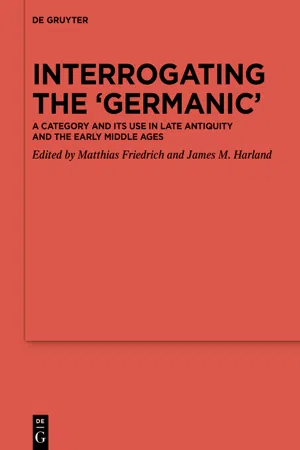
eBook - ePub
Interrogating the ‘Germanic’
A Category and its Use in Late Antiquity and the Early Middle Ages
- 276 pages
- English
- ePUB (mobile friendly)
- Available on iOS & Android
eBook - ePub
Interrogating the ‘Germanic’
A Category and its Use in Late Antiquity and the Early Middle Ages
About this book
Die Germanische Altertumskunde Online wird – wie bereits das in ihr aufgegangene Reallexikon – durch Ergänzungsbände begleitet. Diese Reihe umfasst Monographien ebenso wie Sammelbände zu spezifischen Themen aus Archäologie, Geschichte und Literaturwissenschaft. Damit wird der Inhalt der Datenbank um jene Aspekte erweitert, die einer ausführlichen Analyse bedürfen. Inzwischen sind bereits mehr als 100 Bände erschienen von Germanenproblemen in heutiger Sicht bis zur Germanischen Altertumskunde im Wandel.
Information
Rome and Its Created Northerners
Roland Steinacher
Germani as a Historical Term
In this article I discuss the many problems attached to the use of Germani as a historical term through a consideration of Latin and Greek sources from the first century BCE to the tenth century CE, that is, roughly speaking, from Posidonius of Apameia to ninth- and tenth-century Byzantine and Carolingian writers. Latin texts used the term Germani to describe a barbarian population beyond the Roman borders east of the Rhine and north of the Danube only for a rather short period. In the first two centuries CE, Gaius Julius Caesar and other authors after him, especially Publius Cornelius Tacitus, established the term. Having been introduced by these Roman authors, Germani and Germania survived in a variety of different meanings. After the Principate, Germani in most cases simply described Franks or Alamanni on both banks of the Rhine. In the first century CE, during the reign of emperor Domitian (81–96) the geographical term Germania came in use to name the two Roman provinces along the Rhine, Germania superior and inferior. East of these provinces an area of Roman interest known as Germania appears in the sources throughout the Augustan period. Consistently, Germania described a greater area than Gallia or Italia did. A Roman category had been taken over by early medieval intellectuals but never related to a clear political or territorial concept.
Many Greek scholars simply classified the inhabitants of the northwestern and northeastern Mediterranean as ‘Celts’ and ‘Scythians’, respectively. This remained usual practice in Greek literature until Late Antiquity. A few Greek texts instead use Germanoi (Γερμανοί). These texts either depended on Caesar, or defined the Germanoi as a Celtic people. In most modern archaeological or historical studies, many gentes (barbarian groups) are simply classified as Germani without further discussion. A term like Germani still evokes, no matter how much one tries to avoid it, notions of contingent identities in vast areas east of the Rhine and north of the Danube, including parts of Scandinavia, and with undefined borders to the east.1 This is very near to what Roman writers from the first century BCE to the second century CE, especially Caesar and Tacitus, wanted their fellow Romans to believe. At the same time, centuries after the first use of the term Germani (and in the same way as with the term Celts), such categories offered some security for generations of scholars and their readers in a field of complicated and very often perplexing sources, both in material and in written culture. Such pseudo-ethnic terms became widespread, by offering some order to puzzling material, and they have a long history in scholarship, that continues even today.
Half a millennium ago, when medieval Europe entered an age of fast economic, political, and social change, scholars adapted the terms Germani and Celts. A society claiming classical texts for its own intellectual foundation frequently founded its historical explanations on the written remains of antiquity. Learned men of that age laid the groundwork for a ‘modern’ view of ethnic identity by looking for clear borders between the sixteenth-century Germans and French, Italians and Spaniards—a task that was not especially easy in a Europe unified by a common ecclesiastical and intellectual culture. Roman as well as Greek writers, however, had very different aims from those of sixteenth- to nineteenth-century scholars. Thus, the division of peoples into West Germanic, East Germanic, and North Germanic was an eighteenth- and nineteenth-century linguistic construct.
During the nineteenth century the putative existence of a ‘Germanic’ identity, though in the end nothing more than a fantasy of ancient literature, was given new strength by linguistic theories. The entry “Germanen” in the Deutsches Wörterbuch of Jakob and Wilhelm Grimm offered, for example,a simple explanation: Germani was simply the term for the Deutschen, and the peoples related to them (“germanen ist eine bezeichnung der deutschen und der ihnen stammverwandten völker bei Kelten und Römern, die sich bei letzteren mit sicherheit nicht über den sklavenkrieg [73–71 v. Chr.] hinauf verfolgen läszt”).2 Most scholars had no reservations about the existence of a coherent Germanic world before the Middle Ages. Archaeological, historical, and linguistic research in the German- speaking world defined the Germani, until recently, as the immediate predecessors of the modern Germans.3 It is impossible, however, to generalise about the economic, social, religious, ethnic, or political structures of so-called ‘Germanic’ peoples. The category Germani is a Roman and literary one; there has never been a ‘Germanic’ identity, nor has there ever been a ‘Germanic world’: “The non-existence of ancient Germans is perhaps the most important thing one can say about the barbarians of late antiquity”.4 “A people dubbing itself Germani may have never existed. As a term applied by others, however, Germani had a long and rich history, from Caesar’s Germani up to the present-day English term ‘Germans’.”5 Despite the ambiguity of the antique term Germani, an enduring identity spanning from the constructed Germani in prehistory to the modern German nation has become part of Germany’s public interest today.6 Roman sources classified the societies which Roman soldiers, politicians, and diplomats dealt with.
As these sources have a very different background than our research interests, problems inevitably arise. Modern scholarship has to discuss every individual and every social entity (gens) on its own terms, considering their specific historical circumstances. Prehistoric sociological structures interacted with urban, Mediterranean culture and it was out of these processes of integration and confrontation lasting for centuries, the ‘Transformation of the Roman World’, that medieval Europe emerged. The idea of a ‘Germanic’ identity, apart from a Roman definition of a Germania, did not appear earlier than the sixteenth century. It is much more part of the history of scholarship than of the Roman, barbarian, or post-imperial history of Europe.7
Caesar’s Invention: Germani as a Third Group in between Celts and Scythians
Greek and Roman Ethnography
Greek writers defined identities of human societies in the known world and bequeathed ethnonyms. Since the sixth and fifth centuries BCE, these categories were most often little more than learned constructions. Greek ethnographers like Hekataios, Herodotus and Eratosthenes of Cyrene categorized the world north of the Alps as a western Keltike (Κελτική) and an eastern Scythike (Σκυθική) with the river Tanais (Don) as its frontier.8 Celts and Scythians were known as the two ethne (ἔθνη) living in the northern part of the inhabited world. Ethne was understood to describe greater groups of peoples. Other parts of the world were inhabited by Thracians or Persians, Aethiopians, Libyans, and Maurousioi. Each of these terms is complicated and needs scholarly interpretation.9 Greek ethnographers tried to classify new groups interacting with the Mediterranean world and to understand them as part of one of the known ethne. Observations, deductions, and speculations, combined with empirical knowledge, formed the basis of this written knowledge. The ethne were divided into phylai (φῦλαι).10 Such a φυλή was in the back of Posidonius’s mind when he mentioned Germanoi for the first time. Before we enter into a discussion of the ideas of Posidonius and Caesar, the latter of whom depended on the former, and their afterlife, we must again return to the classics. Aristotle (384 BCE–322 BCE) defined ethnicity as one of the differences between Greeks and barbarians. Greeks lived in their polis, barbarians lived in ethne.11 The Greeks and Romans writing these sources were primarily citizens of their polis, their civitas, or the res publica. The rest of the population in the Mediterranean most likely had identities similar to those of the so-called barbarians.12 The categories of ancient writers remained in use up to Late Antiquity and in many cases to the high Middle Ages.13 For most ancient writers, categorizing peoples north, east, and south of the Mediterranean basin simply meant distinguishing their ways of life from the urbanised civilisation they knew, not mentioning, at the same time, the fact that farming communities did not really differ from barbarian communities in the Mediterranean outside their cities.
Gaius Julius Caesar: An Author with Specific Interests Introduces the Term Germani (with a little help from Posidonius)
Posidonius of Apameia at the Orontes in Syria, who died around 51 BCE (that is, in Caesar’s lifetime), described a fierce Celtic tribe named the Germanoi (Γερμανοί). Posidonius wrote a continuation of the Roman history of ...
Table of contents
- Title Page
- Copyright
- Contents
- Introduction: The ‘Germanic’ and its Discontents
- The Marriage of Philology and Race: Constructing the ‘Germanic’
- Rome and Its Created Northerners
- Re-inventing the ‘Germanic’ in the Early Modern Era: Omnes Germani sunt, contra fabulas quorundam
- The Balloon that Wouldn’t Burst: A Genealogy of ‘Germanic’
- What Can Cultural Anthropology Do for Medievalists? A Methodological Discussion of Ethnicity Applied to Late Antique and Early Medieval History
- From Rhetoric to Dialectic: The Becoming ‘Germanic’ of Visigothic (Legal-)Literature, and (Postulating) the End of a ‘Truth’
- Sidonius Apollinaris’s Use of the Term Barbarus: An Introduction
- A Habitus Barbarus in Sub-Roman Britain?
- A Farewell to Arms: Germanic Identity in Fifth-Century Britain
- Germanic or Slavic? Reconstructing the Transition from Late Antiquity to the Early Middle Ages in East Central Europe
- Linguistic Labels and Ethnic Identity
- (Proto-)Germanic Alliterative Verse: Linguistic Limits on a Cultural Phenomenon
- The Limits of Obligation and Friendship: Hrothgar, Beowulf, and the ‘Germanic’ Ideal
- Index
Trusted by 375,005 students
Access to over 1.5 million titles for a fair monthly price.
Study more efficiently using our study tools.
Frequently asked questions
Yes, you can cancel anytime from the Subscription tab in your account settings on the Perlego website. Your subscription will stay active until the end of your current billing period. Learn how to cancel your subscription
No, books cannot be downloaded as external files, such as PDFs, for use outside of Perlego. However, you can download books within the Perlego app for offline reading on mobile or tablet. Learn how to download books offline
Perlego offers two plans: Essential and Complete
- Essential is ideal for learners and professionals who enjoy exploring a wide range of subjects. Access the Essential Library with 800,000+ trusted titles and best-sellers across business, personal growth, and the humanities. Includes unlimited reading time and Standard Read Aloud voice.
- Complete: Perfect for advanced learners and researchers needing full, unrestricted access. Unlock 1.5M+ books across hundreds of subjects, including academic and specialized titles. The Complete Plan also includes advanced features like Premium Read Aloud and Research Assistant.
We are an online textbook subscription service, where you can get access to an entire online library for less than the price of a single book per month. With over 1.5 million books across 990+ topics, we’ve got you covered! Learn about our mission
Look out for the read-aloud symbol on your next book to see if you can listen to it. The read-aloud tool reads text aloud for you, highlighting the text as it is being read. You can pause it, speed it up and slow it down. Learn more about Read Aloud
Yes! You can use the Perlego app on both iOS and Android devices to read anytime, anywhere — even offline. Perfect for commutes or when you’re on the go.
Please note we cannot support devices running on iOS 13 and Android 7 or earlier. Learn more about using the app
Please note we cannot support devices running on iOS 13 and Android 7 or earlier. Learn more about using the app
Yes, you can access Interrogating the ‘Germanic’ by Matthias Friedrich, James M. Harland, Matthias Friedrich,James M. Harland in PDF and/or ePUB format, as well as other popular books in History & Ancient History. We have over 1.5 million books available in our catalogue for you to explore.