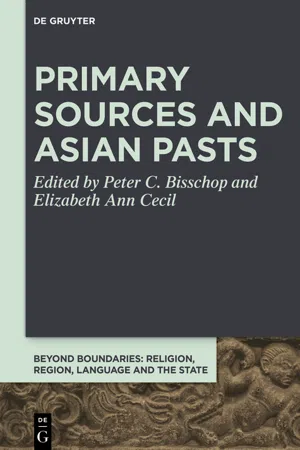
This conference volume unites a wide range of scholars working in the fields of history, archaeology, religion, art, and philology in an effort to explore new perspectives and methods in the study of primary sources from premodern South and Southeast Asia. The contributions engage with primary sources (including texts, images, material artefacts, monuments, as well as archaeological sites and landscapes) and draw needed attention to highly adaptable, innovative, and dynamic modes of cultural production within traditional idioms. The volume works to develop categories of historical analysis that cross disciplinary boundaries and represent a wide variety of methodological concerns. By revisiting premodern sources, Asia Beyond Boundaries also addresses critical issues of temporality and periodization that attend established categories in Asian Studies, such as the "Classical Age" or the "Gupta Period". This volume represents the culmination of the European Research Council (ERC) Synergy project Asia Beyond Boundaries: Religion, Region, Language and the State, a research consortium of the British Museum, the British Library and the School of Oriental and African Studies, in partnership with Leiden University.
eBook - ePub
Primary Sources and Asian Pasts
- 399 pages
- English
- ePUB (mobile friendly)
- Available on iOS & Android
eBook - ePub
Primary Sources and Asian Pasts
About this book
Information
Topic
Theology & ReligionSubtopic
Teaching HistoryPart I: Narrative Form and Literary Legacies
Why So Many ‘Other’ Voices in the ‘Brahmin’ Mahābhārata?
James L. Fitzgerald
1 Introduction
Most scholars agree that the “Great Epic of Ancient India,” the Mahābhārata (MBh), an epic story with a dynastic war over land and succession at its heart, manifests the influence of authors and redactors who were affiliated with the Brahmin traditions of ancient India.1 The Brahmin traditions of India were a heterogeneous mix of intellectual traditions that were notionally centered upon the Vedas – ancient collections of orally transmitted poetry worshiping the Gods – and the employment of the Vedas in fire sacrifices directed to the Gods. But among the priestly families who knew and used the Vedas, different traditions branched out into a whole raft of ancillary concerns from phonetics and grammar to astronomy, philosophy, and statecraft. The minimal Brahmin ideal in ancient times was the priestly ideal – maintaining at least some part of the Veda in memory and conducting at least the most modest of the sacrifices – but it seems that even in the most ancient times, there were men who did not meet this standard, who were criticized for being “brahmins by birth alone.”2 It is important to realize that the social reality of brahmins “on the ground,” as it were, was more complicated than thumbnail sketches of ancient Indian society might lead one to believe.
My understanding of the history of the MBh is that it descended from an older, non-Brahmin, oral epic tradition that told tales of the recurrent rivalries between the Bharata dynasty and the neighboring Pañcāla dynasty. I suggest the earlier form of our epic was simply the Bhārata, “the story of the Bharatas.”3 Sometime around 500 to 400 BCE, the Bhārata story became a supercharged account centered upon a previously unknown, semidivine phratry of five heroes that was grafted into the Bharata family – the five sons of the king Pāṇḍu, the five Pāṇḍavas – who became alienated from the Kaurava phratry that treated them as interlopers. The Pāṇḍavas allied themselves with the Pañcālas through marriage, and then effected the defeat of the Kaurava Bharatas. The injection of the five semidivine heroes into the story was, I believe, the accomplishment of Veda-inspired brahmins entering somehow into the creation and dissemination of popular epic narrative. This new Bhārata story was told, in part, to ensure protection from the armed stratum of society for the inspired elite that claimed the ability to see and understand the Gods and other important unseen realities (e.g., dharma) – that is, the brahmins4– and secure that elite’s socioeconomic position in a world that was being radically transformed by the imperialism and cosmopolitanism of the eastern hegemons and by the successful new religious movements they sponsored (especially Jainism and Buddhism).5 These religious movements rejected Vedic revelation and ritual and the brahmin advocates of those exclusive, esoteric texts and rites in favor of universal reasoning and one or another kind of “soul therapy” for individual persons.6
The eldest Pāṇḍava, Yudhiṣṭhira, is portrayed in the epic as a pious student of brahmins, a patron of brahmins, and a favorite of brahmins. He is in fact, so infused with certain Brahminic values (particularly their adoption of the Jain ideal of “complete harmlessness,” ahiṃsā) that initially he refused to take the crown after he won the bloody, internecine Bhārata war. Yudhiṣṭhira was eventually persuaded that violent kingship was truly necessary when he was told the myth of the first great human king Pṛthu, who was fashioned – fully grown and fully armed – by a group of brahmins out of the right hand of the wicked king Vena, whom the brahmins had slain because, they said, he erased the distinctions between the four canonical orders of society (the four varṇas), a socioeconomically threatening form of varṇa confusion (varṇasaṃkara).7 Pṛthu paid obeisance to the brahmins immediately upon his creation and asked for their commands. The brahmins ordered him to be restrained in his behavior (niyata; no small point, as many stories of kings’ interactions with brahmins in the MBh emphasize);8 also, to do what is Lawfully Right – that is dharma – in all circumstances; to be equitable toward all; to punish with force of arms those who violate dharma; and, lastly, to bend all his efforts to elevating the Vedas as maintained by Vedic brahmins (MBh 12.59.109–112). One of the central points of the MBh narrative is to charter Yudhiṣṭhira, the victorious new king of the Bharatas, as a new Pṛthu preserving dharma with force and protecting brahmins. This episode attests to the MBh as a story based on Brahmin ideology and advancing the claims of brahmins to be the sole determiners of right and wrong in the polity and the society – claims that were certainly not generally accepted at this time. The teachings of the Buddhists, Jains, and Ājīvikas and the edicts of Aśoka positively attest to the bare fact; the many Brahminic registrations of grievance over slights to Brahmin dignity and the many stories in the MBh demonstrating the power of brahmins attest to the pain felt as a result of it.
One of the principal ways that the distinctions between the canonical orders of society were felt by some to be subject to erasure in northern India about 400 BCE was the perceived maldistribution of patronage to unqualified brahmins of poor Vedic learning or low standards in selecting their ritual patrons; or, worse, the patronage of non-brahmins such as Buddhists or Jains. Properly educated brahmins believed that they had a monopoly on knowing and teaching dharma (and receiving patronage for doing so) and one of the main points in fashioning Yudhiṣṭhira as the new Pṛthu and setting him at the center of the Bhārata narrative was to propagate this vision of a society and polity headed by a king dedicated to and guided by brahmins. The only way an elite that produces no material goods can thrive, or even exist, without outright begging, is through a transfer of wealth to them effected by the armed stratum of society and the consequent honor and protection of them by the armed rulers. One of the goals of the MBh was to argue the world should have an honorable and secure place for brahmins – which was not at all a “done deal” in ancient northern India in 400 BCE – and it seems that the MBh was persuasive in this regard for significant portions of the subcontinent across the following centuries, given the widespread patronage of brahmins and Brahmin literary and intellectual pursuits across northern India,9 and beyond, in the stressful centuries following the demise of the Mauryan empire and leading eventually to the rise of the Gupta empire in the fourth century CE.10
But while I think this gloss of the MBh as a reactionary document is true as far as it goes, the burden of my argument in this paper is that some of the cosmopolitanism of the non-brahmin Mauryan emperors and the universalism of the Buddhist and Jain rivals of brahmins seeped into the epic – something that is evident from the very fact that the MBh includes a large number of supplemental narratives teaching dharma in one form or another that depict life outside the courts of the Bharatas and their rivals: life in the wilderness and in various kinds of sacred settlements that dot the wilderness, and life in towns and big cities. And though the majority of these stories present or examine the status and position of brahmins, they often do so in oblique ways, employ an unexpected diversity of voices, and ...
Table of contents
- Title Page
- Copyright
- Contents
- Primary Sources and Asian Pasts: Beyond the Boundaries of the “Gupta Period”
- Part I: Narrative Form and Literary Legacies
- Part II: Political Landscapes and Regional Identity
- Part III: Religion, Ritual, and Empowerment
- Index
Trusted by 375,005 students
Access to over 1.5 million titles for a fair monthly price.
Study more efficiently using our study tools.
Frequently asked questions
Yes, you can cancel anytime from the Subscription tab in your account settings on the Perlego website. Your subscription will stay active until the end of your current billing period. Learn how to cancel your subscription
No, books cannot be downloaded as external files, such as PDFs, for use outside of Perlego. However, you can download books within the Perlego app for offline reading on mobile or tablet. Learn how to download books offline
Perlego offers two plans: Essential and Complete
- Essential is ideal for learners and professionals who enjoy exploring a wide range of subjects. Access the Essential Library with 800,000+ trusted titles and best-sellers across business, personal growth, and the humanities. Includes unlimited reading time and Standard Read Aloud voice.
- Complete: Perfect for advanced learners and researchers needing full, unrestricted access. Unlock 1.5M+ books across hundreds of subjects, including academic and specialized titles. The Complete Plan also includes advanced features like Premium Read Aloud and Research Assistant.
We are an online textbook subscription service, where you can get access to an entire online library for less than the price of a single book per month. With over 1.5 million books across 990+ topics, we’ve got you covered! Learn about our mission
Look out for the read-aloud symbol on your next book to see if you can listen to it. The read-aloud tool reads text aloud for you, highlighting the text as it is being read. You can pause it, speed it up and slow it down. Learn more about Read Aloud
Yes! You can use the Perlego app on both iOS and Android devices to read anytime, anywhere — even offline. Perfect for commutes or when you’re on the go.
Please note we cannot support devices running on iOS 13 and Android 7 or earlier. Learn more about using the app
Please note we cannot support devices running on iOS 13 and Android 7 or earlier. Learn more about using the app
Yes, you can access Primary Sources and Asian Pasts by Peter C. Bisschop, Elizabeth A. Cecil, Peter C. Bisschop,Elizabeth A. Cecil in PDF and/or ePUB format, as well as other popular books in Theology & Religion & Teaching History. We have over 1.5 million books available in our catalogue for you to explore.