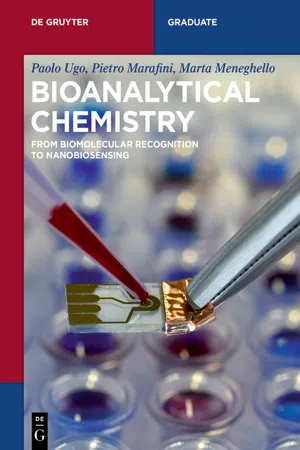
Bioanalytical chemistry plays today a central role in various fields, from healthcare to food and environmental control. This book presents the main methodologies for analyzing biomacromolecules, with a focus on methods based on molecular recognition. The six chapters move from fundamentals to the most recent advances, achieved by a synergetic combination of bio and nanotechnologies. The need for rapid and reliable analytical tools able to perform a large number of quantitative analyses, not only in centralized laboratories and core facilities but also for point-of-care testing, has been dramatically stressed by the recent crisis caused by the COVID-19 pandemic. The aim of the authors is to provide graduate students and young researchers with the elements of interdisciplinary knowledge necessary not only to use the wide arsenal of bioanalytical tools available today but also to contribute to the development of even more effective devices and methods.
The discovery of the substance that would later be known as deoxyribonucleic acid (DNA) was made by Johann Friedrich Miescher in 1869. He extracted the nuclei of leucocytes, taken from the pus on fresh surgical bandages, and he obtained a precipitate called “nuclein”. When the acidic properties of “nuclein” were discovered, the name was changed to “nucleic acid” by Richard Altmann in 1889. Most importantly, in 1944 Oswald, MacLeod and McCarty suggested that DNA carries genetic information, and their finding was confirmed in 1952 by Alfred Hershey and Martha Chase. A year later, James D. Watson and Francis H. C. Crick proposed the double helix structure for DNA.
1.1.1 Structure of nucleotides
DNA and RNA are biological polymers built up from monomers called nucleotides that are linked together by phosphodiester linkages. Nucleotides have three main components: a nitrogen-containing heterocyclic base, a pentose sugar (2′-deoxy-D-ribose in DNA and D-ribose in RNA) and a phosphate (Figure 1.1). There are five different fundamental nitrogenous bases and only four are present in DNA. These are divided into two groups (Figure 1.2):
the purines: adenine (A) and guanine (G);
the pyrimidines: cytosine (C), thymine (T) and uracil (U).
Figure 1.1: Structure of nucleotides. The pentose here depicted is 2′-deoxy-D-ribose (Adapted from P. Marafini, Biophysical Studies of Oligonucleotides Containing Duplex Stabilising Modifications, DPhil Thesis, University of Oxford, 2017. Reproduced with permission from the author).
Figure 1.2: The five nitrogenous bases present in DNA and RNA. Thymine is present in DNA only, while uracil is present only in RNA. The numbering of the nucleobases is in light blue (Adapted from P. Marafini, Biophysical Studies of Oligonucleotides Containing Duplex Stabilising Modifications, DPhil Thesis, University of Oxford, 2017. Reproduced with permission from the author).
The nucleobase is linked to the pentose sugar via an N-glycosidic bond connecting the C-1′ of the sugar with N-9 of purines or N-1 of pyrimidines. The nitrogenous base can be located on the same side of the pentose ring as its 5′-hydroxyl group (β-anomer) or on the opposite side (α-anomer), with naturally occurring oligonucleotides presenting nucleosides in the β-configuration (Figure 1.3).
Figure 1.3: α- and β-anomers of a DNA nucleoside (Adapted from P. Marafini, Biophysical Studies of Oligonucleotides Containing Duplex Stabilising Modifications, DPhil Thesis, University of Oxford, 2017. Reproduced with permission from the author).
The nucleobase can rotate around the N-glycosidic bond, having two extreme conformations (Figure 1.4). The syn conformer has the bigger N-3 (purine) or O-2 (pyrimidine) above the pentose ring, and it is therefore more sterically hindered than the anti conformer that has the smaller H-8 (purine) or H-6 (pyrimidine) above the sugar. For this reason, naturally occurring nucleic acids prefer the anti conformation.
Figure 1.4:Anti and syn conformations of deoxyadenosine (Adapted from P. Marafini, Biophysical Studies of Oligonucleotides Containing Duplex Stabilising Modifications, DPhil Thesis, University of Oxford, 2017. Reproduced with permission from the author).
In order to reduce electronic and steric interactions between the substituents of furanose, the ring is twisted out of plane generating the so-called sugar puckering. There are two forms of sugar pucker, identifiable by the position of the 2′ and 3′ carbons of the pentose ring (Figure 1.5). The South (S) configuration presents the C-2′ on the same side of the ring (endo) as the C-5′, while the North (N) configuration presents the C-3′ in the endo position. In DNA, 2′-deoxy-D-ribose usually adopts the C-2′ endo (S) conformation, while in RNA, D-ribose usually prefers the C-3′ endo (N) conformation.
Figure 1.5: C-2′ endo and C-3′ endo sugar conformations (Adapted from P. Marafini, Biophysical Studies of Oligonucleotides Containing Duplex Stabilising Modifications, DPhil Thesis, University of Oxford, 2017. Reproduced with permission from the author).
1.1.2 Structure of oligonucleotides and duplexes
One of the fundamental steps in understanding DNA structure was made by Erwin Chargaff who noted that the ratio of purines to pyrimidines in cells is equal (i.e. 1:1). This was followed by X-ray diffraction studies by Rosalind Franklin and Maurice Wilkins, which showed that the secondary structure of DNA is helical and humidity dependent. The key discovery in consolidating this information was published in 1953 by Jam...
Table of contents
Title Page
Copyright
Contents
Preface
Abbreviation list
Symbol list
1 Biomacromolecules in analytical chemistry
2 Introduction to bioanalytical assays and biosensors
3 Enzymatic biosensors
4 Immunochemical assays and immunosensors
5 Analysis of nucleic acids
6 Nanotechnologies for bioanalysis
Index
Trusted by 375,005 students
Access to over 1.5 million titles for a fair monthly price.
Study more efficiently using our study tools.
Frequently asked questions
Yes, you can cancel anytime from the Subscription tab in your account settings on the Perlego website. Your subscription will stay active until the end of your current billing period. Learn how to cancel your subscription
No, books cannot be downloaded as external files, such as PDFs, for use outside of Perlego. However, you can download books within the Perlego app for offline reading on mobile or tablet. Learn how to download books offline
Perlego offers two plans: Essential and Complete
Essential is ideal for learners and professionals who enjoy exploring a wide range of subjects. Access the Essential Library with 800,000+ trusted titles and best-sellers across business, personal growth, and the humanities. Includes unlimited reading time and Standard Read Aloud voice.
Complete: Perfect for advanced learners and researchers needing full, unrestricted access. Unlock 1.5M+ books across hundreds of subjects, including academic and specialized titles. The Complete Plan also includes advanced features like Premium Read Aloud and Research Assistant.
Both plans are available with monthly, semester, or annual billing cycles.
We are an online textbook subscription service, where you can get access to an entire online library for less than the price of a single book per month. With over 1.5 million books across 990+ topics, we’ve got you covered! Learn about our mission
Look out for the read-aloud symbol on your next book to see if you can listen to it. The read-aloud tool reads text aloud for you, highlighting the text as it is being read. You can pause it, speed it up and slow it down. Learn more about Read Aloud
Yes! You can use the Perlego app on both iOS and Android devices to read anytime, anywhere — even offline. Perfect for commutes or when you’re on the go. Please note we cannot support devices running on iOS 13 and Android 7 or earlier. Learn more about using the app
Yes, you can access Bioanalytical Chemistry by Paolo Ugo,Pietro Marafini,Marta Meneghello in PDF and/or ePUB format, as well as other popular books in Technology & Engineering & Biochemistry. We have over 1.5 million books available in our catalogue for you to explore.