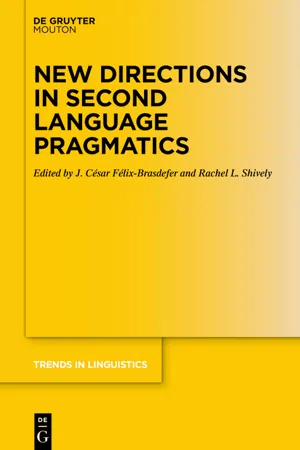
eBook - ePub
New Directions in Second Language Pragmatics
- 360 pages
- English
- ePUB (mobile friendly)
- Available on iOS & Android
eBook - ePub
New Directions in Second Language Pragmatics
About this book
No detailed description available for "New Directions in Second Language Pragmatics".
Information
Part I: Learning and teaching speech acts
1 Pragmatic competence and speech-act research in second language pragmatics
J. César Félix-Brasdefer
Abstract
Speech act theory has been a predominant research topic in second language pragmatics. This chapter focuses on three key topics in the L2 pragmatics literature with regard to speech act production and comprehension: pragmatic competence, speech acts in interaction, and pragmatic instruction of speech acts. I examine the construct of pragmatic competence from the lens of L2 pragmatics, including ways to expand our understanding of this construct to interactional and intercultural competence. Using a pragmatic-discursive approach, I examine the learning and teaching of speech acts at the discourse level in various intercultural contexts. I conclude this chapter with directions for future research.
Keywords: awareness, pragmatic competence, pragmatic instruction, speech acts, study abroad,
1 Introduction
Speech acts have been a predominant research topic in second language (L2) pragmatics since the late 1970s. Early studies include apologies (Cohen and Olshtain 1981; Olshtain and Cohen 1983), complaints (Olshtain and Weinbach 1987), compliments (Wolfson 1981), disagreements (Beebe and Takahashi 1989), requests (Koike 1989; Scarcella 1979; Walters 1979), and pragmatic routines (Coulmas 1981), to name but a few (for a review of L2 speech acts, see Bardovi-Harlig 2010; Félix-Brasdefer 2019a [Ch. 7], 2019b; Kasper and Rose 2002; Pearson and Hasler-Barker 2021). Most research in L2 pragmatics follows Andrew Cohen’s contribution to speech act sets, which describes the strategies or semantic formulas that comprise the speech act itself (for a list of taxonomies of speech acts, see Félix-Brasdefer 2019a, Ch. 7 and Ishihara and Cohen 2010, Ch. 4). In addition, Andrew Cohen’s work has been paramount in providing language instructors with resources for the teaching of speech acts in the classroom and in study-abroad environments (e.g., Cohen 2016, 2018a, 2018b; Félix-Brasdefer and Cohen 2012; Ishihara and Cohen 2010). However, with the exception of a few studies mentioned in Félix-Brasdefer (2019b) and Kasper (2006a) that take a pragmatic-discursive perspective, most research in L2 pragmatics still focuses on speech act strategies in non-interactive contexts.
In this chapter, I examine three topics in L2 pragmatics with regard to speech act research and language learning: pragmatic competence, speech acts in interaction, and the learning of speech acts as a result of pragmatic instruction. The ability to produce and comprehend speech acts in interaction represents one aspect of the learner’s pragmatic competence.
2 Key issues
2.1 Pragmatic competence
What kind of pragmatic knowledge do learners need to develop to communicate effectively in a second language? Researchers in L2 pragmatics generally point to two types of pragmatic knowledge that allow learners to develop pragmatic competence over time (incidental learning) or to improve as a result of pedagogical intervention (for an overview, see Bardovi-Harlig 2001, 2013; Félix-Brasdefer 2017; Kasper and Rose 2002; Taguchi 2017). Pragmalinguistic competence refers to knowledge about and performance of the conventions of language use or the linguistic resources available in a given language that convey “particular illocutions” (Leech 1983: 11). It includes knowledge of strategies (e.g., directness, conventional indirectness) and the linguistic and non-linguistic resources (e.g., head nods and gesture, as well as prosodic features such as final intonation, loudness, and duration) used to convey pragmatic meaning. In contrast, sociopragmatic competence refers to knowledge about and performance consistent with the social norms in specific situations in a given society, as well as familiarity with assessments of (im)politeness and variables of social power and social distance. For example, to issue a request, learners not only need to know the various lexico-grammatical options available in the grammar (e.g., I need/want a letter of recommendation, Can/could/would you write a letter of recommendation?, I was wondering if you would have time to write a letter of recommendation), they must also have knowledge of the where/who/when/how these requests are used in particular situations. For example, they should understand appropriate degrees of directness and indirectness, appropriate degrees of politeness and impoliteness, as well as the sociocultural expectations of when to use a particular request.
In addition to pragmalinguistic and sociopragmatic knowledge, learners of an L2 or more languages must also develop other abilities in interaction: the ability to produce and comprehend speech acts at the discourse level, the ability to understand explicit and indirect meaning (e.g., implicature), the ability to learn the referential and social functions of address forms (deixis) and the sociocultural expectations of the appropriate degrees of (im)politeness, as well as a knowledge of the interactional mechanisms to communicate effectively with users of the target culture. According to Schneider (2017: 317), learners should also develop discourse-oriented macropragmatic competence, that is, “knowing how to behave in interaction” in a variety of formal and informal communicative events.
Following Timpe-Laughlin, Wain, and Schmidgall (2015), pragmatic competence encompasses other abilities, such as discourse (e.g., knowledge of cohesion and coherence) and sociocultural knowledge (e.g., knowledge of the communicative event such as a market transaction), that allow the learner to communicate effectively and appropriately in formal and informal situational contexts. Further, learners also need to develop intercultural competence so as “to interact with ‘others’, to accept other perspectives to be conscious of their evaluations of difference” (Byram, Nichols, and Stevens 2001: 5). Developing intercultural competence should include knowledge and discussion of cultural topics and global issues with speakers from other cultures. Finally, to expand on their ability to negotiate meaning in interaction, learners should develop interactional competence, which includes the ability to produce and comprehend social action in their sequential context, take turns, interrupt or yield the floor, and the ability to open and close an interaction in various discourse practices (Salaberry and Kunitz 2019; Young 2019). In fact, as noted in Barron (2020), interactional competence “recognises that competence in interactional practices, such as, f...
Table of contents
- Title Page
- Copyright
- Contents
- Introduction
- Part I: Learning and teaching speech acts
- Part II: Assessing pragmatic competence
- Part III: Analyzing discourses in L2 digital contexts
- Part IV: Current issues in L2 pragmatics
- Index
Trusted by 375,005 students
Access to over 1.5 million titles for a fair monthly price.
Study more efficiently using our study tools.
Frequently asked questions
Yes, you can cancel anytime from the Subscription tab in your account settings on the Perlego website. Your subscription will stay active until the end of your current billing period. Learn how to cancel your subscription
No, books cannot be downloaded as external files, such as PDFs, for use outside of Perlego. However, you can download books within the Perlego app for offline reading on mobile or tablet. Learn how to download books offline
Perlego offers two plans: Essential and Complete
- Essential is ideal for learners and professionals who enjoy exploring a wide range of subjects. Access the Essential Library with 800,000+ trusted titles and best-sellers across business, personal growth, and the humanities. Includes unlimited reading time and Standard Read Aloud voice.
- Complete: Perfect for advanced learners and researchers needing full, unrestricted access. Unlock 1.5M+ books across hundreds of subjects, including academic and specialized titles. The Complete Plan also includes advanced features like Premium Read Aloud and Research Assistant.
We are an online textbook subscription service, where you can get access to an entire online library for less than the price of a single book per month. With over 1.5 million books across 990+ topics, we’ve got you covered! Learn about our mission
Look out for the read-aloud symbol on your next book to see if you can listen to it. The read-aloud tool reads text aloud for you, highlighting the text as it is being read. You can pause it, speed it up and slow it down. Learn more about Read Aloud
Yes! You can use the Perlego app on both iOS and Android devices to read anytime, anywhere — even offline. Perfect for commutes or when you’re on the go.
Please note we cannot support devices running on iOS 13 and Android 7 or earlier. Learn more about using the app
Please note we cannot support devices running on iOS 13 and Android 7 or earlier. Learn more about using the app
Yes, you can access New Directions in Second Language Pragmatics by J. César Félix-Brasdefer, Rachel Shively, J. César Félix-Brasdefer,Rachel Shively in PDF and/or ePUB format, as well as other popular books in Languages & Linguistics & Linguistics. We have over 1.5 million books available in our catalogue for you to explore.