eBook - ePub
Petrocinema
Sponsored Film and the Oil Industry
- 172 pages
- English
- ePUB (mobile friendly)
- Available on iOS & Android
eBook - ePub
Petrocinema
Sponsored Film and the Oil Industry
About this book
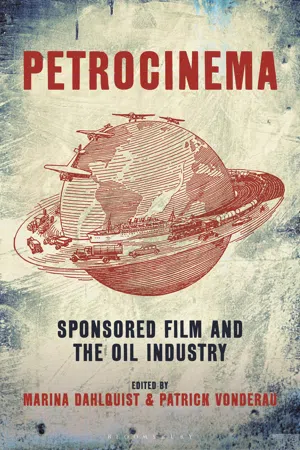
Petrocinema presents a collection of essays concerning the close relationship between the oil industry and modern media-especially film. Since the early 1920s, oil extracting companies such as Standard Oil, Royal Dutch/Shell, ConocoPhillips, or Statoil have been producing and circulating moving images for various purposes including research and training, safety, process observation, or promotion. Such industrial and sponsored films include documentaries, educationals, and commercials that formed part of a larger cultural project to transform the image of oil exploitation, creating media interfaces that would allow corporations to coordinate their goals with broader cultural and societal concerns. Falling outside of the domain of conventional cinema, such films firmly belong to an emerging canon of sponsored and educational film and media that has developed over the past decade. Contributing to this burgeoning field of sponsored and educational film scholarship, chapters in this book bear on the intersecting cultural histories of oil extraction and media history by looking closely at moving image imaginaries of the oil industry, from the earliest origins or "spills" in the 20th century to today's post industrial "petromelancholia."
Information
PART ONE
Oil Rhetoric
1
Oil Media Archives
Mona Damluji
My first encounter in an oil media archive was with a VHS tape in the British Petroleum (BP) Archive that could not be played. A second encounter had me handling a fragile film reel stored in its original canister. Viewing the oil company film on a Steenbeck in a dark basement-level screening room of the British Film Institute was a nerve-racking experience: the celluloid crackled insistently throughout, threatening imminent demise. Next came a stack of photo albums whose pages were filled with aging prints sealed underneath delicate plastic sheets. Individual images demanded every sort of speculation, since no names, locations, or dates accompanied the albums. While studying petroleum company–sponsored films of the Middle East, I have worked in several archives over the course of a decade in search of moving images, still photography, artwork, and other cultural productions sponsored by oil companies—what I call oil media. These earliest encounters troubled my assumptions about what conducting research in corporate archives would be like. How could one of the world’s wealthiest and most powerful corporations be so inconsistent and apparently uninterested in archiving its media?
It was not until I later tracked down the existence of the lesser-known BP Video Library (BPVL) that I realized a major transformation of how the oil company approached media archiving, film in particular, was underway. Access to BP’s film archive would soon be radically different from the experiences I described here. On my first visit to the BPVL, I marveled at stacked shelves of film reels and VHS tapes in an open plan room that housed hundreds of BP’s sponsored films. On that occasion, I requested permission to view a pristinely kept print of the Anglo-Iranian Oil Company (AIOC)-sponsored film Persian Story (1952, Greenpark Productions). Afterward, I remarked to a friendly staff person about the film’s significance in the context of Iran’s political history and her reply startled me. As it turns out, BP was in the middle of digitizing the collection stored in the South London video library and in less than a year the archived films would be available for anyone to watch online. Today, years after I began my research, BPVL’s website offers open access to a searchable interface where visitors can stream digitized versions of the company’s film holdings dating back to 1921.1 At face value, the presentation of the online archive suggests complete access to BP’s film history. And yet, my current research on Iraq Petroleum Company–sponsored films, which are almost entirely missing from the BPVL archive, has demonstrated that this is not the case.
In this chapter, I am concerned with how oil companies archive media in general and sponsored films in particular. When corporations do archive oil media, access to those repositories can be confusing and confounding. While some corporate media archives (like BP) are housed at a public university, others (like Shell) are just about impenetrable to academic researchers. Still others are altogether inaccessible. My purpose here is to begin to map the uneven terrain of oil media archives for academic researchers. What I call oil media archives includes the various manifestations of media collection and preservation by petroleum companies: online and offline, digital and analog, cataloged and undisclosed.
Oil media archives include films, videos, photographs, and other media objects, each ripe for analysis, and also the published and unpublished paper trails and oral histories that help to trace the complex origins, making, publicity, and reception of oil-sponsored media. As a counterpoint to the hyper-visibility of digitized films on the BPVL website, which I will describe and contextualize in detail in the latter half of this chapter, my early encounters in the BP corporate archive point to the existence of films that are thoroughly documented in writing but nowhere to be found or watched in the archives. These findings led me to consider the complex ways in which, as Renée M. Sentilles contends, “our relationship with sources [change] as they become more accessible, more abundant, and less tangible.”2 Entanglements and contradictions become increasingly apparent when moving between “real” archives—that is, material repositories containing historical documents and analog media objects—and their relatively accessible online counterparts.3 Generally, the separation of digital and nondigital practices of archiving films into online and offline spaces that do not explicitly refer to each other can be misleading. In the case of BP, it is apparent that available online and offline archives produce incomplete and disjointed collections of oil media; one should be careful to consult one and not the other.
This chapter sets out to make oil media archives visible and recognizable as “full-fledged historical actors” and a counterpart to what Andrew Barry terms the oil archives.4 It opens a conversation about how researchers might navigate the numerous and variable practices of archiving oil media in the era of digitization. To do this, I examine how BP, the corporation whose archives I am most familiar with, archives its sponsored films and associated paper trails. I also draw attention to how their approach has excluded numerous films from their seemingly complete collection. In particular, I have determined that while the BP Archive acquired the Iraq Petroleum Company’s paper archive, films were excluded from this acquisition. The BPVL is missing all but one of the company’s sponsored films from Iraq, which are difficult and sometimes impossible to track down elsewhere. My foc us on BP should not suggest that its practices are universal. Rather, it presents a case study of a corporation that is among the first to establish open free access to their online media archive.5 As I will discuss, BP’s impetus to undertake a media digitization and archiving project should be understood as a calculated interpretation of the film collection’s commercial value—licensing footage as a revenue stream—and cultural value—mass circulation of BP-sponsored images as well as promoting the idea of BP as a cultural sponsor.
BP’s accessible visual media library of high-quality film footage fosters the reproduction of its content. The website’s slickness—that is, the aesthetic simplicity, ease of searchability, and editorial freedom to select still images or video clips with precision—commands an authority to create and limit how oil and oil modernity is imaged and imagined for mass audiences. As I have written about elsewhere, nearly a century ago, BP and other oil companies established public relations offices to promote film sponsorship widely, from internal training films for oil workers to widely distributed prestige documentaries, or what I term “petrofilms,” for theatergoers, film societies, and classrooms.6 In short, today’s digital media archive continues the BP’s long-standing mission of shaping how audiences—inside and outside of the industry—see themselves in relationship to oil.
Navigating Oil Archives
In Archive Stories, Antoinette Burton’s insists upon “the necessity of talking about the backstage of archives—how they are constructed, policed, experienced, and manipulated.” She reminds us that colonial archives “served as technologies of imperial power, conquest and hegemony” and therefore should not be mistaken as neutral repositories of documentary evidence.7 This reminds us to be attentive to the ways that archives mediate the production of knowledge and in particular how the archives of the world’s most powerful and profitable oil companies reproduce corporate hegemony. Katayoun Shaifee and Andrew Barry have written about BP’s archives in illuminating detail, guiding scholars and provoking new avenues of inquiry.8 However, they neither deal explicitly with the significance of audiovisual media in the archive nor examine how BP archives media.
Until recently, the study of oil was chiefly the domain of political scientists who have narrowly framed its local histories and global effects in economic terms as rent. Excluded from these approaches, Shaifee and others have pointed out, are any serious consideration of “the activities of oil operations, or the ways in which the oil itself, as a liquid material and historical actor, was extracted from under the ground, transported, and sold with political consequences for the state, political community and nation, and possibilities for democracy.”9 In the past several years, scholars across the humanities and humanistic social sciences have charted new trajectories and embraced innovative methodologies for studying oil and its institutions, infrastructures, and images.10
The official BP Archive is housed in the Modern Records Centre at the University of Warwick in Coventry, UK. Since 1993, the BP Archive has operated independently of the university to make the oil company’s large cache of documents and other materials (photographs, periodicals, newspapers, etc.) available to researchers. Shaifee’s historical account of BP’s paper archiving practices offers an important context for any person interested in how oil companies shape knowledge production. Her essay draws a critical link between archive’s emergence and the company’s origins in southwestern Iran at the beginning of the twentieth century. BP’s collection can be traced to 1921, when the Anglo-Iranian Oil Company (AIOC) first decided to preserve all in-house documentation of its operations. This decision, Shaifee points out, concurred with AIOC’s new efforts to expand the documentation of its activities in Iran, using the normative practices of British colonial administration such as maintaining documentation of official communications, reports, and memorandum. Further, the company initiated the extensive photographic and filmic documentation of its operations and infrastructure, as I have documented elsewhere.11
Accomp...
Table of contents
- Cover
- Half-Title
- Title
- Contents
- List of Figures
- Acknowledgments
- Introduction
- PART ONE Oil Rhetoric
- PART TWO Advertisements and Sponsorship
- PART THREE Transformation of Oil Politics
- List of Contributors
- Index
- Copyright
Trusted by 375,005 students
Access to over 1.5 million titles for a fair monthly price.
Study more efficiently using our study tools.
Frequently asked questions
Yes, you can cancel anytime from the Subscription tab in your account settings on the Perlego website. Your subscription will stay active until the end of your current billing period. Learn how to cancel your subscription
No, books cannot be downloaded as external files, such as PDFs, for use outside of Perlego. However, you can download books within the Perlego app for offline reading on mobile or tablet. Learn how to download books offline
Perlego offers two plans: Essential and Complete
- Essential is ideal for learners and professionals who enjoy exploring a wide range of subjects. Access the Essential Library with 800,000+ trusted titles and best-sellers across business, personal growth, and the humanities. Includes unlimited reading time and Standard Read Aloud voice.
- Complete: Perfect for advanced learners and researchers needing full, unrestricted access. Unlock 1.5M+ books across hundreds of subjects, including academic and specialized titles. The Complete Plan also includes advanced features like Premium Read Aloud and Research Assistant.
We are an online textbook subscription service, where you can get access to an entire online library for less than the price of a single book per month. With over 1.5 million books across 990+ topics, we’ve got you covered! Learn about our mission
Look out for the read-aloud symbol on your next book to see if you can listen to it. The read-aloud tool reads text aloud for you, highlighting the text as it is being read. You can pause it, speed it up and slow it down. Learn more about Read Aloud
Yes! You can use the Perlego app on both iOS and Android devices to read anytime, anywhere — even offline. Perfect for commutes or when you’re on the go.
Please note we cannot support devices running on iOS 13 and Android 7 or earlier. Learn more about using the app
Please note we cannot support devices running on iOS 13 and Android 7 or earlier. Learn more about using the app
Yes, you can access Petrocinema by Marina Dahlquist, Patrick Vonderau, Marina Dahlquist,Patrick Vonderau in PDF and/or ePUB format, as well as other popular books in Media & Performing Arts & Film & Video. We have over 1.5 million books available in our catalogue for you to explore.