eBook - ePub
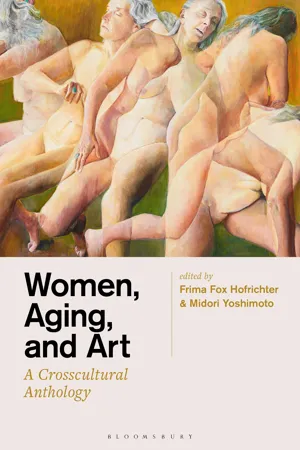
Women, Aging, and Art
A Crosscultural Anthology
- 224 pages
- English
- ePUB (mobile friendly)
- Available on iOS & Android
eBook - ePub
Women, Aging, and Art
A Crosscultural Anthology
About this book
What images come to mind with the words "women", "aging", "old", even "elderly"? Are they stereotypes? Are there any positive associations? The thirteen contributions to this edited volume explore a broad range of images of old women, ranging from medieval "old wives" to contemporary re-imaginations of shamans and witches and empowering self-portraits. Works from medieval Europe to colonialtime Polynesia, present West Africa, Japan, and the Americas, in a multiplicity of media are explored in detail. These studies of varied representations of "old women" offer fresh perspectives and an engaging dialogue about society's values and preconceptions regarding the wisdom of our elders and the "golden years" in different times and cultures.
Information
1
Introduction
Frima Fox Hofrichter and Midori Yoshimoto
She is an old woman. Sculpted in Rome about 2,000 years ago, after a Greek original, she is stooped, bent over, weary, with sagging breasts, a ribbed neck, and deeply hollowed eye sockets—all of which affirm her advanced age (Figure 1.1). She is anonymous, but we recognize that she is old.1 She was traditionally called The Old Market Woman; however, recent scholarship now indicates that she “probably represents an aged courtesan on her way to a festival of Dionysus, the god of wine,” suggested by her ivy wreath and “delicate sandals.”2 The sculpture is well known for its individualized character, sense of realism, and rarity; it stands in marked contrast to the many classical sculptures of youthful goddesses: Venus, Diana, and Andromeda. The world of art is replete with images of young women, whose smooth skin, sparkling eyes, and full head of (often long, tousled, or braided) hair suggest a “perfect” or idealized female form. But when they display the physical signs of aging, women become invisible in most art historical literature. The subject has been overlooked in art history perhaps more than in other areas of the humanities.3 But is that a true assessment?

Figure 1.1 Ancient Rome, Statue of an Old Woman, 14–68 CE. Marble. Metropolitan Museum of Art, NY. Rogers Fund 1909, inv.09.39.
The chapters in Women, Aging and Art: A Crosscultural Anthology will show that images of elderly women are present, and even common, in countless mediums across many cultures. They are represented in paintings, drawings, sculpture, performance, photography, prints, and masks. The women are recognizably old—with furrowed brows, wrinkled cheeks, crow’s feet, leathery or thin and crepey skin, deep nasolabial folds (lines from the nose to the corners of the mouth), marionette lines (from the corners of the mouth to the chin), weak and rheumy eyes, ribbed necks, bulging or exaggerated neck cords, noses and ears that have grown longer and larger, sagging breasts, and thinning gray or white hair. Their hands are brown-spotted, gnarled, and arthritic, their knuckles swollen. By today’s standards as well as in their own time, they often seem made to look deliberately ugly and unsympathetic.
These generic signs of senescence have become the distorted elements that constitute the stereotype, even the caricature, of the procuress, the hag, the crone, and the witch. Old women with these attributes became characteristic of witch iconography.4 Images of particularly withered and wrinkled women, fully nude or nearly so, with unruly hair and sagging breasts, were assumed by art historians to be witches. In fact, images of “old and ugly” women were “clearly the fanciful pictures of what a witch ought to be like.”5 Old women were associated with witchcraft because it was assumed to take nearly a lifetime to learn all the secrets of sorcery. Therefore, despite many examples in art of witches who were young, it was assumed more likely that they would be older. This is, in part, the fascination in the Middle Ages with the methods, formulae, and techniques of “old wives,” as examined by M. E. Warlick in her chapter “Alchemy’s Old Wives.” Images of witches from the early modern period became the prototype for images of witches through the centuries.6 The concept of what is witchlike is examined later in this volume in the commercial self-branding of Louise Nevel son explored in Johana Ruth Epstein’s chapter “Sculptor, Hostess, Witch: Unpacking Louise Nevelson’s Boxes.” The Japanese artist Miwa Yanagi has also tapped into tropes of Western fairy tales in her photographic series as Midori Yoshimoto discusses in her chapter, “Darkness of Girlhood and Lightness of Aging.”
Old women were thought to be especially compelling because of their considerable sexual urges. And in old age, “dried-up” women could be even more powerful, for after menopause they could not be punished by pregnancy (or the threat of it) and thus could be completely uninhibited and dangerous. Furthermore, after menopause, with their flattened chests from drooping, dried-out breasts, and facial hair growth, women’s bodies seem to transform to become more male. The Renaissance scholar Juan Luis Vives asserted that wisdom “equal to that of men” is gained by women in old age and that the wrinkles of an old woman are signs of her new, more masculine authority.7 Women lose many of their female characteristics and look increasingly like men, so that in true old age, there would appear to be only one sex: male.8 Paradoxically, then, old women were either sexualized as flagrant seducers or desexualized to such a degree that they lost connection to their own gender, a dichotomy that demonstrates their overall perceived power.
We can see this blurring of gender distinctions in Caravaggio’s (1571–1610) Judith Beheading Holofernes (Figure 1.2), of c. 1599. Within the bedroom-tent of the Assyrian general, the gender and sexuality of two of the three characters are obvious, pronounced, and even necessary to the story. But the gender of the third figure, the servant who accompanies Judith on her mission and is readying to capture the soon-to-be decapitated head, is ambiguous. The leathered skin, bulging eyes, elongated nose, large ears, multi-furrowed brow, deeply wrinkled face, thinning gray hair, and missing teeth certainly indicate a person of advanced age. But the figure’s severe, harshly taut face is the opposite of feminine. Yet we know from the biblical story that she is Judith’s maid, here desexualized. There is only one desirable woman in this story: Judith. The old maid is a foil for the youthful, soft, and smooth-skinned heroine. We see this as well in the many paintings depicting old procuresses accompanying young prostitutes. The juxtaposition underscores the difference between the women and suggests the eventual loss of youthfulness even in the most courageous, beautiful, and seductive young women.

Figure 1.2 Caravaggio, Judith Beheading Holofernes, c. 1599. Oil on canvas. Palazzo Barberini, Galleria Nazionale d’Arte Antica, Rome.SCALA / Art Resource, NY.
An old woman, then, can serve as a memento mori—a reminder of death. She is not Death herself, but she is very near it and its looming possibility; she is only one step away. This can be seen most directly and even poignantly in a detail from Hans Baldung Grien’s (c. 1484–1545) The Ages of Woman and Death (Figure 1.3), of 1541–4. There is a baby on the ground (not seen in this detail), and three full-length figures; one is a young woman standing to the left. The central figure is a gray-haired, old, thin woman, with sagging breasts set against a bony upper chest and shoulders, ringed neck, sunken cheeks, deepened eye sockets, jowly jawline, and elongated nose. She is the next step in the life span of the young woman beside whom she stands. The old woman is physically closer to the figure on the right—bony Death, who holds an hourglass, counting time. Death loops his arm firmly with the old woman’s, so he is slightly behind her, nudging her on. They are already connected; her fate is sealed. And the two look remarkably similar in their coloring and skeletal framework; certainly one can see that the next stage for the old woman is to look like Death. Death faces in one direction while the old woman looks in the opposite direction, to the fullness of life, not facing what is inevitable. She still holds on to the remnants of her womanhood as she tries to pull the cloth that is covering the private parts of the young woman, indicating that she, too, will be old with time, and that Death is not that far from her either.

Figure 1.3 Hans Baldung Grien, The Ages of Woman and Death (detail), c. 1541–4. Oil on panel. Museo del Prado, Madrid.Erich Lessing / Art Resource, NY (See Plate 1).
Old women were a welcome subject for artists in the early modern period. Painting the particular visual qualities of elderly women may have been considered a tour de force for artists, allowing them to explore the specificity of irregularities in the face, neck, and hands, with the idea that these would be a challenge. Indeed, in 1671, the artist Jan de Bisschop wrote (with disdain and in sarcastic terms) that for Dutch painters, it was “more painterly and artistically preferable [to paint] a misshapen, old, wrinkled person than a well-formed fresh and youthful one.”9 Judging by the number of extant examples of old women in Dutch genre paintings and tronies (head studies), the market for them seems to have been strong.10
Indeed, some artists executed several large paintings of old women, probably widows, alone and in their homes.11 Nicolas Maes’s (1634–93) The Old Woman Asleep (Figure 1.4), of c. 1655, is typical. The woman’s face is wrinkled, her nose long, her hands marked by veins visible through the thinning skin. Her glasses are still in her right hand; her head is resting on her left fist.12 It is clear from all the materials she has made available for herself (her lacemaking, a Bible open to the Book of Amos, another book on her lap) that she had planned to do much that day.13 But she was clearly too ambitious. Maybe it was what she could have done when she was younger but can no longer complete now—without a nap. She has begun her reading, however. A page of the volume on her lap (a book of sermons?) has a corner turned down to keep her place. Her Bible study refers to the piety of old widows.14 Although sleep is associated with laziness, that may not be the point here, as attested by the multiplicity of tasks she has set up for herself. More than a glimpse into the life of an elderly woman living alone, this painting, with its softened lighting, may sympathetically suggest the chores she no longer has the force to accomplish.

Figure 1.4 Nicolaes Maes, Old Woman Asleep, c. 1655. Oil on canvas. Musées Royaux des Beaux-Arts, Brussels.Photo: J. Geleyns-Art Photograp...
Table of contents
- Cover
- Half-Title
- Dedication
- Title
- Contents
- List of Illustrations
- Preface
- Acknowledgments
- 1 Introduction
- 2 Alchemy’s Old Wives
- 3 Silenced, Sidelined, and Even Undressed: Old Women in Seventeenth-Century Religious Art
- 4 Anger, Envy, and Aging: Early Modern Transgressive Old Women
- 5 Frans Hals’s Portrait of an Older Judith Leyster
- 6 Old Maids: Images of Elderly Servants in Early Modern Europe
- 7 Portraits of Power: Masks of Northwest Coast Matriarchs in the Nineteenth Century
- 8 Paetini and Vaekehu: Change and Aging in the Portraits of Marquesan Matriarchs
- 9 Old Woman/New Vision: Lucia Moholy’s Photographs of Clara Zetkin
- 10 Sculptor, Hostess, Witch: Louise Nevelson’s Boxes
- 11 Museums and the Missing Women of Sande
- 12 Aging and Feminist Art: Joan Semmel’s Visible Bodies
- 13 Darkness of Girlhood and Lightness of Aging: Miwa Yanagi’s Transcendental Old Women
- List of Contributors
- Index
- Plates
- Copyright
Trusted by 375,005 students
Access to over 1.5 million titles for a fair monthly price.
Study more efficiently using our study tools.
Frequently asked questions
Yes, you can cancel anytime from the Subscription tab in your account settings on the Perlego website. Your subscription will stay active until the end of your current billing period. Learn how to cancel your subscription
No, books cannot be downloaded as external files, such as PDFs, for use outside of Perlego. However, you can download books within the Perlego app for offline reading on mobile or tablet. Learn how to download books offline
Perlego offers two plans: Essential and Complete
- Essential is ideal for learners and professionals who enjoy exploring a wide range of subjects. Access the Essential Library with 800,000+ trusted titles and best-sellers across business, personal growth, and the humanities. Includes unlimited reading time and Standard Read Aloud voice.
- Complete: Perfect for advanced learners and researchers needing full, unrestricted access. Unlock 1.5M+ books across hundreds of subjects, including academic and specialized titles. The Complete Plan also includes advanced features like Premium Read Aloud and Research Assistant.
We are an online textbook subscription service, where you can get access to an entire online library for less than the price of a single book per month. With over 1.5 million books across 990+ topics, we’ve got you covered! Learn about our mission
Look out for the read-aloud symbol on your next book to see if you can listen to it. The read-aloud tool reads text aloud for you, highlighting the text as it is being read. You can pause it, speed it up and slow it down. Learn more about Read Aloud
Yes! You can use the Perlego app on both iOS and Android devices to read anytime, anywhere — even offline. Perfect for commutes or when you’re on the go.
Please note we cannot support devices running on iOS 13 and Android 7 or earlier. Learn more about using the app
Please note we cannot support devices running on iOS 13 and Android 7 or earlier. Learn more about using the app
Yes, you can access Women, Aging, and Art by Frima Fox Hofrichter, Midori Yoshimoto, Frima Fox Hofrichter,Midori Yoshimoto in PDF and/or ePUB format, as well as other popular books in Art & Art General. We have over 1.5 million books available in our catalogue for you to explore.