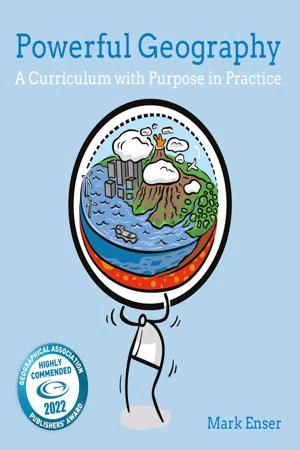
- 192 pages
- English
- ePUB (mobile friendly)
- Available on iOS & Android
eBook - ePub
About this book
In recent years the emphasis has shifted away from a focus on pedagogy (the
how of teaching) and towards curriculum (the what of teaching). Ofsted's revised inspection framework reflects this shift, and their plans to -deep dive- into subject areas - meaning that teachers and department heads now need a much greater understanding of curricular structures - leave many educators having to think about their subject in new ways.
Luckily for geography teachers, however, bestselling author Mark Enser provides plenty of insightful, subject-specific guidance in this all-encompassing book.
Mark explores both the purpose of the geography curriculum and its various applications in practice. He details how teachers can take their students' learning beyond the acquisition of knowledge to transform how they see the world. He also tackles the changing nature of school geography, shares a variety of case studies, and offers his take on how best to facilitate geographical enquiry and fieldwork.
The first part of the book considers the issue of purpose by looking at the role of the school in society and then shows the place that geography occupies within it. It also considers the history of the subject so as to help geography teachers better understand where they stand today, and concludes by discussing how the concepts of powerful knowledge and GeoCapabilities can help them find their way again.
The second part is a practical guide which illustrates how to put this theory of curriculum purpose into practice. It explores the steps which must be taken to create a powerful geography curriculum by deciding on content and places to be studied, putting the components into a sequence and then using all this to do geography. It will also discuss the extent to which teachers need to consider the future and respond to the concerns of the wider world when planning the curriculum.
Suitable for department heads and classroom teachers of geography in secondary schools and subject leads in primary schools.
Powerful Geography was Highly Commended in the Geographical Association Awards 2022.
Information
Topic
EducationSubtopic
Education GeneralPart I
Purpose
Chapter 1
School – what is it good for?
Different possible purposes
One of the problems we have in shaping a curriculum in our schools is that there is scant agreement over what schools should be trying to achieve. This leads to various voices all trying to have their say and insisting that schools should fulfil a function that they deem vital. For example:

Even if we were to strip all these expectations away and argue that the primary purpose of a school is, as discussed in the introduction, to be a place where pupils are taught, we are still left with the question about what they should be taught. As Gert Biesta says:

Perhaps the briefest way to put it is to say that the point of education is not that students learn […] In contrast I wish to suggest that the point of education is that students learn something, that they learn it for a reason, and that they learn it from someone.1
He goes on to argue that schools fulfil three functions within society:
1 Qualification – in which pupils learn to do something through the acquisition of knowledge and skills.
2 Socialisation – which here refers to the initiation into different traditions or ways of doing and being.
3 Subjectification – in which pupils become the subjects of initiatives and actions rather than the object of the initiatives and actions of others.
In other words, schools are places in which pupils are taught the knowledge and skills that allow them to do what they could not do before. They are taught how to think in new ways, apply knowledge in different ways (mathematically, geographically, historically, etc.) and develop the capabilities to use this knowledge as they see fit in the future.
This purpose of schooling seems fairly straightforward and uncontentious but, as this chapter will show, nothing could be further from the truth. The purpose and methods of schooling have been debated for centuries and have left a legacy of confusion and a tangle of competing ideologies that need to be cleared away if we are ever to create our garden of peace – with a clear purpose at its heart – in our schools.
Uncertain foundations
Education – specifically the purpose thereof – was on shaky ground from the very start due to the influence of one of the founders of Western philosophy. Education, according to Socrates, should be concerned with teaching the young to be moral creatures who can differentiate between truth and lies, good and evil, right and wrong, etc. Education was about the examined life – people must be aware of the reasons why they make the decisions they make. This was, in part, because education was seen as something that was only necessary for the ruling classes, and Socrates, along with Plato, was concerned with how to create just societies by ensuring these ruling classes made just decisions.
Perhaps one of Socrates’ biggest influences on education today is the idea that the role of the teacher isn’t really to teach at all, but is to draw out of the pupil that which is already inside of them through questioning that would lead to some sort of revelation. This is the immanence, also termed a maieutic process, discussed in the introduction. It is an idea of education that may make sense if you are largely concerned with the ethics of human actions, starting by exploring the fundamental principle of fairness and then questioning to help the pupil realise how this might apply to complex moral problems, but as a principle it is hard to apply if you want to teach your pupil s...
Table of contents
- Praise
- Title Page
- Acknowledgements
- Contents
- Introduction
- Part I: Purpose
- Part II: Practice
- Conclusion
- Appendix
- Bibliography
- Copyright
Trusted by 375,005 students
Access to over 1.5 million titles for a fair monthly price.
Study more efficiently using our study tools.
Frequently asked questions
Yes, you can cancel anytime from the Subscription tab in your account settings on the Perlego website. Your subscription will stay active until the end of your current billing period. Learn how to cancel your subscription
No, books cannot be downloaded as external files, such as PDFs, for use outside of Perlego. However, you can download books within the Perlego app for offline reading on mobile or tablet. Learn how to download books offline
Perlego offers two plans: Essential and Complete
- Essential is ideal for learners and professionals who enjoy exploring a wide range of subjects. Access the Essential Library with 800,000+ trusted titles and best-sellers across business, personal growth, and the humanities. Includes unlimited reading time and Standard Read Aloud voice.
- Complete: Perfect for advanced learners and researchers needing full, unrestricted access. Unlock 1.5M+ books across hundreds of subjects, including academic and specialized titles. The Complete Plan also includes advanced features like Premium Read Aloud and Research Assistant.
We are an online textbook subscription service, where you can get access to an entire online library for less than the price of a single book per month. With over 1.5 million books across 990+ topics, we’ve got you covered! Learn about our mission
Look out for the read-aloud symbol on your next book to see if you can listen to it. The read-aloud tool reads text aloud for you, highlighting the text as it is being read. You can pause it, speed it up and slow it down. Learn more about Read Aloud
Yes! You can use the Perlego app on both iOS and Android devices to read anytime, anywhere — even offline. Perfect for commutes or when you’re on the go.
Please note we cannot support devices running on iOS 13 and Android 7 or earlier. Learn more about using the app
Please note we cannot support devices running on iOS 13 and Android 7 or earlier. Learn more about using the app
Yes, you can access Powerful Geography by Mark Enser in PDF and/or ePUB format, as well as other popular books in Education & Education General. We have over 1.5 million books available in our catalogue for you to explore.