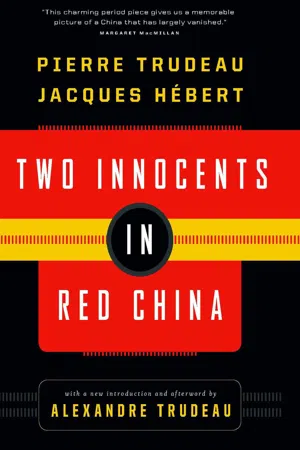
In the spirit of his father, Alexandre Trudeau revisits China to put a ground-breaking journey into a fresh, contemporary context. In 1960, Pierre Trudeau and Jacques Hébert, a labour lawyer and a journalist from Montréal, travelled to China in the midst of the Great Leap Forward. In 1968, when Two Innocents in Red China, Trudeau and Hébert’s sardonic look at a third world country’s first steps into the rest world, was released in English, Trudeau had become prime minister of Canada. "It seemed to us imperative that the citizens of our democracy should know more about China, ” Trudeau wrote in the foreword. Four decades later, China’s emergence as an economic and military heavyweight beckoned Trudeau’s journalist son Alexandre to retrace his father’s footsteps and add additional material to the book. The result is a thought-provoking new perspective on the Canadian classic that helped open China to the world.
- 224 pages
- English
- ePUB (mobile friendly)
- Available on iOS & Android
eBook - ePub
Two Innocents in Red China
About this book
Information
1
IN WHICH THE
EXPEDITION NEARLY SINKS
IN THE THAMES
EXPEDITION NEARLY SINKS
IN THE THAMES
A kingdom can have only one crown;
if I do not dethrone my rival, he will dethrone me.
POPE INNOCENT III
if I do not dethrone my rival, he will dethrone me.
POPE INNOCENT III
· · · LONDON. TUESDAY, 13 SEPTEMBER 1960 · · ·
Montreal to London by jet. A dull passage: we didn’t even get to use the life-rafts. And Hebért wasted five dollars on a flight-insurance premium.
Why London? Because no country in all the Americas recognizes Communist China, except (just lately) Cuba. A letter from Mr Chu Tu-nan, president of the Chinese People’s Association for Cultural Relations with Foreign Countries, had notified us that our Chinese visas would be granted to us in London.
About five o’clock in the afternoon, then, we present ourselves at the office of the Chinese chargé d'faffaires for this little formality. A young Chinese, all smiles and unction, admits us to the old house at 49 Portland Place. “Mr Lin is waiting for you,” he says.
We, as it turns out, wait for Mr Lin—in a vast drawing-room that has known better days. Old furniture upholstered in green velvet, a large worn carpet: they haven’t had occasion to throw a party hereabouts since the good old days of Chiang Kai-shek.
Mr Lin is late. The furniture is mildewing, the carpet is fraying— along with our patience. “There’s probably a plane leaving for Peking this very evening…”
We are exchanging criticisms on the immense Mao Tse-tung in technicolor enthroned above the fireplace, when a slender personage wearing a smile too big for him enters discreetly, on tiptoe: Lin himself!
Delighted to see us, of course. He runs from one to another, distributing friendly words, Chinese cigarettes, matches. We exchange commonplaces with the greatest possible conviction. “You have been to China before?”
“No,” says Hebért. “Hong Kong, Macao—they’re not really China.”
But Trudeau went to China in 1949.
“Really?” says Mr Lin with lively interest.
“From Hong Kong I slipped into the territory still held by the Kuomintang. It was in a state of anarchy. I got myself as far as Shanghai while the Red Army was on the other side of the Yangtze. I would have liked to stay and watch the capture of the city, but a truce was proclaimed. It was not to last long, however; soon after I left, the Red Army entered Shanghai.”
“How amazing,” says Mr Lin, delighted. “I was in the Red Army at that time—in the very contingent that took Shanghai.”
“We might have met in 1949!”
The ice is broken. Mr Lin sends for tea, which he pours himself, remarking that it’s certainly a small world. The excellent jasmine tea leads to confidences. We learn that Mr Lin has been in London for four years, that he studied English in Amsterdam—a lot of instructive facts like that. Not until the third cup do we get to the point of this friendly tea-party: the visas, and the tickets for China.
Mr Lin hands out the visa application forms. The usual questions, plus two that we have also been asked in Spain, Argentina, and a few Arab countries: “Religion? Political party?” To the second question we long to answer “Social Credit,” just to see the reaction in Peking.
Mr Lin takes the forms and the passports. “I’ll be right back. Time to stamp the visas.”
On the table, near the teapot, are tickets from London to Peking. Bits of paper that will allow us to cross half the world and see China at last.
Mr Lin is taking his time in coming back. Let’s just glance at these tickets: “Departure 14 September, 0830 hours.” Hell! that’s tomorrow morning.
What is Mr Lin doing? These Chinese! Still Orientals after all, never in a hurry, as we have always been taught.
Mao Tse-tung smiles down from his splendid gilt frame.
Mr Lin at last! He is smiling too. He has the passports. His smile seems rather forced.
“There is a small difficulty for three of you,” he says carefully, with the air of announcing to a group of invalids that they have small and unimportant cancers.
Mr Lin takes his courage in both hands. “Look. In Miss Legendre’s and Mr Hébert’s passports there is a note from the Canadian Department of External Affairs that—that—”
He says no more, but we understand. In recent years, when the Department issues a passport, it sticks a leaflet on the last page full of careful advice to Canadian citizens travelling to Communist countries. In brief, these travellers are required, before departure, to notify the Canadian government of their plans and to indicate the probable length and the purpose of their journey—all of which we had done. Then, on arrival in a Communist country, they are required to report to the nearest Canadian or United Kingdom diplomatic or consular officer.
Why not? However, that’s not what is bothering Mr Lin. The thing is that the Department of External Affairs of Canada has committed a terrible gaffe in the eyes of a Chinese official by using the term “Mainland China.” The implication is that there is another China, an island one, that we call Formosa and the Chinese call Taiwan.
Micheline Legendre and Jacques Hébert suggest a way out: that Mr Lin should simply tear the questionable leaflet out of the passport, especially as it is held only by a mere spot of gum. Mr Lin’s smile brightens: he must have foreseen this step, since the Chinese visas are already in the passports—except Trudeau’s. “The difficulty is more serious in Mr Trudeau’s case,” says Mr Lin, no longer smiling. “A little more tea?”
No, thank you. Three cups are quite enough.
There is drama in the air. “A more serious difficulty?” inquires Trudeau (who already realizes the trouble).
“Yes. There is a Taiwan visa in your passport.”
“That’s true, I went to Taiwan two years ago.”
“Hmm. What did you go to Taiwan to do?”
“I was travelling in that part of the world. Actually, I wanted to go to China, but your government hadn’t given me permission. So I visited Japan, the Philippines—and Taiwan as it happened to be on my way. I had no sympathy for Chiang Kai-shek, but that was no reason for avoiding Taiwan.”
“I regret to tell you that the policy of my government is explicit on this point: we do not give a visa to anyone who has been to Taiwan.”
“But your government invited me to visit China.”
“Did my government know that you had been to Taiwan?”
“I don’t suppose so. But what does it matter? I could have got a new passport before I left, and you wouldn’t have known anything about my earlier travels.”
“True. But I do know now, and the regulation—”
“I could explain the matter to the Canadian High Commissioner’s office here and get a completely new passport—possibly even today.”
“I am heartbroken,” says Mr Lin, really looking heartbroken. “But my duty requires me to seek advice from Peking.”
We parley for over an hour, each of us invoking new arguments to convince Mr Lin that Trudeau is neither an agent of American imperialism nor an admirer of Chiang Kai-shek.
“Terribly sorry,” repeats Mr Lin, “but I have to ask for authority from Peking before I give you a visa.”
There is no more point in insisting.
“In my telegram, however, I shall take your arguments into account. I will even add a word of recommendation.”
“How soon will you have an answer?”
“Let us have at least two or three days,” says Mr Lin, glancing at the five tickets spread out on the table like a mandarin’s fan. The icy w...
Table of contents
- COVER PAGE
- TITLE PAGE
- COPYRIGHT PAGE
- CONTENTS
- INTRODUCTION
- A NOTE ON THE FIRST ENGLISH EDITION
- TRANSLATOR’S NOTE
- PREAMBLE
- 1. IN WHICH THE EXPEDITION NEARLY SINKS IN THE THAMES
- 2. LONDON TO PEKING
- 3. FROM THE PEOPLE ’S PALACE TO THE PALACE OF THE EMPERORS
- 4. A VISIT TO PEKING PRISON
- 5. THE CHINESE MINORITIES
- 6. THE NORTH-EAST, PRIDE OF NEW CHINA
- 7. ONE FACTORY AFTER ANOTHER
- 8. HOW TO MAKE DOCTORS AND STEEL
- 9. ALL THE CHINESE WORK
- 10. A FEW THOUSAND VISITORS
- 11. INDUSTRY AND CULTURE IN THE SERVICE OF THE STATE
- 12. SHANGHAI REVISITED
- 13. A FACTORY, A COMMUNE, AND A CAPITALIST
- 14. FROM THE EMPTY CATHEDRAL TO THE CHILDREN’S PALACE
- 15. AT MARXISM SCHOOL
- 16. THE PEACE OF HANGCHOW
- 17. CANTON
- 18. THE SACRISTAN
- 19. SIGHTSEEING IN THE LAST FEW DAYS
- EPILOGUE
- AFTERWORD
Trusted by 375,005 students
Access to over 1.5 million titles for a fair monthly price.
Study more efficiently using our study tools.
Frequently asked questions
Yes, you can cancel anytime from the Subscription tab in your account settings on the Perlego website. Your subscription will stay active until the end of your current billing period. Learn how to cancel your subscription
No, books cannot be downloaded as external files, such as PDFs, for use outside of Perlego. However, you can download books within the Perlego app for offline reading on mobile or tablet. Learn how to download books offline
Perlego offers two plans: Essential and Complete
- Essential is ideal for learners and professionals who enjoy exploring a wide range of subjects. Access the Essential Library with 800,000+ trusted titles and best-sellers across business, personal growth, and the humanities. Includes unlimited reading time and Standard Read Aloud voice.
- Complete: Perfect for advanced learners and researchers needing full, unrestricted access. Unlock 1.5M+ books across hundreds of subjects, including academic and specialized titles. The Complete Plan also includes advanced features like Premium Read Aloud and Research Assistant.
We are an online textbook subscription service, where you can get access to an entire online library for less than the price of a single book per month. With over 1.5 million books across 990+ topics, we’ve got you covered! Learn about our mission
Look out for the read-aloud symbol on your next book to see if you can listen to it. The read-aloud tool reads text aloud for you, highlighting the text as it is being read. You can pause it, speed it up and slow it down. Learn more about Read Aloud
Yes! You can use the Perlego app on both iOS and Android devices to read anytime, anywhere — even offline. Perfect for commutes or when you’re on the go.
Please note we cannot support devices running on iOS 13 and Android 7 or earlier. Learn more about using the app
Please note we cannot support devices running on iOS 13 and Android 7 or earlier. Learn more about using the app
Yes, you can access Two Innocents in Red China by Pierre Elliot Trudeau,Jacques Hebert in PDF and/or ePUB format, as well as other popular books in Politics & International Relations & International Relations. We have over 1.5 million books available in our catalogue for you to explore.