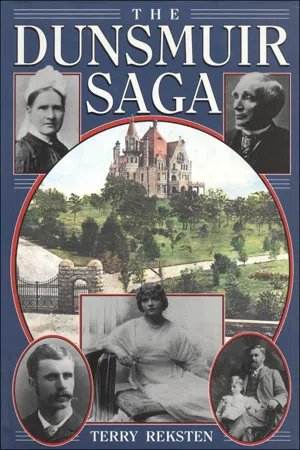
The Dunsmuir Saga brings to life three generations of the legendary Dunsmuir family of Vancouver Island. Robert Dunsmuir -- canny, acquisitive and imaginative -- became the richest man in British Columbia; his sons struggled to consolidate the family fortune; his grandchildren spent it. Award-winning author Terry Reksten brings the members of the Dunsmuir family and their colourful saga to life with her lively writing, vivid anecdotes and careful research. A selection of 50 historical photographs depicts the Dunsmuirs and their grand style of life.
- 292 pages
- English
- ePUB (mobile friendly)
- Available on iOS & Android
eBook - ePub
The Dunsmuir Saga
About this book
Information
PART ONE
Robert Dunsmuir

Robert Dunsmuir. B.C. ARCHIVES AND RECORDS SERVICE/HP64971
One

Diminutive and fine-boned, a quick-to-anger bantam cock of a man, Robert Dunsmuir possessed a relentless capacity for hard work, an eye firmly fixed on the main chance and several very good reasons for leaving Scotland—just the qualities that boded well for success in a new country. He would parlay an eleventh-hour opportunity to sail for the coalfields of Vancouver Island into a fortune.
He would rise from the position of an indentured miner to become “one of Canada’s millionaires,” the richest and most powerful man in British Columbia. A coal baron and railway tycoon, he would be seen by some as a capitalist icon, a paragon whose success was due to pluck and plod, an altruist who chose to risk his hard-earned dollars to increase the wealth of the province rather than to line his own pockets. To others he was “King Grab,” a rapacious robber baron whose fortune was based on the niggardly wages he paid his employees and on the open-handed assistance he received from the government he was said to “carry in his breeches pocket.” A man around whom controversy swirled, his career would strike chords that are still reverberating through the province more than a century later.
Later it would be suggested that Dunsmuir’s was a true rags-to-riches story. But that was not quite the case. The first child of twenty-year-old James Dunsmuir and his wife, Elizabeth, Robert Dunsmuir was born in Scotland in 1825 into a family that had already moved out of the working class and was poised on the brink of even greater prosperity.
In 1816 his grandfather, Robert Dunsmuir, “a practical miner of good business habits,” acquired a coal lease near the village of Old Hurlford a few miles from the Ayrshire market town of Kilmarnock. The valleys of Riccarton and Kilmarnock parishes were dotted with small coal mines, each serving only those customers who were a mile or two from the pit. Where their potential markets overlapped, coalmasters competed for sales by dropping their prices. Dunsmuir moved to correct that unhappy state of affairs by buying out his nearest competitor. And having won control of the local trade, he immediately raised his prices. Next, he turned his attention to Kilmarnock. In 1820 he leased land on the town’s main street and opened a coalyard. And as Kilmarnock grew and the number of householders increased and new coal-hungry industries were introduced, Dunsmuir’s coal was waiting, stockpiled in his Portland Street depot, ready to meet the demand.
Dunsmuir, his neighbours observed, was “gradually becoming rich.” By the summer of 1832, he was fifty-three years old, a man of property and prospects. He had moved his family into a fine new house, and he could note with pride that the gold watch nestled in his pocket was worth £25. The first man to demonstrate that mining Hurlford coal could be “a very lucrative speculation,” he had acquired additional coal leases and trained his two sons to manage his mines.
During the 1840s the railway would arrive. Hurlford coal would come within reach of the voracious Glasgow market, and the railway would encourage the exploitation of local iron deposits and lead to the establishment of flourishing ironworks with furnaces fuelled by Hurlford coal. The Dunsmuir family was well positioned to make the most of the great changes that were about to reshape the area. But then, in August 1832, disaster struck.
No letters exist; no diaries record the events of that summer. Providing the only witness are two tombstones standing side by side in an old churchyard near Hurlford. One belongs to young Robert’s parents, James Dunsmuir and Elizabeth Hamilton; the other to his grandparents, Robert Dunsmuir and Jean Kirkland.
The first to die, on 13 August, was Robert’s mother, Elizabeth. Five days later his father, James, died. His grandmother, Jean Kirkland Dunsmuir, died on 21 August. And the deaths did not end there. By the end of the month, two of his sisters had joined their parents in the grave. Of James and Elizabeth’s family, only seven-year-old Robert and his four-year-old sister, Jean, survived.
That five members of one family succumbed within days of each other suggests a local epidemic, and perhaps it was cholera, the “dreadful scourge” of Kilmarnock, Hurlford and other towns and villages of Riccarton parish. Or perhaps they died as the result of typhoid, an outbreak stimulated by August heat and unsanitary drains. Whatever the cause, whether it was typhoid or cholera or whether the deaths were coincidental, the effect on the Dunsmuir family, and particularly on the orphaned children, must have been devastating. And three years later their lives underwent another upheaval when their grandfather died in his fifty-seventh year.
He died a relatively wealthy man. In addition to his coal leases and the property he held in Hurlford and Kilmarnock, he left an estate of £1,294, of which a third had been set aside for the care and education of his orphaned grandchildren. Jean remained in Hurlford with her maternal grandmother. Robert was sent away to school—first to Kilmarnock Academy, the rather grandly named parish school that stood on Portland Street just a few steps away from his grandfather’s coal depot, and then to Paisley, where the Mercantile and Mechanical School provided the technical knowledge helpful to boys who hoped to become coalmasters. His education complete, he was sent into the mines to learn the practical aspects of the trade under the tutelage of Boyd Gilmour, a young coalmaster who, a few years earlier, had married Robert’s aunt, Jean Dunsmuir.
Robert Dunsmuir seldom spoke about his life in Scotland. Biographical sketches published during his lifetime dismiss his Ayrshire years with a single sentence. And for good reason. A whiff of scandal clings to those early Scottish years. Even after he had risen to a position of power and prominence, vague rumours would continue to suggest that he had left Scotland to escape something shameful in his past. And those whispered stories contained more than a grain of truth.
On 11 September 1847, shortly after his twenty-second birthday, Robert Dunsmuir married nineteen-year-old Joan White, the daughter of a Kilmarnock spademaker. She was a suitable match, a pretty girl with hazel eyes and light brown hair, whose square-jawed, thin-lipped little face suggested a character of iron will and steely determination. But the Dunsmuirs, it seems, were a rather lusty lot. Two months earlier his sister, Jean, had been called before the church elders at the Riccarton Kirk Session to plead guilty to “fornication” with one Hugh Ferguson, who had admitted to having fathered her child but who had apparently shown no inclination to marry her. Now, as Joan White stood before the minister to be married, she was hugely pregnant with Robert’s child. She was delivered of a daughter on 19 September—only eight days after they exchanged their vows.
They named the baby Elizabeth Hamilton after Robert’s mother, but they were banned from the kirk—forbidden to attend services and barred from having their child baptized—until after they had confessed to their sin and performed appropriate penance. On 10 February 1848 they appeared at the Session of the Kilmarnock Laigh Kirk and admitted to “having been guilty of antenuptial fornication together.” And only after being rebuked for their sin were they “absolved of the scandal thereof” and readmitted to the kirk.
Almost three years had passed, and a second daughter had been born, when chance, in the form of Boyd Gilmour’s desperation, presented the Dunsmuirs with the opportunity to escape from any lingering scandal.
On 5 December 1850 Boyd Gilmour heard a piece of news that convinced him he had just made the worst decision of his life. A few days earlier he had signed a contract with the Hudson’s Bay Company, agreeing to take his wife, Jean, and their five children on a 10,000-mile voyage to the end of the earth—to Vancouver’s Island off the northwest coast of North America—where he would work the Company’s coal mines for three years before returning home to Scotland. Now he learned that the Muir party, a group of colliers who two years earlier had signed a contract similar to his own, had met with some kind of calamity. With shaky spelling and an unsteady hand, he confided his misgivings in a letter to David Landale, the Hudson’s Bay Company’s recruitment officer.
“We have recevied a deal of bad news from Vancouvers,” Gilmour wrote. “Muirs party are all left the Island … The present party are very much dishartened. The[y] think it would be much better to lay in jail in Scotland than lay in irons in Vancouvers … I do not see how we can proceed in the face of rebelon.”
Landale acted promptly. “I disbelieve every word of the story and am surprised that your minds could take in such a monstrous absurdity,” he scolded. The Hudson’s Bay Company was the “most respectable Company in the kingdom,” he wrote. Surely Gilmour should find that guarantee enough that he would be treated fairly.
The most respectable Company in the kingdom has been founded in England in 1670 as the Company of Adventurers Trading into Hudson’s Bay. By the beginning of the nineteenth century, it had expanded its field of operations to the Pacific coast, and while its most significant profits continued to come from the fur trade, the Company had begun to dabble in other commodities. On Vancouver Island the most promising source of profit was coal.
Coal had been discovered on a beach on the island’s northeast coast, and a brisk trade had developed with Indians encamped at the site who were selling the coal that they gathered on the surface for two shillings a ton. James Douglas, the HBC’s principal officer in the west, was convinced that they were harvesting the trailing edge of rich underground deposits. Encouraged by Douglas’s reports, the HBC embarked on the construction of Fort Rupert and recruited experienced Scottish colliers to work the mine. John Muir, an Ayrshire collier and the head of “a good, kind, patriarchal Scotch family,” had contracted his services together with those of his four sons and two other young colliers.
Problems had arisen almost immediately. Fort Rupert was not what the colliers had been led to expect. They found the proximity of a large Indian village decidedly unsettling. “The Indians has come down and threatened to shoot us,” a miner confided to his diary.
Adding to their discontent was the fact that they were earning less money than they had been promised. Their wages were fixed at £50 a year, but they would receive a bonus of two shillings and sixpence for every ton of coal they raised above the 30 tons per month covered by their contracts. They had expected to find a working colliery, or at least a workable seam. At Fort Rupert, they found neither. And until there was coal to mine, there was no hope of earning their bonus. They began by sinking a pit near the palisade. After discovering that it persistently filled with water, they tried a second pit almost a mile from the fort. They reached a depth of 41 feet, and while they had passed through five seams of coal, the largest was only four and a half inches thick.
“We came out here to work for coal not to look for it and do all manner of work,” the colliers complained. And they decided to take their grievances to Capt. William McNeill, the HBC officer in charge of Fort Rupert. McNeill had commanded a trader sailing out of Boston before he joined the Company. A square, fierce-faced man, accustomed to viewing problems of discipline from the perspective of a ship’s bridge, McNeill regarded the miners’ threat to strike as mutiny. He flew into a rage and, snatching up his pistol, levelled it at the men. “You’ll return to work or I’ll shoot you like crows,” he roared. Taken by surprise, they returned to work, but a few weeks later when they were told to dig a drainage ditch, they refused. They were experienced miners, they said, and such a menial task was beneath their dignity. McNeill responded by throwing them into the fort’s bastion where they remained for over a week.
By July 1850, they had had enough. All the colliers, with the exception of the oversman, John Muir, seized an opportunity to desert. Borrowing an Indian canoe, they slipped away from the fort, and after having been picked up by an American ship outbound from Fort Rupert, they made their way to San Francisco.
In Scotland six months later, when Boyd Gilmour heard an account of the Fort Rupert affair, he had not known which way to turn. Time was fleeting; his ship, the Pekin, was due to sail within the week; his decision could not be delayed. By 7 December he had made up his mind. Better to court disaster on Vancouver Island than be seen as timid and indecisive by the influential David Landale.
“I am fully determined to go through the undertaken or die in the attempt,” he informed Landale. But he could not say the same for David Miller, John Holland and Hugh Goldie, all of whom had “fully fixed on not going.”
“What can I do?” Gilmour scrawled. “You are not here … I do not know properly how to act … more hands must be engaged … the undertaking can’t go on with so few as we are.”
Robert Dunsmuir was given only twenty-four hours to decided whether or not he would join Gilmour’s party. But perhaps that was more than enough. His aunt, Jean, was the only member of his family with whom he had retained close ties. And he had served his apprenticeship in the mines under her husband. Between family loyalty and the opportunity to make a fresh start, the hurried decision forced on Robert and Joan Dunsmuir may have been an easy one.
By 8 December, Gilmour was relieved to be able to report that he had succeeded in finding replacements for his party. Arthur Queegly had agreed to take Miller’s place; Archibald French had decided to join his brother, Adam, the only member of the original party who remained determined to proceed. And Hugh Goldie’s place would be taken by Robert Dunsmuir.
It took a particular kind of grit for Joan Dunsmuir and Jean Gilmour to face the voyage that lay ahead. Between them they had seven children; Jean’s five, ranging in age from fourteen to two; and Joan’s two little girls, Elizabeth and Agnes. Hard enough to contemplate months and months of caring for children in cramped shipboard quarters. But worse, both women were pregnant—and their ship, the Pekin, was expected to be at sea for six months.
The Pekin sailed on 19 December. By March, the passengers were on short rations; by May, most of the children were suffering from scurvy. To Joan and Jean, both by now heavily pregnant, it must have seemed as if the voyage would never end. And then, at the mouth of the Columbia River, with their destination almost in sight, the Pekings’s captain ran his ship “hard and fast on a sandbar.” The delay was too much for Jean. On 20 June, as the Pekin edged its way up the river, she gave birth to a son, and so that neither of them would ever forget the circumstances of his birth, she christened the boy Allan Columbia Gilmour. Finally, on the evening of 29 June, 191 days out from London, their ship tied up at Fort Vancouver’s wharf.
Compared to other Hudson’s Bay Company outposts on the west coast, Fort Vancouver was a veritable metropolis. Located on the Columbia’s wide north bank, the fort was the largest the Company built in the west. Wooden pickets, 15 feet high, enclosed an area of five and a half acres. At one corner stood a three-storey bastion armed with a 9-pound cannon. Arranged in a rectangle within the palisade were twenty squared-log buildings. In 1847 Fort Victoria on the southern tip of Vancouver Island had replaced Fort Vancouver as the Company’s western headquarters, and since then the buildings within the fort had been allowed to deteriorate. Fort Vancouver was a “dilapidated, dirty place,” one visitor exclaimed.
The crewmen were certainly unimpressed by its charms. Grumbling about short provisions and low wages, sickened with scurvy and boiling with gold fever, most of the Pekings’s company, together with collier Arthur Queegly, deserted their posts and headed for the goldfields of California.
The Dunsmuirs, the Gilmours and the Frenches were moved into the bachelors’ quarters, seventeen one-storey cottages joined under a single roof and built to house Company clerks and other junior officers. The door of each cottage op...
Table of contents
- Cover Page
- Title Page
- Copyright Page
- Contents
- Preface
- Part One: Robert Dunsmuir
- Part Two: James Dunsmuir
- Notes
- Sources
- Index
Trusted by 375,005 students
Access to over 1.5 million titles for a fair monthly price.
Study more efficiently using our study tools.
Frequently asked questions
Yes, you can cancel anytime from the Subscription tab in your account settings on the Perlego website. Your subscription will stay active until the end of your current billing period. Learn how to cancel your subscription
No, books cannot be downloaded as external files, such as PDFs, for use outside of Perlego. However, you can download books within the Perlego app for offline reading on mobile or tablet. Learn how to download books offline
Perlego offers two plans: Essential and Complete
- Essential is ideal for learners and professionals who enjoy exploring a wide range of subjects. Access the Essential Library with 800,000+ trusted titles and best-sellers across business, personal growth, and the humanities. Includes unlimited reading time and Standard Read Aloud voice.
- Complete: Perfect for advanced learners and researchers needing full, unrestricted access. Unlock 1.5M+ books across hundreds of subjects, including academic and specialized titles. The Complete Plan also includes advanced features like Premium Read Aloud and Research Assistant.
We are an online textbook subscription service, where you can get access to an entire online library for less than the price of a single book per month. With over 1.5 million books across 990+ topics, we’ve got you covered! Learn about our mission
Look out for the read-aloud symbol on your next book to see if you can listen to it. The read-aloud tool reads text aloud for you, highlighting the text as it is being read. You can pause it, speed it up and slow it down. Learn more about Read Aloud
Yes! You can use the Perlego app on both iOS and Android devices to read anytime, anywhere — even offline. Perfect for commutes or when you’re on the go.
Please note we cannot support devices running on iOS 13 and Android 7 or earlier. Learn more about using the app
Please note we cannot support devices running on iOS 13 and Android 7 or earlier. Learn more about using the app
Yes, you can access The Dunsmuir Saga by Terry Reksten in PDF and/or ePUB format, as well as other popular books in History & North American History. We have over 1.5 million books available in our catalogue for you to explore.