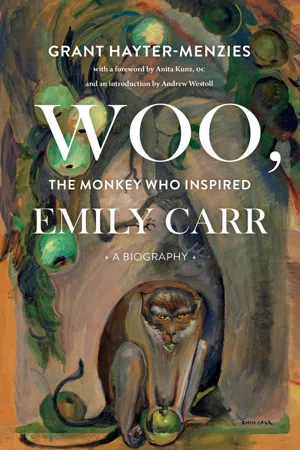
Although Emily Carr is now considered a Canadian legend, the most enduring image is that of her pushing a beat-up old pram into downtown Victoria, loaded with dogs, cats, birds—and a monkey. Woo, a Javanese macaque whom Carr adopted in1923, has become inextricably linked with Carr in the popular imagination. But more than that, in her short lifetime Woo became equally connected to Carr's lifeandart.
Born to a strictly religious family, Carr was never able to reconcile her wild and passionate nature with the stifling mores of the well-to-do Victorian society in which she was raised. Over the years, she increasingly turned to the company of animals to find the love and trust missing from her human relationships. Across the world in an Indonesian jungle lagoon, Woo (like Carr) was parted from her mother at a young age. The tiny ape with a "greeny-brown" pelt and penetrating golden eyes was then shipped across the world. When Carr spotted Woo in a pet store, she recognized a kindred spirit and tookherhome.
Woo was many things to Carr—a surrogate daughter, a reflection of herself, a piece of the wild inside her downtown Victoria boarding house. Welcoming the mischievous Woo into her life, Carr also welcomed a freedom that allowed a full blooming of artistic expression and gave Canada and the world great art unlike any other before or since.However, despite Carr's clear love for Woo, her chaotic life did not always allow Carr to properly care for her. Tragically, after Carr was hospitalized due to heart failure, she arranged for Woo to be sent to the Stanley Park Zoo. Bereft of Carr, Woo died alone in her cage only a yearlater.
Hayter-Menzies approaches his subject from a contemporary perspective on bringing wild animals into captivity while remaining empathetic to the unique relationship between artist andmonkey.
The leaded windows of the Empress hotel’s wood-panelled library peered, as we did, at a perfect picture postcard view of the Inner Harbour, through panes slender as a slice of afternoon teacake. With nightfall, the panes reflected back to us the light of chandeliers inside the elegant room and a colourful party taking place there.
I had been invited to the party by Linda Rogers, poet laureate of Victoria and cousin of the Victorian poet Gerard Manley Hopkins, he who wrote of the spirit of man in terms of an animal seeking freedom, “As a dare-gale skylark scanted in a dull cage.”12 We were among some three dozen people gathered to celebrate the funding, creation and eventual raising of a statue dedicated to artist Emily Carr, who for too long had been scanted in her own dull cage when it came to a public memorial in the city of her birth.
A maquette—a small-scale model of the bronze statue-to-be of Carr—stood on a heavy oak table in the library, presided over by actress Molly Raher Newman impersonating the artist. Carr’s hairnet, the grey and black workaday clothing that made Gertrude Stein look a fashion plate, and her sardonic smile, all recreated by Newman, are echoed in the maquette, itself inspired by a famous photograph of Carr. Carr’s friend, painter Nan Cheney, took the photo of Carr in her Simcoe Street garden in 1930, her pet monkey, Woo, on her right shoulder, one of her Brussels griffon dogs cradled in her left arm. Carr smiles but Woo, wearing collar and chain but not her signature frock, sits brooding, eating something, perhaps uncomfortable as the centre of attention, unhappy sharing Carr with Cheney, or both. The sculptor, Barbara Paterson of Edmonton, creator of the Famous Five statue in Ottawa, took artistic licence to its natural conclusion, omitting the griffon and placing at Carr’s feet her bobtail sheepdog, Billie, raising his head for a scruff; adding the frock to Woo; and seating Carr on a rock, the most elemental furniture possible for this celebrant of the wild poetry of British Columbia’s natural world. The completed statue now stands on the corner of Government and Belleville Streets on Empress hotel property, facing the Inner Harbour, where it is rarely to be seen without a small crowd of Carr fans and selfie-seekers surrounding it, Billie’s head rubbed shiny with passing affection.
The story of how this striking, and overdue, statue finally came to be is a lengthy one. No one would be blamed for wondering why the province of British Columbia, or indeed the nation of Canada, had not already erected such a statue in Victoria years before. The reason that is so is that Carr is still viewed by many in and outside of Victoria as a sort of dotty old auntie who pushed her pets around in a pram and just happened to paint some immortal pictures along the way. Part of this impression is understandable, because I well know that even those who see Carr as a dotty old auntie also revere her as one of Canada’s greatest artists, and in that strange antechamber between truth and fiction anyone may come to grips with a genius even if she does carry a monkey on her shoulder to do the week’s shopping. It should be said, though, that Carr was much more than a character—some might say she was much more than an artist. “A force of nature” fits her pretty well, and is a title of which I like to think she would have been proud.
The Emily Carr Statue Fund was born in 2004 through the efforts of the Parks and Recreation Foundation of Victoria. Two years later, the province ponied up five thousand dollars. The model of the statue was unveiled in 2007, and a year later, British Columbia found another fifteen thousand to donate to the statue project. Saanich–Gulf Islands MP Gary Lunn lobbied the federal government for a large slice of the needed funds, and more support came from Calgary, then awash in oil cash, and sources back east. Actress Clarice Evans, a friend of the sculptor who was active in Hollywood’s Golden Age and once the roommate of Marilyn Monroe, contributed twenty thousand dollars, the only woman to make such a gift.13 This brings us back to August 2008, as I stood in the Empress library with Linda Rogers and fellow guests, raising our champagne glasses to the hard-won success of the endeavour, to celebrate that there was to be a memorial to Emily at last.
Victoria does not lack for other bronzed immortals. The city has its namesake luminary, Queen Victoria, who squints imperially over the Inner Harbour from the top of a granite plinth. For other figures, you have to dig into Google to find out what brought them to this metallic state of public veneration: Captain James Cook, the first European explorer to set foot on Vancouver Island, is one example of these. But for many decades there was no monument in Victoria to Carr, aside from a small stone footbridge—a fond but characteristically practical memorial—erected by her sister Alice Carr in 1945, the year of Emily’s death, in Beacon Hill Park.
Victoria is justly famed for its references to vestiges of the lost British Empire, in the form of tea shops, flower baskets, that statue of Queen Victoria and money-making anachronisms like horse-drawn carriage rides. These are, after all, powerful tools of the tourist trade. But it is just as true that when people around the world think of Victoria, they also think of something else. They think of Emily Carr’s stunning artworks, each stroke and colour suffused with living breath, even if they don’t recognize her as the artist: Indian Church (1929), or Big Raven (1931), or A Rushing Sea of Undergrowth (1932–35). Those who read think of her literary works, in which she wielded a pen with as much genius as she did her paintbrush. There are those, myself among them, who would consider these more than enough of a monument to a creative artist. Still, the absence of something palpable, something people could visit without trudging to an art gallery, pose with, be inspired by, remained, and troubled some people in Victoria and elsewhere. It was a situation that might have amused Carr, all too familiar with being a prophet without honour in her own town.
Who was this artist with a monkey on her shoulder? Born on December 13, 1871 in the James Bay neighbourhood of Victoria, on a street named for her family (later changed to Government Street), Emily Carr was the fifth daughter of Richard Carr, an Englishman who had made a small fortune selling staples to gold miners in California before building a tall, Italianate house in a suburb of what would become British Columbia’s capital city and settling his large family into its spacious rooms. Emily was the eighth of nine children, and the first of the family to be born after Confederation. She was thus a true Canadian, but also a true daughter of colonial privilege. At the farthest outskirts of the British Empire, where the pink map stopped at the edge of the Pacific Ocean, she had drawing and music lessons and was her father’s pet, accompanying him everywhere until, still in childhood, she began to ask herself why she was treating him like a god—a question she was to ask herself about many a fellow human being, but one she never asked of Nature: she (Carr’s preferred third-person pronoun when referring to Earth) remained sacred to her, not to be pestered with questions but celebrated as the visible source of ultimate goodness more conventionally religious folks ascribed to a hoped-for heaven.
Carr seemed to have been born to be disappointed in life as it presented itself, her world from childhood till old age punctuated by sudden moments of elated revelation followed by abject doubt. It was indeed a tragedy that she lost her mother in her sensitive teens. Emily saw fragile Mrs. Carr as a kind of visiting angel, not meant to spend much time among earthly beings. Emily Saunders Carr was clearly a loving woman with a free imagination. One of daughter Emily’s most enchanting and moving pieces of writing is her description of sharing a picnic with her mother, who though ill with the tubercular cough that presaged her death, was heard to tell the family’s minister that if her voice had given out, at least her heart sang. According to Emily, Mrs. Carr’s heart also sang for her, with breath she could scarcely spare, those few hours among the white lilies of Richard Carr’s field. It was Carr’s last private time with her mother, who died of consumption shortly afterward, in 1886. From that point on, it seems to me, Carr was on the hunt not for another mother but for something to love and mother herself. Animals, those childlike beings so easy to put under human control and cast in roles pleasing to their human, about which they had no choice, became her focus. They were, indeed, reflections of herself. And it is clear she yearned to treat them and love them as she herself would have liked to have been treated and loved, trusting them as she would have liked to have been able to trust humans.
Richard Carr also died of consumption, in November 1888, after mourning Mrs. Carr for two years. He may have also been grieving the death of his formerly close relationship with his daughter Emily. Sometime in 1883, when Emily was eleven or twelve years old, Richard Carr had made what is thought to have been an attempt to explain the facts of life to his daughter. Something about the conversation mysteriously left Emily devastated then and for the rest of her life. It was an event that she afterward referred to cryptically as the “brutal telling” and blamed for the estrangement that fell between her and her father. (This event remains enigmatic to Carr scholars.) Yet she forever celebrated his one great gift to her: his love of birds and of all animals. It would be easy to ascribe this to sentimentality, but if we do so we do her and her animal family a disservice, for animals were the fulcrum of Carr’s greatness. They were what allowed Emily Carr to become, magnificently, the artist and writer she was meant to be, the woman who inspires us today. It was the one bit of purity Emily was still willing to accord Richard Carr after the “brutal telling.” Animals remained the reliable, neutral bridge that crossed even the deepest canyons between one person and another.
Carr’s career as an artist moved along slowly, at a pace chosen as if by traversing a room in darkness. If she trusted animals, she did not trust people, nor even herself or her talent, at least in the beginning and for far too long. She studied art in California, in England and in France, and was older than many of the students beside her. With a keen eye for the art techniques she admired, Carr was able to pick up French impressionism with admirable results, but her own individual voice was not to be heard in any of these early canvases. She travelled north of Vancouver Island, spending time in the Indigenous communities along the mainland coast, sketching people and totems in what she saw as a race against time, because both the people of the region and their cultural artefacts were fading away.
Yet it was never clear, especially to Carr, whether she was appropriating Indigenous art forms as her own, in the naïve, well-meant but ultimately unoriginal style of an anthropologist collecting data, or presenting to the world a unique body of work. She was, at the same time, paddling a figurative canoe into dark and uncharted waters, seeking her own artistic way.
In the meantime, Carr had to make a living. In 1913, she built and ran an apartment building she called Hill House and which, in her 1944 memoir about her life as landlady, she dubbed “The House of All Sorts.” Originally conceived to offer two rentable suites, with living space and studio for Carr, the interior of Hill House had to be subdivided over time to create additional units, as Carr found her venture not as lucrative as she had dreamed. Increasing rentable space meant adding to the number of potential tenants, perhaps as many as a dozen at a time when business was good. But with good business came the stress of dealing with the needs of people, and in the financial slump after World War I, even increasing the number of tenants did not add much to Carr’s income. So another of her money-making efforts was the breeding of English bobtail sheepdogs and, later, Brussels griffons. Without doubt, this sideline was far more agreeable to Carr than the hectic sideshow of being a landlady. As she confided to her journal in 1934, “Heaven forgive me. How I hate tenants.”14 Heaven forgave her. Animals, nature, a broad notion of a godhead embracing a universe of infinite goodness, and many pains dealt her heart here on Earth, none of them fatal but none forgettable, and some unforgiveable—these were what kept Emily Carr going through the worst life could throw at her, rather like another Emily she brings to mind, which I was keen to share with Linda Rogers as we studied Barbara Paterson’s maquette on the table before us in the Empress library.
“I’ve always seen Emily Carr as our Emily Dickinson,” I said to her.
“Yes,” she said, nodding. “Loved animals and flowers. Could do without people, except for those few monolithic, mythic beings she revered beyond reason or reality. Was considered nutty in Amherst, as Carr was in Victoria. Was most honoured after her death. Yes, I see it.”
“And while her genius has been recognized around the world,” I continued, “she is still regarded by some as just that, Squire Dickinson’s half-cracked daughter. She didn’t mingle, she loved birds and flowers, she kept her own society, and so must be half-cracked. And, what’s worse, cute. The way Walt Whitman is never seen as cute, or Tom Thomson.”
“Ugh,” Linda agreed, taking a sip of champagne. “Poetry is a strange thing. You either get it or you don’t. Those that get it can’t always tell those that don’t why they get it, because the art form reaches places inside them where, paradoxically, words can’t convey the ecstasy they cause. And, too, a lot of those who don’t get it think poets and poetasters are nuts to begin with. Our Emily was double trouble: a painter and a poet.”
“Was Carr nuts?” I asked.
Oh no, she assured me, with emphasis. “Wasn’t it Dickinson who said, ‘Much madness is divinest sense?’ Carr had a very different, very special way of seeing her world. She was a vessel not without its flaws. But what she spilled over for our eyes to enjoy—that is divinest sense, I think.”
But the animals, I persisted. Did Linda see my point? That Carr’s menagerie, a potent source of inspiration, was ironically one of the factors that lowered her standing when she and her oeuvre were compared with the Group of Seven (that all-male fellowship of Canadian landscape painters) in the eyes of self-styled art aficionados inclined to see her as a “lady artist” with the numerous dogs and cats of the bona fide eccentric. It was a sexist thing too, I went on. Few male artists, to my knowledge, are given the same treatment because of the pets they love. When was the last time you read a “crazy cat lady” (or dog lady) send up of Charles Dickens, or Pablo Picasso, or Richard Wagner? It seemed to me only women were judged negatively by the kinds and numbers of pets they included in their private lives. How was that fair?
“I remember reading that Carr, for some reason, was afraid of monkeys,” Linda said. “Perhaps Woo gave her permission to exorcise whatever monkey demons haunted her?”
As we listened to the pleasant conversations around us, the tinkling of wine glasses and the murmu...
Table of contents
Foreword
Introduction
Prologue
Part I
Part II
Endnotes
Bibliography
Acknowledgements
About Story Book Farm Primate Sanctuary
Index
Photos
Trusted by 375,005 students
Access to over 1.5 million titles for a fair monthly price.
Study more efficiently using our study tools.
Frequently asked questions
Yes, you can cancel anytime from the Subscription tab in your account settings on the Perlego website. Your subscription will stay active until the end of your current billing period. Learn how to cancel your subscription
No, books cannot be downloaded as external files, such as PDFs, for use outside of Perlego. However, you can download books within the Perlego app for offline reading on mobile or tablet. Learn how to download books offline
Perlego offers two plans: Essential and Complete
Essential is ideal for learners and professionals who enjoy exploring a wide range of subjects. Access the Essential Library with 800,000+ trusted titles and best-sellers across business, personal growth, and the humanities. Includes unlimited reading time and Standard Read Aloud voice.
Complete: Perfect for advanced learners and researchers needing full, unrestricted access. Unlock 1.5M+ books across hundreds of subjects, including academic and specialized titles. The Complete Plan also includes advanced features like Premium Read Aloud and Research Assistant.
Both plans are available with monthly, semester, or annual billing cycles.
We are an online textbook subscription service, where you can get access to an entire online library for less than the price of a single book per month. With over 1.5 million books across 990+ topics, we’ve got you covered! Learn about our mission
Look out for the read-aloud symbol on your next book to see if you can listen to it. The read-aloud tool reads text aloud for you, highlighting the text as it is being read. You can pause it, speed it up and slow it down. Learn more about Read Aloud
Yes! You can use the Perlego app on both iOS and Android devices to read anytime, anywhere — even offline. Perfect for commutes or when you’re on the go. Please note we cannot support devices running on iOS 13 and Android 7 or earlier. Learn more about using the app
Yes, you can access Woo, the Monkey Who Inspired Emily Carr by Grant Hayter-Menzies in PDF and/or ePUB format, as well as other popular books in Literature & Literary Biographies. We have over 1.5 million books available in our catalogue for you to explore.