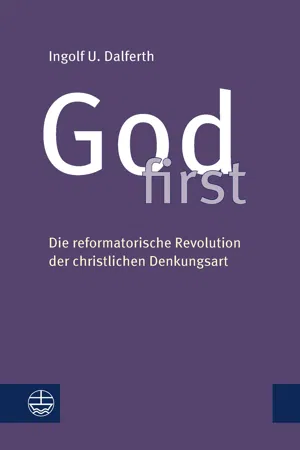
Die Reformation war nicht nur ein historisches Ereignis mit weltweiter Wirkung, sondern eine spirituelle Revolution. Ihre Triebkraft war die befreiende Entdeckung, dass Gott in seiner Schöpfung bedingungslos als Kraft der Veränderung zum Guten gegenwärtig ist. Gott allein ist der Erste, alles andere das Zweite. Das führte existenziell zu einer Neuausrichtung des ganzen Lebens an Gottes Gegenwart und theologisch zu einer grundlegenden Umgestaltung der traditionellen religiösen Denksysteme. Indem die Reformatoren alles Leben und Denken, Erfahren und Leiden, Vorstellen und Tun kompromisslos auf die schöpferische Gegenwart Gottes hin ausrichteten, revolutionierten sie die christliche Lebens- und Denkungsart.Das Buch des international bekannten Systematikers und Religionsphilosophen Ingolf U. Dalferth kegt dar, was es heißt, Gott vom Kreuzesgeschehen her theologisch zu denken. Und es entfaltet den christlichen Monotheismus nicht als System der Vergewaltigung Andersdenkender, sondern als Lebensform radikaler Freiheit und Liebe, die sich als Resonanz der Gnade Gottes versteht.[God First. The Reformation Revolution of the Christian Way of Thinking]The Reformation was not only a historical event with worldwide effects, but a spiritual revolution. Its driving force was the liberating discovery that God is unconditionally present in his creation as the power of change for the good. God alone is the first, everything else is the second. This led existentially to a reorientation of the whole life towards God's presence and theologically to a fundamental transformation of the traditional systems of religious thought. By orienting all life and thought, experience and suffering, imagining and doing uncompromisingly towards this creative presence of God, the Reformers revolutionized the Christian way of living and thinking.The book reconstructs the way of thinking of Protestant theology by explaining what it means to think God theologically based on the event of the cross. And it unfolds Christian monotheism not as a system of violence against other religions, but as a way of life of radical freedom and love, which sees itself as a resonance of the free gift of God's grace.
- 304 pages
- English
- ePUB (mobile friendly)
- Available on iOS & Android
eBook - ePub
About this book
Information
Topic
Theology & ReligionSubtopic
Christian TheologyENDNOTEN
I
EINLEITUNG
1Vgl. G. Horner, The Heresy of John Milton, Calvinist: Reforming the Puritan Poet with Historical Theology (Diss. Claremont 2017), 234-237.
2Die theologische Doppelformel der cognitio dei und cognitio hominis, die sich nicht nur bei Calvin, sondern auch bei Luther und Zwingli findet (vgl. G. Ebeling, Cognitio Dei et hominis, in: Ders., Lutherstudien Bd. I, Tübingen 1971, 221-272), wird missverstanden, wenn sie neuprotestantisch von der cognitio als menschlicher Aktivität her als cognitio hominis der cognitio dei und der cognitio hominis gelesen und konstruiert wird. Die cognitio dei wird dann zum Implikat der cognitio suiipsius und das Denken Gottes subjektivitätstheoretisch fundiert und entfaltet. Für Luther war es gerade umgekehrt: Die cognitio hominis ist immer ein Explikat der cognitio dei. Allerdings so, dass diese nicht richtig verstanden wird, wenn sie nicht zugleich als cognitio hominis entfaltet wird. Denn wie man Gott nicht recht kennt, wenn man nicht weiß, wie er an und für uns Gutes wirkt, so kennen wir uns nicht recht, wenn wir uns nicht als die verstehen, an denen Gott baut. In diesem Sinn kann Luther das Geschäft der Theologie präzis bestimmen: »Cognitio dei et hominis est sapientia divina et proprie theologica. Et ita cognitio dei et hominis, ut referatur tandem ad deum iustificantem et hominem peccatorem, ut proprie sit subjectum Theologie homo reus et perditus et deus iustificans vel salvator.« (M. Luther, Ennarratio Psalmi LI (1532), WA 40,2; 327,11–328,2; vgl. J. E. Brush, Gotteserkenntnis und Selbsterkenntnis. Luthers Verständnis des 51. Psalms, Tübingen 1997). Diese cognitio dei ist kein Implikat der cognitio suiipsius, sondern hat ihre Pointe darin, dass sie Gott so kennt, wie Gott selbst sich kennt, indem sie Gottes cognitio suiipsius, die im Wort (Jesus Christus) manifest wird und sich durch den Geist unserem Geist vermittelt und erschließt, in seinem Wirken an und für uns zum Ausdruck kommen sieht und in diesem Sinn als unsere cognitio dei et cognitio hominis entfaltet. Gott zu kennen, heißt Gott so zu kennen, wie Gott selbst sich kennt. Wie Gott sich selbst kennt, zeigt sich daran, wie er an uns und seiner Schöpfung Gutes wirkt. Deshalb kennen wir Gott dann so, wie Gott selbst sich kennt, wenn wir uns als die erkennen, an denen und für die Gott Gutes wirkt.
3Ich spreche im Folgenden durchgehend von »Christen« und nicht von »Christen und Christinnen«, weil »Christ« theologisch den Menschen des neuen Lebens bezeichnet und »Mensch« im Deutschen (bislang) als Integralbezeichnung für Männer und Frauen verwendet wird. Solange es keine Menschinnen gibt, gibt es auch keine Christinnen.
II
DIE REFORMATION ALS REVOLUTION DES GLAUBENS
4»The Protestant Reformation is a pivotal event in the history of Christianity, and the momentous issues it raised then still echo in different forms today«. Young-Ho Chun, Letter of invitation to the 5th Biennial Conference of the East/West Theological Forum, June 15–17, 2017: The Protestant Reformation Then and Now: Lessons from the Past, Challenges of the Present, Prospects for the Future.
5W. Pannenberg, Reformation zwischen gestern und morgen, Gütersloh 1969, 14.
6Vgl. F. W. Graf, Ist Luther der erste Aufklärer, der erste moderne Mensch? NZZ 1.4.2017 (https://www.nzz.ch/feuilleton/500-jahre-reformation-ist-er-der-erste-aufklaerer-der-erste-moderne-mensch-ld.154546?reduced=true); E. Gräb-Schmidt, Freiheit und Selbsterkenntnis – Zur Bedeutung der Buße in der Anthropologie Luthers, ThLZ 143 (2018), 571–588.
7B. S. Gregory, The Unintented Reformation: How a Religious Revolution Secularized Society, Cambridge, Mass. 2012; Kurt Kardinal Koch, Wie das Reformationsgedenken in ökumenischer Gemeinschaft begehen? Impulse aus dem theologischen Denken Wolfhart Pannenbergs, in: G. Wenz (Hrsg.), Pannenberg Lectures 1, München 2015, 21–47; I. U. Dalferth (Hrsg.), Reformation und Säkularisierung, Tübingen 2017.
8Vgl. K. Rahner, Löscht den Geist nicht aus, in: Ders., Schriften zur Theologie, Bd. 7, Einsiedeln 1966, 77–90.
9Kurt Kardinal Koch, The Reformation in the Ecumenical Outlook of the Catholic Church, JMJ 71 (2017), 3–21, 5.
10A. a. O., 9.
11A. a. O., 10.
12A. a. O., 7.
13A. a. O., 10.
14I. Kant, Die Religion innerhalb der Grenzen der bloßen Vernunft, AA VI, 47.
15Wenn Gott Gutes wirkt, dann ist das nicht nur relativ besser als das Üble bzw. Gute, das zuvor war, sondern es ist durchgehend und unverrückbar gut. Während bei menschlichen Bemühungen gilt, dass das Bessere der Feind des Guten ist, gilt bei Gott, dass das Gute der Feind des Besseren ist. Besseres als das von ihm gewirkte Gute gibt es nicht. Besseres als das von uns gewirkte Beste aber gibt es allemal.
16Vgl. A. Farrer, Love Almighty and Ills Unlimited. An Essay on Providence and Evil, London 1961, 93–99; ders., Faith and Speculation. An Essay in Philosophical Theology, London 1967, Kap. 5.
17J. Rivera, The Contemplative Self after Michel Henry, Notre Dame, IN 2015, 240 (meine Übersetzung).
18A. a. O., 221.
19A. a. O., 247.
20Vgl. S. Kierkegaard, Philosophische Brocken. De Omnibus Dubitandum Est, übers. v. E. Hirsch, Regensburg 1952, 11–20.
21M. Luther, Von der Freiheit eines Christenmenschen (1520), WA 7, 21, 1–4 (modernisiert nach https://www.luther2017.de/de/martin-luther/texte-quellen/lutherschrift-von-der-freiheit-eines-christenmenschen/).
22I. U. Dalferth, Luther on the Experience of Faith, HeyJ 21 (1980), 50–56.
23B. D. Cowan, The Spirit Unchained: Towards the Construction of Pneumatology rooted in the Pentecostal and Black Tradition (Diss. Claremont 2017).
...Table of contents
- Cover
- Titel
- Über den Autor
- Impressum
- Vorwort
- Inhalt
- I. Einleitung
- II. Die Reformation als Revolution des Glaubens
- III. Die Vernunft des Glaubens
- IV. Die Freiheit des Glaubens
- V. Die Vielfalt und Verschiedenheit des Glaubens
- VI. Das Denken des Glaubens
- VII. Die Denkform evangelischer Theologie
- VIII. Gott theologisch denken
- IX. Die theologische Denkform des Unbedingten
- X. Radikaler Monotheismus als Lebensform der Freiheit
- Hinweis
- Endnoten
- Weitere Bücher
Trusted by 375,005 students
Access to over 1.5 million titles for a fair monthly price.
Study more efficiently using our study tools.
Frequently asked questions
Yes, you can cancel anytime from the Subscription tab in your account settings on the Perlego website. Your subscription will stay active until the end of your current billing period. Learn how to cancel your subscription
No, books cannot be downloaded as external files, such as PDFs, for use outside of Perlego. However, you can download books within the Perlego app for offline reading on mobile or tablet. Learn how to download books offline
Perlego offers two plans: Essential and Complete
- Essential is ideal for learners and professionals who enjoy exploring a wide range of subjects. Access the Essential Library with 800,000+ trusted titles and best-sellers across business, personal growth, and the humanities. Includes unlimited reading time and Standard Read Aloud voice.
- Complete: Perfect for advanced learners and researchers needing full, unrestricted access. Unlock 1.5M+ books across hundreds of subjects, including academic and specialized titles. The Complete Plan also includes advanced features like Premium Read Aloud and Research Assistant.
We are an online textbook subscription service, where you can get access to an entire online library for less than the price of a single book per month. With over 1.5 million books across 990+ topics, we’ve got you covered! Learn about our mission
Look out for the read-aloud symbol on your next book to see if you can listen to it. The read-aloud tool reads text aloud for you, highlighting the text as it is being read. You can pause it, speed it up and slow it down. Learn more about Read Aloud
Yes! You can use the Perlego app on both iOS and Android devices to read anytime, anywhere — even offline. Perfect for commutes or when you’re on the go.
Please note we cannot support devices running on iOS 13 and Android 7 or earlier. Learn more about using the app
Please note we cannot support devices running on iOS 13 and Android 7 or earlier. Learn more about using the app
Yes, you can access God first by Ingolf U. Dalferth in PDF and/or ePUB format, as well as other popular books in Theology & Religion & Christian Theology. We have over 1.5 million books available in our catalogue for you to explore.