Der brasilianische Theologe und Kulturwissenschaftler Euler Renato Westphal fragt kritisch nach heutigen Formen der Enteignung und Monopolisierung von Leben. Stichworte hierfür sind "Biopiraterie" oder "Patent-Kolonialismus". Bei genauerem Hinsehen handele es sich bei Teilen des wissenschaftlichen und technologischen Fortschritts um die Fortführung der kolonialen Herrschaft mit anderen Mitteln. Der Fortschritt offenbart darin seine Schattenseiten.Das Buch ist ein wichtiger Beitrag zur Diskussion um die Frage von Theologie als Wissenschaft und ihrer Beziehung zu anderen Wissenschaften, insbesondere Biologie und Angewandte Ethik.Das Werk wurde zuerst auf Portugiesisch unter dem Titel "O Oitavo Dia: Na era da seleção natural" publiziert. Die englische Fassung erschien unter dem Titel "The Eighth Day. In the age of artificial selection. An analysis on the post-modern thought, its esthetic expressions and its scientific practice".[Protestant Orientations in a Postmodern CultureBioethical Challenges and Lutheran Theology]The Brazilian scholar Prof. Dr. Euler Renato Westphal, holder of a chair for systematic theology, analyzes scientific as well as technological progress and opens in this way, against his theological background, an interdisciplinary dialogue on bioethics. The book is an important contribution to the debate on the scientific character of theology and its relation to other sciences, particularly biology and applied ethics. The book was first published in Portuguese under the title "O Oitavo Dia: Na era da seleção natural". The English version appeared under the title "The Eighth Day. In the age of artificial selection. An analysis on the post-modern thought, its esthetic expressions and its scientific practice.
eBook - ePub
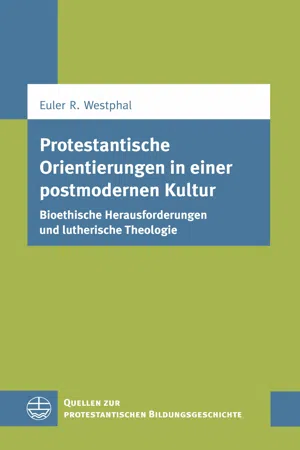
Protestantische Orientierungen in einer postmodernen Kultur
Bioethische Herausforderungen und lutherische Theologie
- 132 pages
- English
- ePUB (mobile friendly)
- Available on iOS & Android
eBook - ePub
Protestantische Orientierungen in einer postmodernen Kultur
Bioethische Herausforderungen und lutherische Theologie
About this book
Information
Topic
Theology & ReligionSubtopic
ChristianityFußnoten
Biopiraterie und Gerechtigkeit – Eine einführende Übersicht
1
Die Frage des Zusammenhangs von Patentierung und Wissen wird hier nicht ausführlich behandelt, zwei Dinge sind aber anzumerken. Zum einen gibt es im amerikanischen Recht zwei Patente für Pflanzenmaterial. A) „[A] utility patent for nonobvious, useful and unique plant materials that requires users to pay royalties“ (Landon 2007 : 64) und B) „[P] lant variety protection that requires users additional uniformity, but requires no royalties“ (Landon 2007 : 64). Der in diesem Fall angewendete Typ der Patentierung ist Typ A, der die indigenen Völker rechtlich dazu verpflichtet, für ihre selbstentwickelten Extraktionstechniken und Pflanzenderivate an die amerikanischen Pharmaunternehmen Abgaben zu zahlen. Bereits diese simple Unterscheidung kann zu ethisch relevanten Anschlussfragen an das Patenrecht führen, die hier nicht weiter ausgeführt werden. Neben der Patentierung ist die Form des indigenen Wissens eine Erwähnung wert. Es muss betont werden, dass es sich bei indigenem Wissen zumeist um gemeinschaftliche Formen des Wissens handelt, die nur selten auf einzelne Dörfer oder gar Individuen zurückgeführt werden können (vgl. Brush 1993/Brush 1999).
2
Sicherlich darf man nicht allen Verfechtern des Bioprospecting zuschreiben, dass sie die negativen Folgen für die einheimische Bevölkerung willentlich in Kauf nehmen würden. Ausnahmen von der Regel der Übervorteilung von indigenen Bevölkerungsgruppen existieren, sind aber selten.
3
Zitiert wird in diesem Text ausschließlich aus der deutschen Übersetzung, angeführt als Nagoya 2010.
Einleitung
4
Vgl. Steven CONNOR: Cultura Pós-Moderna: Introdução às teorias do contemporâneo. 3. Ed. São Paulo 1993, S. 58 – 82; David HARVEY: Condição Pós-Moderna: Uma pesquisa sobre as origens da mudança cultural. 8. Ed. São Paulo 1999.
5
Vgl. John HORGAN: O fim da ciência. São Paulo 1998.
6
Vgl. John NAISBITT, Patrícia ALBURDENE: Megatrends 2000: Dez novas tendências de transformação da sociedade nos anos 90. 4. Ed. São Paulo 1990, S. 283.
7
Vgl. Lucien SFEZ: A Saúde Perfeita: Crítica de uma nova utopia. São Paulo 1996, S. 251 – 291.
„Der Kampf gegen die Universalien“
8
Vgl. Peter ENGELMANN: Einführung. Postmoderne und Dekonstruktion: Texte französischer Philosophen der Gegenwart. Stuttgart 1993. S. 10; Jean-François LYOTARD: Randbeme...
Table of contents
- Cover
- Titel
- Impressum
- Vorwort
- Inhalt
- Geleitwort zur deutschen Ausgabe
- Menschliche Perfektion in der vermeintlichen Leere – Der Tanz um das Goldene Kalb in der Gegenwart
- Biopiraterie und Gerechtigkeit – Eine einführende Übersicht
- Protestantische Orientierungen in einer postmodernen Kultur
- Weitere Bücher
- Fußnoten
Trusted by 375,005 students
Access to over 1.5 million titles for a fair monthly price.
Study more efficiently using our study tools.
Frequently asked questions
Yes, you can cancel anytime from the Subscription tab in your account settings on the Perlego website. Your subscription will stay active until the end of your current billing period. Learn how to cancel your subscription
No, books cannot be downloaded as external files, such as PDFs, for use outside of Perlego. However, you can download books within the Perlego app for offline reading on mobile or tablet. Learn how to download books offline
Perlego offers two plans: Essential and Complete
- Essential is ideal for learners and professionals who enjoy exploring a wide range of subjects. Access the Essential Library with 800,000+ trusted titles and best-sellers across business, personal growth, and the humanities. Includes unlimited reading time and Standard Read Aloud voice.
- Complete: Perfect for advanced learners and researchers needing full, unrestricted access. Unlock 1.5M+ books across hundreds of subjects, including academic and specialized titles. The Complete Plan also includes advanced features like Premium Read Aloud and Research Assistant.
We are an online textbook subscription service, where you can get access to an entire online library for less than the price of a single book per month. With over 1.5 million books across 990+ topics, we’ve got you covered! Learn about our mission
Look out for the read-aloud symbol on your next book to see if you can listen to it. The read-aloud tool reads text aloud for you, highlighting the text as it is being read. You can pause it, speed it up and slow it down. Learn more about Read Aloud
Yes! You can use the Perlego app on both iOS and Android devices to read anytime, anywhere — even offline. Perfect for commutes or when you’re on the go.
Please note we cannot support devices running on iOS 13 and Android 7 or earlier. Learn more about using the app
Please note we cannot support devices running on iOS 13 and Android 7 or earlier. Learn more about using the app
Yes, you can access Protestantische Orientierungen in einer postmodernen Kultur by Euler Renato Westphal, Ralf Koerrenz, Sebastian Engelmann in PDF and/or ePUB format, as well as other popular books in Theology & Religion & Christianity. We have over 1.5 million books available in our catalogue for you to explore.