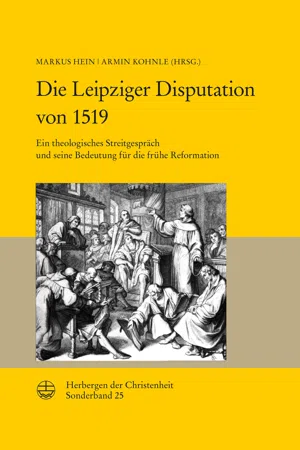
Vor 500 Jahren, im Sommer 1519, trafen Martin Luther, sein Wittenberger Kollege Andreas Bodenstein von Karlstadt und der Ingolstädter Theologe Johannes Eck in der Hofstube des herzoglichen Schlosses in Leipzig zu einem akademischen Streitgespräch zusammen. Dabei sollte es eigentlich um den Ablass gehen. Doch längst standen auch die reformatorische Lehre und ihre Konsequenzen für die damalige Kirche auf der Tagesordnung. Die Disputation lief auf die Frage hinaus, ob der Primat des römischen Papstes, der die Strukturen und die Lehre der abendländischen Kirche seit dem Mittelalter prägte, auf göttlichem oder nur menschlichem Recht beruhte. Eck bezichtigte Luther offen der hussitischen Ketzerei, dieser wiederum wurde sich seiner Distanz zur Papstkirche in Leipzig erst richtig bewusst.Der Band behandelt neben der theologischen Kontroverse auch das stadt- und landesgeschichtliche Umfeld der Disputation.Mit Beiträgen von Michael Beyer, Enno Bünz, Markus Cottin, Irene Dingel, Markus Hein, Heiko Jadatz, Helmar Junghans ?, Armin Kohnle, Volker Leppin, Christoph Münchow, Thomas Noack, Stefania Salvadori, Christoph Volkmar, Christian Winter, Johann Peter Wurm und Doreen Zerbe.[The Leipzig Disputation of 1519. A Theological Debate and its Importance for Early Reformation]500 years ago, in summer 1519, Martin Luther, his Wittenberg fellow Andreas Bodenstein von Karlstadt, and the Ingolstadt theologian Johannes Eck met for an academic debate in the parlor of ducal Pleissenburg Castle in Leipzig. The discussion was supposed to focus on indulgence, however the reformatory teachings and their consequences for the then-church were long since on the agenda. The disputation amounted to the question, whether the Primate of the Roman Pope, who had been shaping the structures and teachings of the occidental church since medieval times, was based on divine or just human law. Eck openly accused Luther of Hussite heresy, who himself became only now fully aware of his distance to the papal church in Leipzig. Next to the theological controversy the volume also covers the historical environment of the disputation.
eBook - ePub
Die Leipziger Disputation von 1519
Ein theologisches Streitgespräch und seine Bedeutung für die frühe Reformation
- 260 pages
- English
- ePUB (mobile friendly)
- Available on iOS & Android
eBook - ePub
Die Leipziger Disputation von 1519
Ein theologisches Streitgespräch und seine Bedeutung für die frühe Reformation
About this book
Information
Endnoten
Vorwort
1 Vgl. die entsprechende Mitteilung der Stadt Leipzig vom 8. Mai 2017: https://www.leipzig.de/news/news/erinnerungsort-an-die-leipziger-disputation-1519-wird-enthuellt/ (abgerufen am 6.4.2019); dort auch eine Abbildung der Portraitplakette Martin Luthers und der Text des Schriftbands. Vgl. auch: GEDENKTAFELN FÜR »LEIPZIGER DISPUTATION« AM NEUEN RATHAUS ANGEBRACHT. Leipziger Volkszeitung vom 12. Mai 2017 (http://www.lvz.de/Leipzig/Lokales/Gedenktafeln-fuer-Leipziger-Disputation-am-Neuen-Rathaus-angebracht7).
2 LUTHER IM DISPUT: Ausstellung im Stadtgeschichtlichen Museum Leipzig/ hrsg. von Volker Rodekamp. Leipzig 2017.
3 DIE LEIPZIGER DISPUTATION 1519: 1. Leipziger Arbeitsgespräch zur Reformation/ hrsg. von Markus Hein und Armin Kohnle (HCh Sonderband; 18), Leipzig 2011.
4 https://adw-goe.de/forschung/weitere-forschungsprojekte/karlstadt-edition/; https://karlstadt-edition.org.
Irene Dingel: Die Leipziger Disputation 1519 in ihrem historischen Kontext Verfahren – Realisierung – Wirkung
1 Die folgenden Ausführungen sind vor allem in der Einleitung sowie den Abschnitten I bis II deckungsgleich mit meinem Beitrag Irene DINGEL: Von der Disputation zum Gespräch. LuJ 85 (2018), 61-84. Abschnitt III ist in seiner Fokussierung auf die Leipziger Disputation neu gefasst. Hier finden sich nur gelegentliche Parallelen.
2 Das Genre selbst kann bis in die griechische Antike zurückverfolgt werden, so Olga WEIJERS: In Search of the Truth: A History of Disputation Techniques from Antiquity to Early Modern Times (Studies of the Faculty of Arts: History and Influence; 1). Turnhout 2013, 22.
3 Zu den mittelalterlichen Religionsgesprächen zwischen Islam und Christentum sowie Judentum und Christentum und deren spezifisch anderer Ausrichtung vgl. Jacques WAARDENBURG: Art. Religionsgespräche II. Muslimisch christlich (TRE 28 [1997], 640-648); Ora LIMOR: Art. Religionsgespräche III. Jüdisch-christlich (TRE 28 [1997], 649-654).
4 Schon gegen Ende des 16. Jahrhunderts begann eine Wiederbelebung des Syllogismus auch im evangelischen Raum. In der von Kurfürst August von Sachsen im Jahre 1580 erlassenen Universitätsordnung für die Leucorea findet sich z.B. eine Ermahnung an die Professoren, dass sie »ihre discipulos mit fleis vermanen / das sie nicht in den Disputationibus predigen / sondern alle ihre argumenta in forma Syllogismi oder Enthymematis [= Argumenten] vorbringen …«. Zit. nach Kenneth G. APPOLD: Orthodoxie als Konsensbildung: das theologische Disputationswesen an der Universität Wittenberg zwischen 1570 und 1710 (BHTh 127). Tübingen 2004, 29.
5 So im Titel eines von Gindhart und Kundert herausgegebenen Sammelbands; vgl. DISPUTATIO 1200-1800: Form, Funktion und Wirkung eines Leitmediums universitärer Wissenskultur (Trends in Medieval Philology 20)/ hrsg. von Marion Gindhart und Ursula Kundert. Berlin 2010.
6 So Marcel NIEDEN: Die Erfindung des Theologen: Wittenberger Anweisungen zum Theologiestudium im Zeitalter von Reformation und Konfessionalisierung (SuR NR; 28). Tübingen 2006, 53.
7 Vgl. Hanspeter MARTI: Kommunikationsnormen der Disputation: die Universität Halle und Christian Thomasius als Paradigmen des Wandels. In: Kultur der Kommunikation: die europäische Gelehrtenrepublik im Zeitalter von Leibniz und Lessing/ hrsg. von Ulrich Johannes Schneider (Wolfenbütteler Forschungen; 109). Wiesbaden 2005, 318.
8 Vgl. Weijers: In Search of the Truth (wie Anm. 2), 119-147.
9 »Disputatio est actus sillogisticus unius ad alterum ad propositum ostendendum. Cum autem ad disputationem quinque exigantur, – scilicet ille a quo est actus disputandi, scilicet opponens, et ille ad quem est actus disputandi, scilicet respondens, et ipsum propositum de quo disputatur, et ipse actus disputandi, et instrumentum disputationis […]«, Petrus HISPANUS: Summulae Logicales cum Versorii Parisiensis Clarissmia Expositione (Repr. der Ausg. Venedig 1572). Hildesheim 1981, VII,1, 89. Die Übersetzung findet sich in: Petrus HISPANUS: Logische Abhandlungen: Tractatus / Summulae Logicales/ aus dem Lateinischen von Wolfgang Degen und Bernhard Pabst. München 2006, 109.
10 Vgl. Idea Boni Disputatoris Et Malitiosi Sophistae: Exhibens Artificium, Non Solum Rite Et stratagematice disputandi; sed fontes solutionum aperiens, e quibus quodvis spinosissimum Sophisma dilui possit / Auctore M. Johanne Conrado DANNHAWERO P. L. Caes. & Prof. Oratoriae Publico, Argentorati: Glaserus, 1629. – Tractatus Novus De Methodo Docendi & Disputandi: In quo de totius Encyclopaedias in communi, tum in specie, de Theologiae, Medicinae, Gnostologiae, Habitus intelligentiae, Metaphysicae, Pneumaticae, Physicae, scientiarum Mathematicarum, Philosophiae Practicae, de Thematum simplicium cuiusuis generis specialißime … / Authore M. Abraham CALOVIO, Morunga-Porusso, Rostochii: Hallervordius, 1637.
11 Vgl. dazu Donald FELIPE: Ways of disputing and principia in 17th century German disputation handbooks. In: Disputatio 1200-1800 (wie Anm. 5), 33-61.
12 Marti: Kommunikationsnormen … (wie Anm. 7), 317.
13 Disputatio 1200-1800 (wie Anm. 5), 11.
14 Vgl. ebd.
15 Vgl. ebd, 12 f.
16 Vgl. Appold: Orthodoxie als Konsensbildung (wie Anm. 4), 317, der zudem von eine...
Table of contents
- Cover
- Titel
- Impressum
- Inhalt
- Vorwort
- Irene Dingel: Die Leipziger Disputation 1519 in ihrem historischen Kontext Verfahren – Realisierung – Wirkung
- Armin Kohnle: Die Leipziger Disputation und ihre Bedeutung für die frühe Reformation
- Markus Hein: Die Leipziger Disputation in der Forschung
- Christian Winter: Die Protokolle der Leipziger Disputation
- Axel Noack: Der Ort der Disputation – die Pleißenburg
- Enno Bünz: Territorium – Stadt – Universität - Das Umfeld der Leipziger Disputation 1519
- Heiko Jadatz: Herzog Georg von Sachsen und die Leipziger Disputation
- Helmar Junghans†: Martin Luther und die Leipziger Disputation
- Stefania Salvadori: Andreas Bodenstein von Karlstadt und die Leipziger Disputation
- Johann Peter Wurm: Johannes Eck und die Disputation von Leipzig 1519 - Vorgeschichte und unmittelbare Folgen
- Markus Cottin: Das Bistum Merseburg zur Zeit der Leipziger Disputation
- Volker Leppin: Papst, Konzil und Kirchenväter - Die Autoritätenfrage in der Leipziger Disputation
- Michael Beyer: Luthers Erinnerungen an die Leipziger Disputation
- Christoph Volkmar: Von der Wahrnehmun des Neuen - Die Leipziger Disputation in den Augen der Zeitgenossen
- Doreen Zerbe: Bilder der Leipziger Disputation
- Christoph Münchow: Die Leipziger Disputation und die Ökumene heute
- Autorenverzeichnis
- Abbildungsverzeichnis
- Abkürzungsverzeichnis
- Personenregister
- Endnoten
Trusted by 375,005 students
Access to over 1.5 million titles for a fair monthly price.
Study more efficiently using our study tools.
Frequently asked questions
Yes, you can cancel anytime from the Subscription tab in your account settings on the Perlego website. Your subscription will stay active until the end of your current billing period. Learn how to cancel your subscription
No, books cannot be downloaded as external files, such as PDFs, for use outside of Perlego. However, you can download books within the Perlego app for offline reading on mobile or tablet. Learn how to download books offline
Perlego offers two plans: Essential and Complete
- Essential is ideal for learners and professionals who enjoy exploring a wide range of subjects. Access the Essential Library with 800,000+ trusted titles and best-sellers across business, personal growth, and the humanities. Includes unlimited reading time and Standard Read Aloud voice.
- Complete: Perfect for advanced learners and researchers needing full, unrestricted access. Unlock 1.5M+ books across hundreds of subjects, including academic and specialized titles. The Complete Plan also includes advanced features like Premium Read Aloud and Research Assistant.
We are an online textbook subscription service, where you can get access to an entire online library for less than the price of a single book per month. With over 1.5 million books across 990+ topics, we’ve got you covered! Learn about our mission
Look out for the read-aloud symbol on your next book to see if you can listen to it. The read-aloud tool reads text aloud for you, highlighting the text as it is being read. You can pause it, speed it up and slow it down. Learn more about Read Aloud
Yes! You can use the Perlego app on both iOS and Android devices to read anytime, anywhere — even offline. Perfect for commutes or when you’re on the go.
Please note we cannot support devices running on iOS 13 and Android 7 or earlier. Learn more about using the app
Please note we cannot support devices running on iOS 13 and Android 7 or earlier. Learn more about using the app
Yes, you can access Die Leipziger Disputation von 1519 by Hein Markus, Kohnle Armin in PDF and/or ePUB format, as well as other popular books in Theology & Religion & Christianity. We have over 1.5 million books available in our catalogue for you to explore.