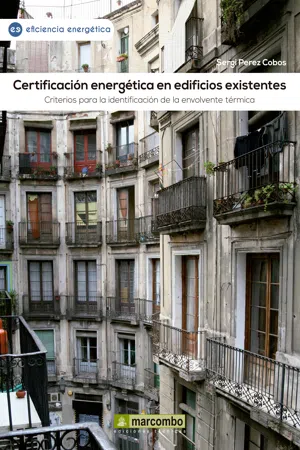
Con la aparición del esperado Real Decreto 235/2013, por el que se aprueba el proceso básico para la certificación de la eficiencia energética de los edificios, en el que se aprueba que cuando se construyan, vendan o alquilen edificios o unidades de éstos, deberán disponer de certificado de eficiencia energética. El principal escollo para la certificación energética de un edificio existente es la determinación del comportamiento de su envolvente térmica, ya que en la mayoría de casos no se dispone de documentación que acredite la composición de esta envolvente (si tiene cámara de aire, aislamiento térmico, etc?) Este manual tiene como objetivo, aportar herramientas para ayudar a deducir el comportamiento térmico de la piel del edificio a través de la identificación de los sistemas constructivos que la componen, y de esta manera facilitar el desarrollo, no sólo de la certificación energética en edificios existentes, sino también otras tareas como las auditorías energéticas de edificios. Sergi Pérez Cobos es arquitecto y arquitecto técnico por la UPC. Amplia experiencia en ejecución de obra. Recientemente ha fundado GreenStorm donde realiza trabajos de consultoría en eficiencia energética y implementación de energías renovables en edificios nuevos y existentes, y coordina contenidos para cursos y postgrados de eficiencia energética.
- 160 pages
- English
- ePUB (mobile friendly)
- Available on iOS & Android
eBook - ePub
Certificación energética en edificios existentes
About this book
Information
Table of contents
- Cubrir
- Título de la página
- Derechos de Autor
- Prólogo
- Índice
- Dedicación
- Tema 1: Introducción
- Tema 2: Procedimiento para la obtención de datos
- Tema 3: Importancia del año de construcción
- Tema 4: Deducción del comportamiento térmico de la envolvente
- Tema 5: Deducción del comportamiento de los huecos
- Tema 6: Ejemplo de distintas tipologías edificatorias en función del año de construcción
Trusted by 375,005 students
Access to over 1.5 million titles for a fair monthly price.
Study more efficiently using our study tools.
Frequently asked questions
Yes, you can cancel anytime from the Subscription tab in your account settings on the Perlego website. Your subscription will stay active until the end of your current billing period. Learn how to cancel your subscription
No, books cannot be downloaded as external files, such as PDFs, for use outside of Perlego. However, you can download books within the Perlego app for offline reading on mobile or tablet. Learn how to download books offline
Perlego offers two plans: Essential and Complete
- Essential is ideal for learners and professionals who enjoy exploring a wide range of subjects. Access the Essential Library with 800,000+ trusted titles and best-sellers across business, personal growth, and the humanities. Includes unlimited reading time and Standard Read Aloud voice.
- Complete: Perfect for advanced learners and researchers needing full, unrestricted access. Unlock 1.5M+ books across hundreds of subjects, including academic and specialized titles. The Complete Plan also includes advanced features like Premium Read Aloud and Research Assistant.
We are an online textbook subscription service, where you can get access to an entire online library for less than the price of a single book per month. With over 1.5 million books across 990+ topics, we’ve got you covered! Learn about our mission
Look out for the read-aloud symbol on your next book to see if you can listen to it. The read-aloud tool reads text aloud for you, highlighting the text as it is being read. You can pause it, speed it up and slow it down. Learn more about Read Aloud
Yes! You can use the Perlego app on both iOS and Android devices to read anytime, anywhere — even offline. Perfect for commutes or when you’re on the go.
Please note we cannot support devices running on iOS 13 and Android 7 or earlier. Learn more about using the app
Please note we cannot support devices running on iOS 13 and Android 7 or earlier. Learn more about using the app
Yes, you can access Certificación energética en edificios existentes by Sergi Pérez Cobos in PDF and/or ePUB format, as well as other popular books in Technology & Engineering & Renewable Power Resources. We have over 1.5 million books available in our catalogue for you to explore.