eBook - ePub
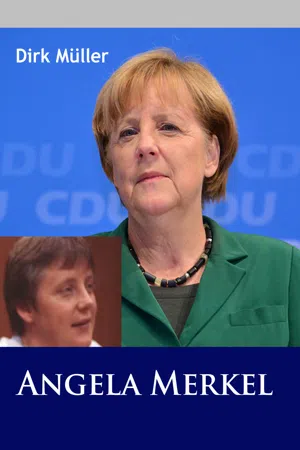
Angela Merkel
short biography - from a youth in the GDR to chancellorship in united Germany
- 39 pages
- English
- ePUB (mobile friendly)
- Available on iOS & Android
eBook - ePub
Angela Merkel
short biography - from a youth in the GDR to chancellorship in united Germany
About this book
Anyone wishing to find information about Angela Merkel can do so through current daily sources, on the Internet or read the big biographies by Langguth and others. This book aims to close the gap between those bite-sized sources of information and the long biographies. The first are short and disjointed. The latter are time-consuming and, as well, partly written from a one-sided (positive or negative) perspective. As the sub-title suggests, this short biography concentrates on the early period, partly shrouded in mystery, up to arrival in Germany's chancellery.
Information
Publisher
Ideenbrücke VerlageBook ISBN
9783945909386
Year
2015A little later than the others: the peaceful revolution and beginnings of a political career (1989–1990)
At the beginning of the ‘democratic awakening’ in the GDR in the autumn of 1989, any activities against the dictatorship were still a highly risky matter. None of the early Monday demonstrators in Leipzig knew that the regime would not (like after the falsified local elections!) act against peaceful demonstrators with truncheons or even with lethal weapons. Many believed at the time – and believe even today – that something like that would have occurred if Gorbachev had not exercised a moderating influence from Moscow.
Merkel did not demonstrate from the beginning on – just as little as Joachim Gauck. But gradually it could be seen that, in the East of Germany, new democratic forces were evolving – without violence. The number of the Monday demonstrators increased and their demands became louder and braver. The power of the SED crumbled on 4 November, 1989 when the demonstration “against violence and for constitutional rights and freedom of the press, speech and assembly” took place. Estimated number of participants: 1million.
Approximately one month later, Merkel began working with the recently established “Demokratischer Aufbruch” (Democratic Awakening) (DA) first in December 1989 in an honorary position as the system administrator, from February 1990 then as a fulltime clerk close to the chairman Wolfgang Schnur in its Berlin office. She drafted pamphlets, became the press spokeswoman and was also a member of the DA committee.
The “Demokratischer Aufbruch” fluctuated strongly in its political orientation at first and was basically seen for a while, like the other organisations of the opposition movement, on the left side of the political spectrum. Most of the revolutionaries were aiming at a type of democratic socialism: there was plenty of idealism in this attitude but not much political or, in particular, economic concept.
Soon, however, a position became clear from which the “Demokratischer Aufbruch” rejected socialism on principle, i.e. also the initial dream of a democratic type. This became clearer when, at the beginning of 1990, conservative West German politicians worked towards the first democratic elections for the Volkskammer (Peoples’ Parliament) on 18. March 1990 and Volker Rühe, as the secretary general of the West German CDU, established the electoral alliance “Allianz für Deutschland” (Alliance for Germany”). The DA occupied a key position in this as the newly established opposition movement. The federal German chancellor, Helmut Kohl, leader of the West-CDU, did not wish to bank alone on the east CDU (which was at a disadvantage as a ‘block’ party). The Deutsche Soziale Union (DSU) [German Social Union, eastern daughter organization of the Bavarian conservative Party CSU] was not sufficient either for Kohl, who, years previously, had shut out his rival, Franz-Josef Strauß (long-year leader of the CSU in Bavaria).
Some of her friends and acquaintances from the seventies and eighties years later expressed their astonishment that Merkel in the end became a CDU-politician as they assumed more ideological proximity to the Greens. Until today, it has never become clear whether Merkel completed this process as a result of inner conviction or whether she felt she could build a career more easily close to the West-CDU. On the streets, demonstrators had begun to sing the German national anthem (of the Federal Republic) and Helmut Kohl, whose days were seen in the West to be numbered, reaped storms of jubilation in Dresden.
The DA’s reputation was almost destroyed when, a few days before the Volkskammer elections, it became known that Schnur had worked from 1965 to 1989 for the Ministry for Security (Ministerium für Staatssicherheit [MfS], GDR equivalent of the Soviet KGB). Merkel conducted the press conference at which the DA committee expressed its dismay about it.
Their shock must have been genuine as they anticipated the consequences.
The first free Volkskammer elections on 18 March 1990 finished for Merkel’s Demokratischer Aufbruch (DA) in a 0.9-percent-disaster. In comparison, the SED, which had changed its name to PDS, turned out virtually to be a major party (which it actually became in the end in the new Länder).
Thanks to the landslide 41 percent for the alliance party East CDU, which hardly anyone had really expected, the joint Alliance for Germany factually became the election winners. Observers of all political colours were in agreement: the people voted for the east CDU but actually meant the west party with Helmut Kohl and the West German Deutsche Mark.
Under the top CDU-candidate, Lothar de Maizière, a coalition emerged within the following weeks consisting of the Alliance, the Social Democrats and the Liberals. On 12 April, the members of Volkskammer from these coalition partners elected Lothar de Maizière as the first and las...
Table of contents
- Impressum
- Foreword
- About this book
- From the Elbe metropolis to the Brandenburg province – childhood and schooldays
- The “first career” I – studies in Leipzig (1973–1978)
- The “first career” II – scientist and “cultural advisor” (1978–1989)
- A little later than the others: the peaceful revolution and beginnings of a political career (1989–1990)
- The way to the CDU (1990)
- His “girl” – government minister under Kohl
- “She can do it?” – German minister for the environment (1994–1998)
- Secretary General of the CDU (1998–2000)
- The woman from behind the scenes – CDU-donations scandal (1999)
- At the head of the party: CDU leader (from 2000)
- Almost lost but then right to the top: snap Bundestag elections 2005
- Literature
- By the same author
Trusted by 375,005 students
Access to over 1.5 million titles for a fair monthly price.
Study more efficiently using our study tools.