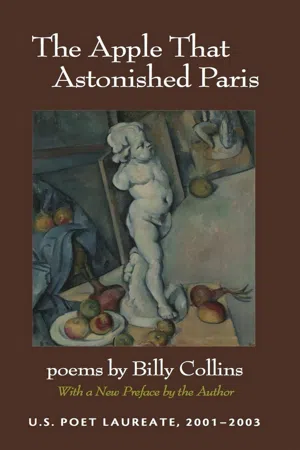
The Apple That Astonished Paris
eBook - ePub

The Apple That Astonished Paris

Poems

  1. English
  2. ePUB (mobile friendly)
  3. Available on iOS & Android
eBook - ePub

The Apple That Astonished Paris

Poems

About this book

Bruce Weber in the New York Times called Billy Collins "the most popular poet in America." He is the author of many books of poetry, including, most recently, The Rain in Portugal: Poems.

In 1988 the University of Arkansas Press published Billy Collins's The Apple That Astonished Paris, his "first real book of poems," as he describes it in a new, delightful preface written expressly for this new printing to help celebrate both the Press's twenty-fifth anniversary and this book, one of the Press's all-time best sellers. In his usual witty and dry style, Collins writes, "I gathered together what I considered my best poems and threw them in the mail." After "what seemed like a very long time" Press director Miller Williams, a poet as well, returned the poems to him in the "familiar self-addressed, stamped envelope." He told Collins that there was good work here but that there was work to be done before he'd have a real collection he and the Press could be proud of: "Williams's words were more encouragement than I had ever gotten before and more than enough to inspire me to begin taking my writing more seriously than I had before."

This collection includes some of Collins's most anthologized poems, including "Introduction to Poetry," "Another Reason Why I Don't Keep a Gun in the House," and "Advice to Writers." Its success over the years is testament to Collins's talent as one of our best poets, and as he writes in the preface, "this new edition . . . is a credit to the sustained vibrancy of the University of Arkansas Press and, I suspect, to the abiding spirit of its former director, my first editorial father."

Frequently asked questions

Yes, you can cancel anytime from the Subscription tab in your account settings on the Perlego website. Your subscription will stay active until the end of your current billing period. Learn how to cancel your subscription.
At the moment all of our mobile-responsive ePub books are available to download via the app. Most of our PDFs are also available to download and we're working on making the final remaining ones downloadable now. Learn more here.
Perlego offers two plans: Essential and Complete
  • Essential is ideal for learners and professionals who enjoy exploring a wide range of subjects. Access the Essential Library with 800,000+ trusted titles and best-sellers across business, personal growth, and the humanities. Includes unlimited reading time and Standard Read Aloud voice.
  • Complete: Perfect for advanced learners and researchers needing full, unrestricted access. Unlock 1.4M+ books across hundreds of subjects, including academic and specialized titles. The Complete Plan also includes advanced features like Premium Read Aloud and Research Assistant.
Both plans are available with monthly, semester, or annual billing cycles.
We are an online textbook subscription service, where you can get access to an entire online library for less than the price of a single book per month. With over 1 million books across 1000+ topics, we’ve got you covered! Learn more here.
Look out for the read-aloud symbol on your next book to see if you can listen to it. The read-aloud tool reads text aloud for you, highlighting the text as it is being read. You can pause it, speed it up and slow it down. Learn more here.
Yes! You can use the Perlego app on both iOS or Android devices to read anytime, anywhere — even offline. Perfect for commutes or when you’re on the go.
Please note we cannot support devices running on iOS 13 and Android 7 or earlier. Learn more about using the app.
Yes, you can access The Apple That Astonished Paris by Billy Collins in PDF and/or ePUB format, as well as other popular books in Literature & American Poetry. We have over one million books available in our catalogue for you to explore.

Information

II
HOME
BOOKS
From the heart of this dark, evacuated campus
I can hear the library humming in the night,
a choir of authors murmuring inside their books
along the unlit, alphabetical shelves,
Giovani Pontano next to Pope, Dumas next to his son,
each one stitched into his own private coat,
together forming a low, gigantic chord of language.
I picture a figure in the act of reading,
shoes on a desk, head tilted into the wind of a book,
a man in two worlds, holding the rope of his tie
as the suicide of lovers saturates a page,
or lighting a cigarette in the middle of a theorem.
He moves from paragraph to paragraph
as if touring a house of endless, panelled rooms.
I hear the voice of my mother reading to me
from a chair facing the bed, books about horses and dogs,
and inside her voice lie other distant sounds,
the horrors of a stable ablaze in the night,
a bark that is moving toward the brink of speech.
I watch myself building bookshelves in college,
walls within walls, as rain soaks New England,
or standing in a bookstore in a trench coat.
I see all of us reading ourselves away from ourselves,
straining in circles of light to find more light
until the line of words becomes a trail of crumbs
that we follow across a page of fresh snow;
when evening is shadowing the forest
and small birds flutter down to consume the crumbs,
we have to listen hard to hear the voices
of the boy and his sister receding into the woods.
ON CLOSING ANNA KARENINA
I must have started reading this monster
a decade before Tolstoy was born
but the vodka and the suicide are behind me now,
all the winter farms, ice-skating and horsemanship.
It consumed so many evenings and afternoons,
I thought a Russian official would appear
to slip a medal over my lowered head
when I reached the last page.
But I found there only the last word,
a useless looking thing, stalled there,
ending its sentence and the whole book at once.
With no more plot to nudge along and nothing
to unfold, it is the only word with no future.
It stares into space and chants its own name
as a traveler whose road has just vanished
might stare into the dark, vacant fields ahead,
knowing he cannot go forward, cannot go back.
INDOORS
I lose perspective in national museums
wandering through the nest of rooms.
I forget that history is a long scroll
floating over a smoky battlefield.
When I bend over a glass case to inspect
the detail on an engraved shield,
I stop at a curlicue as if it were everything.
Then in the rare books room I am mesmerized
by little illustrations in the margins
of dictionaries, ink pictures of a lizard, a kayak.
Lost down a corridor of suits of armor,
I cannot find the daylight of an exit
or even an airy room of outdoor paintings,
no blue sky and white clouds in a gold frame.
Maybe it is time to return to the beginning
of knowledge, to relearn everything quietly,
to open an alphabet book and say to myself,
lips moving silently, A is for Apple.
DEATH
In the old days news of it traveled by foot.
An aproned woman would wave to her husband
as he receded down the lane, hauling
the stone of the message.
Or someone would bring it out by horse,
a boy galloping, an old man trotting along.
A girl would part a curtain wondering
what anyone would be doing here at this hour,
as he dismounted, hitched the beast to a post,
then lifted the brass knocker, cold as the night.
But today we have the telephone.
You can hear one from where you are right now,
its hammer almost touching the little bell,
ready to summon you, ready to fall from your hand.
REMEMBERING DREAMS
No one seems to be a champ at this.
We lift from the pillow a head flickering
with the light from an unlikely scene:
we are driving backwards down a highway in space
or searching a house with cockeyed walls for a door,
or stairs, and running into the face of a dead uncle.
But the rest of the story vanishes
as if someone had ripped an ancient epic from our hands
leaving us with a fragment, a few hexameters
whose rhythm is drowned out by the beat of daylight.
Just as well we salvage ...

Table of contents

  1. Title Page
  2. Copyright Page
  3. Dedication
  4. Contents
  5. Acknowledgments
  6. Preface
  7. I. AWAY
  8. II. HOME
  9. About the Author