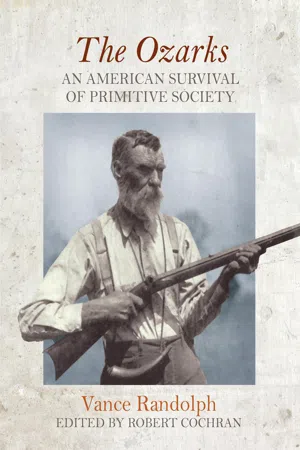
Vance Randolph was perfectly constituted for his role as the chronicler of Ozark folkways. As a self-described "hack writer," he was as much a figure of the margins as his chosen subjects, even as his essentially romantic identification with the region he first visited as the vacationing child of mainstream parents was encouraged by editors and tempered by his scientific training. In The Ozarks, originally published in 1931, we have Randolph's first book-length portrait of the people he would spend the next half-century studying. The full range of Randolph's interests—in language, in hunting and fishing, in folksongs and play parties, in moonshining—is on view in this book that made his name; forever after he was "Mr. Ozark," the region's preeminent expert who would, in collection after collection, enlarge and deepen his debut effort. With a new introduction by Robert Cochran, The Ozarks is the second entry in the Chronicles of the Ozarks series, a reprint series that will make available some of the Depression Era's Ozarks books. An image shaper in its day, a cultural artifact for decades to come, this wonderful book is as entertaining as ever.
- English
- ePUB (mobile friendly)
- Available on iOS & Android
eBook - ePub
About this book
Information
CHAPTER VII.
Ozark Folk-Songs
IN PIONEER DAYS THE OZARK hillmen had religious scruples against dancing and card-playing, and singing was one of their principal forms of social entertainment. Men and women who sang well were always in demand, and enjoyed considerable prominence in the social life of the neighborhood. They had no written music, and most of them could not read anyhow, so they clung to the good old songs which their parents sang before them, and which had been perpetuated for generations by oral transmission.
Recently, however, the Ozark country has been commercialized as a Summer playground, and the younger hill people in particular are now more or less corrupted by contact with the tourists and realtors. Since the coming of schools, newspapers and phonographs the old songs and ballads are rapidly falling into disrepute; the younger generation knows little about them and cares less, while the older people have grown sensitive and sullen under the derision of the schoolmarms and other rural cognoscenti, and are more and more inclined to keep their memories to themselves.
It is still possible, however, for the diplomatic collector to obtain a considerable number of old songs in the more isolated sections of the Ozark highland, and it is a harvest well worth the reaping. Some of the oldest ballads came over from England with the seventeenth-century colonists, others are evidently later importations, still others had their origin in the mountains of Kentucky and Tennessee, and some are derived from comparatively modern songs which have somehow filtered into the hill country, to be gradually molded by the mountain singers into the traditional folk-song pattern. Whatever their origin, the Ozark singers have long ago lost all knowledge of the authorship and provenience of these pieces, and they are all true folk-songs in the modern sense of the term.
The collecting of this material is a delicate and difficult matter at best, and the man who simply rides up to a mountain cabin and asks somebody to sing old songs will never hear any songs worth recording. The successful collector must either be introduced and vouched for by someone whom the natives know and trust, or he must cultivate the hillman for himself, and lead up to the subject of balladry by slow and easy stages. The mountain man usually begins the conversation, and the stranger must always be prepared to give his name, his address, and all the details of his lineage and means of livelihood, after which he is usually permitted to talk on topics of general interest as freely as he likes. Meanwhile the hillfolk sit around and eye him narrowly, usually replying in a courteous but noncommittal fashion. After an hour or so of this, if he has convinced them that he is a serious minded and responsible person, not too “fine-haired” or “stuck-up”, he may at least make known the object of his quest.
I usually begin by telling them frankly that I am getting up an old-fashioned songbook in order that our children may be able to sing the good old ballads, which are infinitely superior to the songs in vogue among the young folk today. Many people, I aver, would be glad to buy a book with the real old-time songs in it, were such a book obtainable. The trouble is, however, that so many of the old ballad-singers have died recently—and here I name several local examples—that it is mighty hard to find anybody who can sing the old songs properly. At this point there is often a vigorous nodding of heads, because every singer knows that he sings the ballads correctly, and that all other versions are degenerate corruptions. “Now”, I say to the most promising member of the group, “folks all tell me that you know more old songs than anybody else in these parts, and I have ridden a long way today to ask you to sing a few of the best ones, so that I can write them down and print them in my book.”
Only in rare instances is there any immediate response to such a plea as this. Usually, after some meditation, the person addressed admits that perhaps he might have sung a little in his youth, but adds that he has long ago forgotten every word of the old songs. Very often he refers me to some other old singer, and volunteers minute directions as to the best route to the other singer’s cabin. I always make a careful note of this information, but do not make any motion to leave; I rather try to lead the talk away from old songs for awhile, in order to let the singer consider the matter a bit, and get accustomed to the idea of singing for me.
After awhile, if nobody returns to the subject nearest my heart, I name over a few of the songs that I am most anxious to obtain. If this fails to get any response I whistle a bar or two, and then say suddenly: “By the way, I got a good one the other day from old man so-and-so,” naming some local character known to my hearers, and then boldly begin to sing the ballad, but contrive to make some grievous error in the third or fourth stanza. This butchering of an old favorite is more than any genuine ballad-singer can endure, and he frequently bursts out with “Hell! Thet aint it!” after which he is very likely to sing the entire song without any further persuasion. It is a peculiar fact that, the ice once broken, the singe...
Table of contents
- Cover Page
- Title Page
- Copyright Page
- Dedication
- Contents
- Series Editor’s Preface
- Introduction
- Author’s Preface
- I. Old Trails and Campfires
- II. The Hill-Billy at Home
- III. Womenfolk and Social Life
- IV. The Ozark Dialect
- V. Signs and Superstitions
- VI. The Passing of the Play-Party
- VII. Ozark Folk-Songs
- VIII. Ways That Are Dark
- IX. Shooting for Beef
- X. Jumpers, Giggers and Noodlers
- XI. Fools’ Gold
- XII. The Coming of the “Furriners”
Trusted by 375,005 students
Access to over 1.5 million titles for a fair monthly price.
Study more efficiently using our study tools.
Frequently asked questions
Yes, you can cancel anytime from the Subscription tab in your account settings on the Perlego website. Your subscription will stay active until the end of your current billing period. Learn how to cancel your subscription
No, books cannot be downloaded as external files, such as PDFs, for use outside of Perlego. However, you can download books within the Perlego app for offline reading on mobile or tablet. Learn how to download books offline
Perlego offers two plans: Essential and Complete
- Essential is ideal for learners and professionals who enjoy exploring a wide range of subjects. Access the Essential Library with 800,000+ trusted titles and best-sellers across business, personal growth, and the humanities. Includes unlimited reading time and Standard Read Aloud voice.
- Complete: Perfect for advanced learners and researchers needing full, unrestricted access. Unlock 1.5M+ books across hundreds of subjects, including academic and specialized titles. The Complete Plan also includes advanced features like Premium Read Aloud and Research Assistant.
We are an online textbook subscription service, where you can get access to an entire online library for less than the price of a single book per month. With over 1.5 million books across 990+ topics, we’ve got you covered! Learn about our mission
Look out for the read-aloud symbol on your next book to see if you can listen to it. The read-aloud tool reads text aloud for you, highlighting the text as it is being read. You can pause it, speed it up and slow it down. Learn more about Read Aloud
Yes! You can use the Perlego app on both iOS and Android devices to read anytime, anywhere — even offline. Perfect for commutes or when you’re on the go.
Please note we cannot support devices running on iOS 13 and Android 7 or earlier. Learn more about using the app
Please note we cannot support devices running on iOS 13 and Android 7 or earlier. Learn more about using the app
Yes, you can access The Ozarks by Vance Randolph, Robert Cochran in PDF and/or ePUB format, as well as other popular books in Social Sciences & Cultural & Social Anthropology. We have over 1.5 million books available in our catalogue for you to explore.