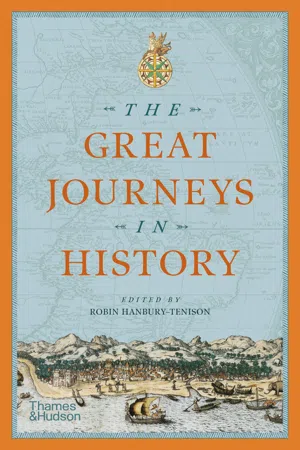
Marco Polo, Ferdinand Magellan, David Livingstone, Amelia Earhart, Neil Armstrong: these are some of the greatest travellers of all time. This book chronicles their stories and many more, describing epic voyages of discovery from the extraordinary migrations out of Africa by our earliest ancestors to the latest voyages into space. In antiquity, we follow Alexander the Great to the Indus and Hannibal across the Alps; in medieval times we trek beside Genghis Khan and Ibn Battuta. The Renaissance brought Columbus to the Americas and the circumnavigation of the world. The following centuries saw gaps in the global maps filled by Tasman, Bering and Cook, and journeys made for scientific purposes, most famously by von Humboldt and Darwin. In modern times, the last inhospitable ends of the earth were reached including both poles and the world's highest mountain and new elements were conquered. With evocative photographs, paintings and portraits, The Great Journeys in History reveals the stories of those who were there first, who explored the unexplored and who set out into the unknown, bringing alive the romance and thrill of travel.
- English
- ePUB (mobile friendly)
- Available on iOS & Android
eBook - ePub
The Great Journeys in History
About this book
Information
Subtopic
World HistoryIndex
History19TH CENTURY
Scientific investigation explodes in the 19th century, when intrepid explorers penetrate pristine regions to apply Linnaean principles of classification to the welter of unknown plants and animals they find. Some began also to recognize and record the experience and wisdom of the people they met. This is the great era of exploration, when most of the remaining blanks on the maps of Africa, South America and Central Asia are filled in. The search for fame and glory spurs many, while others are driven by religious or patriotic fervour. National pride in simply being the first begins to play a major role, and this is evident wherever flags are proudly raised, but behind this nearly always lay the global scramble for power and influence.
In the 19th century travel enjoyed its finest hour. These were true ‘Renaissance Men’ – fearless and brave, they were scientists, linguists, archaeologists and naturalists. They spent years in often desperately harsh conditions, plagued by diseases such as malaria and surrounded by hostile locals – many died on their travels – but they were determined to succeed. They began the massive task of unravelling how the world worked, and named and labelled everything they encountered.
Humboldt epitomized this attitude. A rich German nobleman, he took huge amounts of equipment with him and recorded absolutely everything he could get his hands on. The breadth of his travels throughout South America still dazzle and his scientific output remains of interest and value. Darwin was cast in the same mould. Although his journeys were less arduous, his conclusions resulted in the theory of evolution, which he propounded in On the Origin of Species, and changed our view of the world for ever.
Other scientists began to examine the traces of vanished civilizations, travelling into remote parts of the known and still unknown world to do so. Burckhardt, travelling in disguise, was the first westerner to visit Petra, as well as many of the legendary Egyptian temples, such as Abu Simbel, some of which Belzoni was soon to excavate. Stephens and Catherwood were revealing similar treasures in the jungles of Central America, where huge Maya temples had lain hidden for hundreds of years.
Back in Africa, Barth finally crossed the Sahara and demonstrated that the legendary empires to its south and the fabled city of Timbuktu were not as great as had been thought. The search for the source of the Nile gathered pace, sending Burton, Speke and many others to compete for the prize of finding it. Livingstone’s colossal journeys through the continent revealed more of its geography, followed by Stanley, who crossed it from side to side. The Frenchman Garnier, hailed at that time with Livingstone as one of the two greatest explorers of the age, set off up another major unknown river, the Mekong in Southeast Asia. His journey was to lay the foundations of an empire, the French colonies of Indo-China.
Burke and Wills successfully crossed Australia for the first time, but perished in the attempt. Doughty and Palgrave penetrated the wastes of Arabia Deserta, to be followed by others fascinated by the purity of these arid regions and the hard people who lived there. Przhevalsky and Younghusband competed to unravel the mysteries of remote parts of Central Asia, and began the Great Game for economic and strategic advantage between their Russian and British masters. In places where westerners could not go, however clever their disguise, the exploration was done by courageous Pundits, Indian servants of the British Raj, who risked their lives to survey the Himalaya.
In America, the urge to occupy all the lands to the west was given a major boost by the successful crossing of the continent by Lewis and Clark. They were helped by the many Indian tribes they met along their route; this, however, did not prevent their lands being taken from them. Some 10,000 Cherokee people were forced to march from their ancestral homelands along what became known as the Trail of Tears, with many dying on the way. This was only one shameful example of American oppression of its native people at that time.
The search for the Northwest Passage continued, still unsuccessfully and resulting in terrible suffering and loss of life. The attempt by Franklin and his disappearance sparked searches for survivors which continued for a decade, and the route was not successfully negotiated until the next century. By contrast, the Northeast Passage, around the top of Russia, was completed in 1879 by the Swedish naval officer, Nordenskïold. Neither passage fulfilled the hopes of centuries that they would provide fast routes around the continents, but perhaps with global warming that will change.
GHILLEAN PRANCE
ALEXANDER VON HUMBOLDT
1799–1804
I shall collect plants and fossils and make astronomical observations. But that’s not the main purpose of my expedition – I shall try to find out how the forces of nature interact upon one another and how the geographic environment influences plant and animal life. I must find out about the unity of nature.
von Humboldt, 3 June 1799
Alexander von Humboldt was a true polymath who could unite the different sciences of geography, meteorology, magnetism, heat distribution, botany, zoology, anthropology, politics and agriculture. A glance at the list of the equipment he took with him on his expedition shows its broad scientific aims: it includes books, barometers, a rain gauge, chronometers, hygrometers, electrometers, telescopes, sextants, theodolites, quadrants, a dipping needle, compasses, a magnetometer, a pendulum, eudiometers to measure atmospheric oxygen, a cynometer to measure the blueness of the sky, and chemical reagents for analyses. Everything was carted on oxen and mules through the plains of Venezuela and over the Andes of Colombia and Ecuador, and by boat on long trips at sea and along rivers. It is evident that it was all put to good use – everything that could possibly be measured was indeed measured.
An epic journey
A journey that started in 1799 and climbed the highest peak in the Canary Isles, crossed the mountains and plains of Venezuela, ascended the Orinoco to its meeting with the Amazon, briefly visited Cuba, travelled 55 days up the Magdalena River valley, to the great cordilleras and volcanoes around Quito in Ecuador, navigated the margin of the Pacific Ocean, wandered over extensive areas of Mexico and then returned to Europe via the United States in 1804, must certainly rank as one of the great journeys of history.
Humboldt and his travelling companion, the French botanist Aimé Bonpland, set sail from La Coruña in Spain on 15 June 1799 in the ship Pizarro. The ship’s captain was instructed to stop in Tenerife long enough for them to ascend Tiede peak, which they determined to be 12,182 ft (3,713 m) high. Humboldt also defined five different zones of vegetation as he ascended the mountain. Already, while waiting for permission from the governor to land, they had measured the longitude of Santa Cruz harbour with their Berthoud’s Chronometer; their figure differed from that of Captain Cook, but was later found to be accurate. From then on measurements, observations and the collecting of specimens never ceased throughout their journey.
The travellers landed at Cumaná on the northern coast of what is now Venezuela on 16 July. During their stay of several months they made excursions to the Araya Peninsula, Chaima Indian missions and to the caves of the guácharo oil birds. Since there had been earthquakes in Cumaná in 1776 and 1797 Humboldt wrote extensively about them in his Personal Narrative of the expedition. On 11–12 November he observed a spectacular meteor shower of the Leonids. Shortly thereafter the party left for Caracas where they stayed until 7 February 1800, when they set out to explore the Orinoco region.
This remarkable trip crossed the llanos to the Apure River, ascended many cataracts and arrived at San Fernando de Atabapo on 24 April. The Orinoco section of the expedition alone lasted four months and covered 2,760 km (1,725 miles) of wild country, inhabited by many different tribal peoples and with numerous hazardous rapids and plagues of insects. The most important result was establishing the existence of a communication between the water-systems of the Orinoco and the Amazon through the Río Casiquiare. They then drifted downstream to Angostura (now Ciudad Bolívar), from where, after recovering from malaria, they made their way back to Cumaná. Of this part of the expedition Humboldt wrote:
How hard it is to express the pleasure of arriving in Angostura.… The discomforts felt in small boats cannot be compared to those felt under a burning sky, surrounded by swarms of mosquitoes, cramped for months on end in a pirogue that does not let you budge an inch because of its delicate balance.
They next sailed to Cuba on 24 November. During their three-month stay there, Humboldt and Bonpland made several excursions around Havana and then sailed back to the mainland town of Cartagena on 5 March 1801. During the next four months they ascended the swollen Magdalena River to reach Bogotá, where they met the great Spanish botanist José Celestino Mutis. Proceeding south along the Andes they crossed frozen ridges and deep valleys to reach Quito, in Ecuador, on 6 January 1802. During their six months around Quito they ascended the volcanoes Pichincha and Chimborazo. Although they did not reach the summit of the latter, then believed to be the world’s highest mountain, their climb to 6,005 m (19,700 ft) was a world altitude record at the time.
From Quito they made their way to Lima via the sources of the Amazon, arriving on 2 September. At Callao, Humboldt observed the Transit of Mercury and while on the coast he studied the fertilizing properties of guano, which led to its introduction to Europe. On 3 January 1803 they left Guayaquil for Mexico and after a tempestuous sea journey arrived in Acapulco in mid-February. It is appropriate that the ocean current that flows up the western coast of South America is named after Humboldt.
Humboldt and Bonpland reached Mexico City on 11 March and explored the country until early in 1804, including a climb up Jorulla volcano. They then began the return journey home via the United States, first visiting Cuba, where they had left part of their specimens. The purpose of the two-month visit to the United States was to study its political constitution and commercial relations, but Humboldt also befriended president Thomas Jefferson, who asked the German’s advice about the impending expedition by Lewis and Clark (p. 201). The great journey finally ended when Humboldt and Bonpland arrived in Bordeaux on 3 August 1804.

Map of Humboldt and Bonpland’s journey to the equinoctial regions of the New Continent.
Humboldt’s account of his expedition dwells relatively little on the hardships, illnesses and adventures, yet these were numerous. Instead, he wrote extensively about the geology, astronomy, natural history, the measurements of altitudes and longitude, the peoples of the many different cultures he encountered, and the hospitality of many missionaries in Venezuela. We just get a few glimpses of the hazards, such as: ‘The descent [of Cerro Imposible] is very dangerous for the pack-animals; the path is only some 15 inches wide, with precipices on either side’, and he does admit to fright when encountering a large jaguar alone on a beach. Humboldt’s attitude to the indigenous peoples is also commendable. He says that he uses the terms ‘wild’ or ‘savage’ with regret because they imply a difference of cultivation which does not always exist. He provided many useful details about cultures that have long been extinct and became quite concerned about slavery after visiting a slave market in Cumaná.
Scientific results
One of the most remarkable outcomes of Humboldt and Bonpland’s voyage is the huge scientific output they published after their return to Europe. It was so great that only a few publications can be mentioned here. The seven-volume folio Nova Genera et Species Plantarum described and illustrated many new genera and about 4,500 species of plants. This was backed up by a herbarium collection of over 6,000 dried and pressed specimens, and Bonpland’s botanical journal describing 4,000 species. Perhaps the greatest contribution to botany was Humboldt’s Essai sur la Géographie des Plantes, that forms the basis for modern plant geography and ecology. Much light was shed on the migrations and relations of the indigenous tribes of the Americas, their origin, languages and behaviour, in Vues des Cordillères et monumens des peuples indigènes de l’Amérique, published in 1811.
Humboldt also published two volumes on the animals he had encountered, and a geological comparison between the rocks of Europe and South America. His astronomical observations were brought together in Recueil d’obser...
Table of contents
- Cover
- Title Page
- Other titles of interest
- Contents
- Introduction
- Ancient World
- Medieval World
- Plate Section One: Maps
- The Renaissance
- 17th & 18th Centuries
- Plate Section Two
- 19th Century
- Plate Section Three
- Modern Times
- Contributors
- Further Reading
- Sources of Illustrations
- Index
- Copyright
Trusted by 375,005 students
Access to over 1.5 million titles for a fair monthly price.
Study more efficiently using our study tools.
Frequently asked questions
Yes, you can cancel anytime from the Subscription tab in your account settings on the Perlego website. Your subscription will stay active until the end of your current billing period. Learn how to cancel your subscription
No, books cannot be downloaded as external files, such as PDFs, for use outside of Perlego. However, you can download books within the Perlego app for offline reading on mobile or tablet. Learn how to download books offline
Perlego offers two plans: Essential and Complete
- Essential is ideal for learners and professionals who enjoy exploring a wide range of subjects. Access the Essential Library with 800,000+ trusted titles and best-sellers across business, personal growth, and the humanities. Includes unlimited reading time and Standard Read Aloud voice.
- Complete: Perfect for advanced learners and researchers needing full, unrestricted access. Unlock 1.5M+ books across hundreds of subjects, including academic and specialized titles. The Complete Plan also includes advanced features like Premium Read Aloud and Research Assistant.
We are an online textbook subscription service, where you can get access to an entire online library for less than the price of a single book per month. With over 1.5 million books across 990+ topics, we’ve got you covered! Learn about our mission
Look out for the read-aloud symbol on your next book to see if you can listen to it. The read-aloud tool reads text aloud for you, highlighting the text as it is being read. You can pause it, speed it up and slow it down. Learn more about Read Aloud
Yes! You can use the Perlego app on both iOS and Android devices to read anytime, anywhere — even offline. Perfect for commutes or when you’re on the go.
Please note we cannot support devices running on iOS 13 and Android 7 or earlier. Learn more about using the app
Please note we cannot support devices running on iOS 13 and Android 7 or earlier. Learn more about using the app
Yes, you can access The Great Journeys in History by Robin Hanbury-Tenison in PDF and/or ePUB format, as well as other popular books in History & World History. We have over 1.5 million books available in our catalogue for you to explore.