The expansion of capitalism and neoliberal ideologies have delivered economic integration between countries and brought global inter-connectedness to individuals. So why do so many people now feel that they are citizens of nowhere, disparaged by the cosmopolitan elites? Has democracy and the power of nation states been irredeemably weakened by unfettered global finance, opaque forms of global governance, and the power of transnational corporations? Can the huge rise in social and economic inequality be reversed? Can diverse cultural expression be maintained in a globalizing world? In the context of the current nationalist backlash and the momentous impacts of the COVID-19 pandemic, this thought-provoking volume considers whether globalization is dead or whether it will survive, and perhaps transform. Written in a clear and engaging style, the volume traces the development of economic globalization starting from the first wave of colonialization in the 15th century, through the first period of globalization at the end of the 19th century, and up to the contemporary period of globalization that started in the 1980s and appears today to be teetering on the brink of collapse. It explores the impacts of globalization on todays world, from global supply chains and tax havens to rising economic inequality, climate change and pandemics, and assesses the different impacts on rich and poor countries, and on the rich and poor within countries. It then reviews the growing anti-globalization sentiment, starting from the anti-IMF protests that raged through developing countries in the 1980s and 1990s, to the emergence of the transnational anti-globalization movement of the 2000s, to more recent uprisings such as the Arab Spring, The Occupy Movement, the Gilets Jaunes, and to the current populist nationalist backlash led by President Trump and embodied in the 2016 Brexit vote. Sensing that globalization has reached a tipping point, the book considers a range of possible scenarios for the future world order, including nationalism, authoritarianism and democratic globalism. Finally, it explores whether globalization can be democratized in a world in which effective and inclusive global governance is crucial to solving global problems, such as tackling climate change, controlling global pandemics and upholding universal human rights.
- English
- ePUB (mobile friendly)
- Available on iOS & Android
eBook - ePub
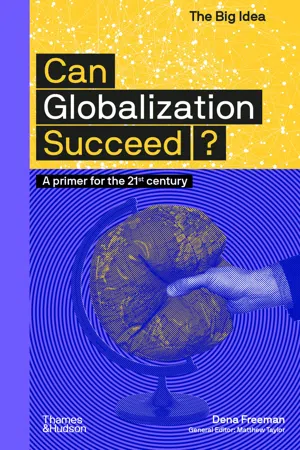
Can Globalization Succeed?
About this book
Information
Subtopic
Mondialisation1. The History of Globalization


AAn account of Peruvian history sent by a Peruvian noble to the King of Spain in 1615. In the 16th century Spanish conquistadors seized Mexico from the Aztec people and Peru from the Incas, plundered their riches and killed millions of native inhabitants.
While complex systems of long-distance exchange first emerged thousands of years ago, and empires have waxed and waned across large swathes of Asia and Europe since c. 3000 BC, it was European sea-faring technology that eventually brought the whole world into one interconnected system.
At the end of the 14th century, the world consisted of large empires in Asia – most importantly the Ming dynasty (1368–1644) in China and the Mughal dynasty (1526–1857) in and around much of present-day India – and a range of small and medium-sized polities in Europe and Africa, all connected through various long-distance trade routes. Farther afield, other small and medium-sized polities existed in the Americas and in the Pacific, but as yet these areas were quite separate and unknown to each other. The development of Portuguese maritime expertise and the desire of the Portuguese king to take control of the lucrative spice trade between Asia and Europe ultimately led to the coming together of these separate spaces and the emergence of a truly global system. Since then, the interconnections have deepened and transformed as we move towards an increasingly globalized world.
The first wave of European colonialism started in the early 15th century, mainly led by Spain and Portugal. During the 15th and 16th centuries, the king of Portugal controlled much of the coast of Africa, major areas of southern India and South East Asia, and parts of what is now Brazil, while the king of Spain controlled most of what was known of the Americas. Whereas the Portuguese focused on trade, the Spanish decided to form large settlements in their colonies. Thousands of Spaniards flocked to the Americas to explore and settle the new lands.
The territory was, of course, not empty, but full of native peoples, and a series of violent wars ensued as the local people sought to defend themselves and their resources against the foreign invaders. Europeans also brought new diseases to the Americas, including smallpox, measles, typhus and cholera, leading to the deaths of millions of native people. On their return home, European sailors brought syphilis to Europe, which though less lethal caused great social disruption across the continent.
In their search for cheap labour to work on the plentiful American lands, the Spanish and Portuguese developed the transatlantic slave trade. In 1526, the Portuguese made the first transatlantic slave voyage, bringing slaves from Africa to Brazil, and over the next 300 years some 12 million Africans were abducted from their communities, sold to Europeans and brought to the Americas as slaves to work in appalling conditions in the plantations and mines.
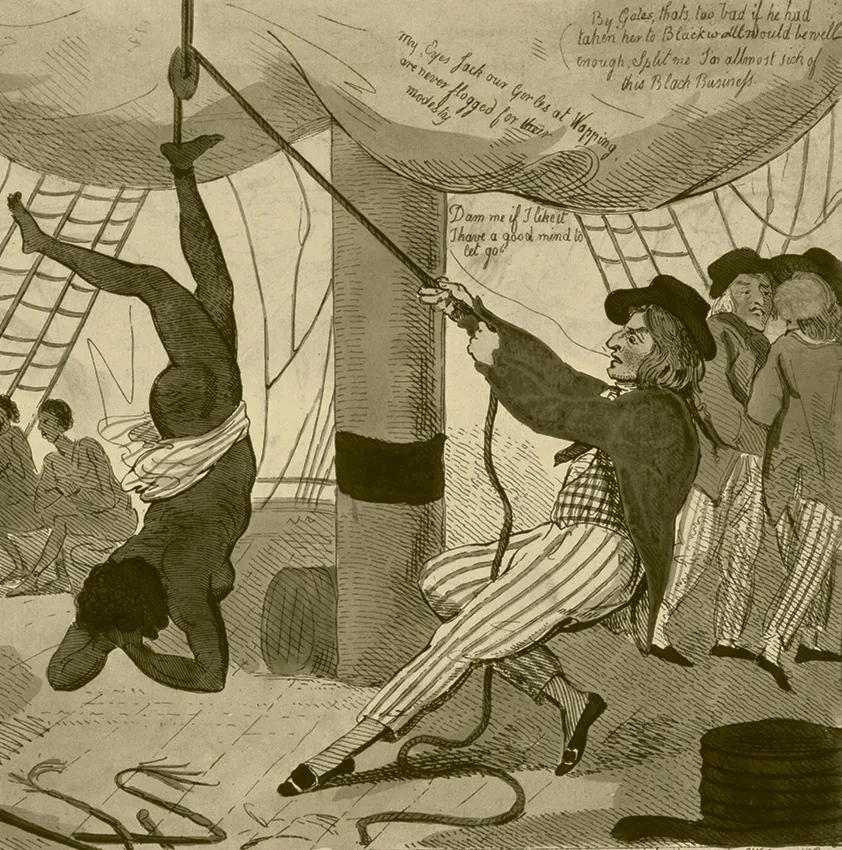
BAfrican slaves were subject to inhumane conditions on the slave ships, as shown in this picture by Isaac Robert Cruickshank from 1792.

CA slave auction in Richmond, Virginia, 1860. In the Americas, African slaves were bought and sold as commodities. In Africa, slave raiding led to the breakdown of local communities and the collapse of emergent state systems.
As voyagers travelled back and forth between Europe, Africa and the Americas, they brought with them animals, plants, fungi, diseases, technologies, minerals and ideas, changing lives and landscapes on both sides of the ocean. Known as the ‘Columbian exchange’, this movement of goods between the New World and the Old World can be thought of as the first globalization – the globalization of crops and diseases.
A second wave of European colonialism took place in the 17th and 18th centuries as France, Britain and the Netherlands began to compete with Spain and Portugal for control of territories around the world. During this period, the form of colonialism also began to change, linked to the emergence of an early form of capitalism known as mercantile capitalism. Instead of being carried out by individuals on behalf of the king, colonial activities were increasingly carried out by chartered trading companies: joint-stock companies that had received a monopoly over a particular trade from the king. In essence, these chartered companies were the first transnational corporations (TNCs). However, in contrast to today’s corporations, which are seen as part of the private sector and quite distinct from the state, these chartered companies were in some senses arms of the emerging state.
In mercantile capitalism, or mercantilism, money is made mainly by buying goods from a market where they are cheap and then transporting them and selling them in a market where they are expensive.
Chartered trading companies included the Dutch East India Company, the Royal African Company and the Hudson’s Bay Company. The first major chartered trading company was the Muscovy Company, formed in 1555 and given a monopoly to trade between England and Muscovy (a principality centred around Moscow).

AAn 18th-century portrayal of a British East India Company official riding on an elephant. At the height of its power the company ruled over one-fifth of the world’s people, ran a huge private army and generated a revenue greater than that of the whole of Britain.
Their charters gave them not only a monopoly over a particular trade, but also sovereign powers over the lands where they traded. They could wage wars, set up forts and trading posts, print money, impose duties and tariffs, enter into treaties, administer justice and generally rule the local population. Wars could be waged between rival corporations abroad without the European states getting involved.
During the 19th century, a number of political, economic and technological changes took place in Europe, which brought about the modern world order and set the scene for real economic globalization. States became the basic unit of political organization, the Industrial Revolution set in motion a global system of production, exchange and consumption, and workers and poor people began to demand democracy and political emancipation.
In the Industrial Revolution (1760–1840) new manufacturing processes were developed which made use of machines, steam engines and chemical agents, leading to the rise of the mechanized factory system.

AAn illustration of the battle between British soldiers and citizens of Boston in 1770 that became known as the ‘Boston Massacre’. In the late 18th century the thirteen colonies fought against the British and eventually gained independence in 1776. Similar wars of independence soon followed in Latin America and by 1830 almost all of the Americas, with the exception of Canada, had gained independence and become sovereign states in their own right.
By the end of the 18th century, sovereign states had emerged as the main unit in which society and politics were organized in Europe and the Americas. While European overseas empire would continue for another 150 years, and indeed expand, the course had now been set towards the world of independent sovereign states, which would finally come fully into being in the late 20th century.
Sovereign states are political entities that have one centralized government that has sovereignty over a specific territory. They came into being in Europe during the 17th and 18th centuries. Before that, in the medieval period, there was a mix of city states, fiefdoms, kingdoms and empires. None of these were sovereign, because the Pope and the Catholic Church could intervene in their affairs.
During the same period, the scientific revolution and Enlightenment, with their focus on reason, progress and liberty, had brought forward new theories of government. The philosophy of liberalism, with its idea that all people should be considered as citizens of the state, with equal rights and equal representation, had begun to catch the public imagination. In 1789 the French Revolution sought to sweep away the traditional, hierarchically structured ‘ancien régime’ and to establish instead a democratic republic based on Enlightenment ideals of liberty, equality and democracy.
Over the course of the 19th century, a long process of dem...
Table of contents
- Cover
- Title Page
- About the Authors
- Other titles of interest
- Contents
- Milestones
- How to Read
- Introduction
- 1. The History of Globalization
- 2. The Impact of Globalization Today
- 3. The Anti-Globalization Backlash
- 4. Is Another Globalization Possible?
- Conclusion
- Further Reading
- Picture Credits
- Index
- Acknowledgments
- Copyright
Trusted by 375,005 students
Access to over 1.5 million titles for a fair monthly price.
Study more efficiently using our study tools.
Frequently asked questions
Yes, you can cancel anytime from the Subscription tab in your account settings on the Perlego website. Your subscription will stay active until the end of your current billing period. Learn how to cancel your subscription
No, books cannot be downloaded as external files, such as PDFs, for use outside of Perlego. However, you can download books within the Perlego app for offline reading on mobile or tablet. Learn how to download books offline
Perlego offers two plans: Essential and Complete
- Essential is ideal for learners and professionals who enjoy exploring a wide range of subjects. Access the Essential Library with 800,000+ trusted titles and best-sellers across business, personal growth, and the humanities. Includes unlimited reading time and Standard Read Aloud voice.
- Complete: Perfect for advanced learners and researchers needing full, unrestricted access. Unlock 1.5M+ books across hundreds of subjects, including academic and specialized titles. The Complete Plan also includes advanced features like Premium Read Aloud and Research Assistant.
We are an online textbook subscription service, where you can get access to an entire online library for less than the price of a single book per month. With over 1.5 million books across 990+ topics, we’ve got you covered! Learn about our mission
Look out for the read-aloud symbol on your next book to see if you can listen to it. The read-aloud tool reads text aloud for you, highlighting the text as it is being read. You can pause it, speed it up and slow it down. Learn more about Read Aloud
Yes! You can use the Perlego app on both iOS and Android devices to read anytime, anywhere — even offline. Perfect for commutes or when you’re on the go.
Please note we cannot support devices running on iOS 13 and Android 7 or earlier. Learn more about using the app
Please note we cannot support devices running on iOS 13 and Android 7 or earlier. Learn more about using the app
Yes, you can access Can Globalization Succeed? by Dena Freeman in PDF and/or ePUB format, as well as other popular books in Politique et relations internationales & Mondialisation. We have over 1.5 million books available in our catalogue for you to explore.