A first-ever account of one of the United Kingdom's foremost ducal families and a history of the times in which they lived.
Discover over two hundred years of fascinating history relating to one of Great Britain's foremost aristocratic dynasties, the (Orde-) Powletts, for several generations the Dukes of Bolton. The family motto, Love Loyalty, references their devotion to the monarchy, but it applies equally to their hearts. Willing to risk all in the pursuit of love, this is the previously untold story of the Dukes of Bolton and their ancestors—the men and women who shaped the dynasty, their romances, triumphs, foibles, and tragedies.
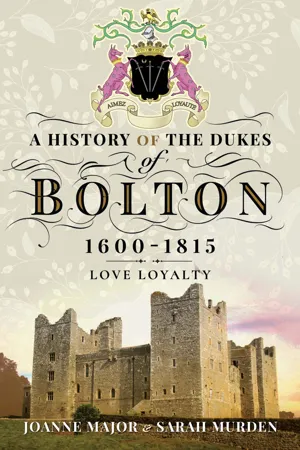
- 200 pages
- English
- ePUB (mobile friendly)
- Available on iOS & Android
eBook - ePub
About this book
Information
Chapter One
A Sudden Death in Grosvenor Square

Wednesday, 5 July 1765: Grosvenor Square, Mayfair, London
In the heat of the late morning’s summer sun, while servants bustled inside elegant townhouses and tradesmen outside called out their wares for sale, the well-heeled residents of Grosvenor Square were rising from their slumbers to a fashionably late breakfast. The normality of everyday life shattered when a loud pistol shot exploded the scene, its echo reverberating against the houses that lined the square, before fading to a shocked silence. A woman’s piercing, anguished screams filled the void. The 5th Duke of Bolton, dressed simply in breeches, morning gown and a cap, had taken down one of the two pistols that hung above the mantelpiece in the front parlour of his home on the south side of Grosvenor Square. With a calmness that belied his intentions, it was the matter of a moment for the duke to load the pistol, hold it against the right side of his head … and pull the trigger.1
Mary Banks Brown, the duke’s long-term mistress and mother of his daughter, had been upstairs in her drawing room. When the shot rang out, Mary ran pell-mell down the stairs. The door to the front parlour was locked, but in the back parlour was an interconnecting door and it was at this door Mary stood, staring and screaming at the awful sight before her. The prone body of the man she loved lay on the floor, a gaping, visceral wound visible on the left side of his head. The pistol still rested in the duke’s right hand. On the floor, among the carnage, was the cap that the duke had been wearing minutes before. When it was picked up, the leaden bullet that had passed clean through the duke’s head was discovered to be resting inside.
Sometime before this fateful day, the entry of the duke and Mary’s clandestine marriage, in a ceremony conducted by the infamous Alexander Keith at the May Fair Chapel in Curzon Street, had been torn from the pages of the register it … had been no marriage at all.
***
The day of the duke’s death had started unremarkably. Charles Powlett, 5th Duke of Bolton, had awoken feeling feverish but there wasn’t anything unusual in that; it was how he had felt on most mornings for more than a month. It was always worse in the morning. He had odd ‘feels’ in his stomach and a trip to the country had done nothing to help. In fact, when the duke returned to his lavish London townhouse in Grosvenor Square, he had been worse than ever. His doctor worried that something troubling was playing on the duke’s mind and making him unwell, but the duke brushed this away. At the same time, Lord Bolton admitted to his doctor that he felt as though his head was confused and – at times – he was afraid that his ‘inward feels’ would get the better of him and he would take leave of his senses.

A perspective view of Grosvenor Square by John Maure, dating to 1741. To the right is the south side of the square where the duke’s house was located. (Yale Center for British Art, Paul Mellon Collection)
Once he was awake, the duke had rung the bell in his bedroom; it was 10 o’clock and George Best, the duke’s valet du chambre scampered upstairs. As usual, the door to the duke’s room was locked. On any other morning the duke would still be reclined in his bed and, when his valet knocked at the door, would stumble out and across to the door to turn the key in the lock. On this day, however, the duke had been up for some time and was dressed in a pair of unbuttoned breeches and a morning gown, a cap on his head. Brushing away his valet’s attentions, Lord Bolton went downstairs to the front parlour on the first floor of the house, his valet following helplessly in his wake. In the parlour, the duke paced around the room looking wild and confused. Best asked his master who he would see that day and got one word growled at him in reply: nobody!
Confused as the duke was, conventions had to be adhered to and he had to be dressed. As the duke sat down to tie the garters to his breeches, his valet dashed back upstairs to fetch the duke’s knee buckles. He was no more than two minutes at most but when he returned, the door from the hall to the parlour had been locked from the inside. George Best sat himself down on a chair in the hallway to wait for the duke to open the door, making the most of the opportunity to idle for a few stolen minutes on such a pleasant morning.
From his vantage point outside the parlour, the valet heard a knock at the front door and saw a footman open it to Joseph Partridge, who was shown in. Partridge was one of the partners of the well-established apothecary firm of Truesdale, Partridge and Halifax in St James’s Street; he had been treating the duke for his feverish complaint for several weeks, with little success. George Best ran to the door between the two parlours and, in a low voice, informed his master that ‘Mr Partridge the Apothecary is here, My Lord’, but there was no reply. Returning to the hallway, Best told the apothecary that the duke was busy and showed him upstairs to Mrs Brown’s room (as the servants addressed Mary). A short time later, Sir Clifton Wintringham, the duke’s doctor, turned up and he too was escorted upstairs to Mrs Brown. The valet, bored with kicking his heels in the hallway, crept away to the lower floor and the more comfortable surroundings of the housekeeper Eleanor Carter’s room.2
Wintringham was the best doctor in London. He had been employed by William, Duke of Cumberland and had served as one of the two joint military physicians to the armed forces. Since 1762 Wintringham had been elevated to the role of physician-in-ordinary to Cumberland’s older brother, King George III. The Duke of Bolton, a former army officer himself and one of Cumberland’s friends, chose to employ the best and most fashionable medical attendants London had to offer, although little good it did him.3
Mary sent a footman named Joseph Smart downstairs to make sure the duke knew his doctor had arrived; Joseph knocked on the door between the front parlour and the hall two or three times but received no answer. By this time, it was 11 o’clock. Smart turned to go back up to Mrs Brown’s room when the gunshot rang out and a commotion broke out on the floor above. In a blind panic, Mary ran down the stairs, into the back parlour and pulled open the connecting door to the front parlour. There she stood, screaming in horror at the scene before her eyes. Sir Clifton Wintringham and Joseph Partridge ran into the room but there wasn’t anything they could do other than confirm what was already obvious: Charles Powlett, 5th Duke of Bolton, was dead … by his own hand.
The newspapers were circumspect in their manner of reporting the incident, informing their readers of the duke’s sad demise after ‘a short illness’. The gossips knew better though, and the news rippled across London and then further afield. In his Downing Street office, just a few hours after the duke’s suicide, the Prime Minister George Grenville scribbled a postscript onto the end of the letter he had written to Thomas Villiers, Lord Hyde: ‘This afternoon a most melancholy event has happened or at least is confidently reported that the Duke of Bolton shot himself through the head and died immediately at his house in Grosvenor Square.’4
The following day Grenville wrote to his elder brother, Richard Grenville-Temple, 2nd Earl Temple. As is the wont, embellishments to the sorry tale had already crept in, clinging tentacle-like as high-society tongues began to wag:
Downing Street, 6 July 1765
My dear Brother,
It is with the greatest concern that I mention to you the melancholy event which was reported yesterday and is confirmed today of the sudden death of the Duke of Bolton. The circumstances attending this misfortune if true render it still more deplorable. Many are talked of and amongst others the following which seems the most probable. He is said to have returned home from riding out and soon after to have complained of a most violent pain in his head and that in order to obtain some relief from it he sent his servant for a surgeon to bleed him, who at his return found the Duke dead upon the floor shot through the head. If this was the case this unhappy accident seems to have been the effect of the gout flying up into his head to a degree to bereave him of his senses. To whatever cause it was owing, his loss will I am afraid effect you very sensibly from the honourable attachment which I understand he has born [sic] towards you and that consideration cannot but extend itself to me whose cordial affection to you will ever make me take the warmest and sincerest part in whatever gives you grief or joy. I will say no more upon this unhappy subject.5

Richard Grenville Temple, engraving of a portrait by William Hoare. (New York Public Library)
Lord Temple’s seat was the magnificent Stowe House in Buckinghamshire, a grand mansion set amid picturesque landscaped grounds laid out by Capability Brown (who had been the estate’s head gardener). It was from this idyllic setting that Lord Temple, reeling from the shocking news, replied to his brother, and the letter contained a thinly veiled reference to the 5th Duke of Bolton’s younger brother and heir, Harry:
Stowe, July 9, 1765
I am much obliged to you, my dear brother, for the trouble you have taken, in sending me an account of the heavy loss I have sustained, in the death of the Duke of Bolton; as bad news travels fast, I learnt it by express a little after six o’clock on the day it happened. I wish I could say he has left many behind him whom I have so abundant reason to love, and honour, to the degree my heart felt for him: but no more on the melancholy subject …6
The eighteenth-century gossip Horace Walpole could not resist adding to the rumours. He wrote to his friend Horace Mann from Arlington Street:
12 July 1765
The Duke of Bolton the other morning – nobody knows why or wherefore, except that there is a good deal of madness in the blood, sat himself down upon the floor in his dressing-room, and shot himself through the head. What is more remarkable is, that it is the same house and same chamber in which Lord Scarborough performed the same exploit. I do not believe that shooting one’s self through the head is catching, or that any contagion lies in a wainscot that makes one pull a suicide-trigger, but very possibly the idea might revert and operate on the brain of a splenetic man. I am glad he had not a blue garter but a red one ...7
(The Duke of Bolton was created a Knight of the Bath in 1753, hence Walpole’s taunt relating to coloured garters. He had hoped to be made a Knight of the Garter, a much higher honour, but had been rebuffed.)
Richard Lumley, 2nd Earl of Scarborough, the former resident of the duke’s Grosvenor Square townhouse, had committed suicide by shooting himself through the roof of his mouth a quarter of a century earlier, although his death was reported as an apoplectic fit. In private, rumours spoke of a recent carriage accident in which the earl had received a bump on the head leading to a temporary mental disorder but, in fact, the earl had been sensible of his act. It was claimed that his bride-to-be, the 34-year-old dowager Duchess of Manchester, née Lady Isabella Montagu, had betrayed Lumley by repeating a secret entrusted to him by the king, George II. The king, when he heard, told Lumley that he had ‘lost a friend and I a good servant’. The disgrace was too much to bear and the earl’s suicide was the result. A third, much simpler reason for Lord Scarborough’s decision to end his life is given by the politician Thomas Anson of Shugborough Hall in Staffordshire, a man who was held in great esteem by the...
Table of contents
- Cover
- Title
- Copyright
- Table of contents
- Introduction
- Acknowledgements
- Monarchs of the Tudor, Stuart and Hanoverian Era
- Notes
- Chapter 1 A Sudden Death in Grosvenor Square
- Chapter 2 The Earl, his Cook and their Castles
- Chapter 3 A Nest of Idolatry
- Chapter 4 The Court-in-Exile
- Chapter 5 Restoration
- Chapter 6 The Great Riddle of the Age
- Chapter 7 Glorious Revolution
- Chapter 8 A Great Booby
- Chapter 9 The Polly Peerage
- Chapter 10 His Brother’s Heir
- Chapter 11 The Duke and his Housekeeper
- Chapter 12 The Last Duke of Bolton
- Chapter 13 Baron Bolton
- Endnotes
- Bibliography
- Plate section
Trusted by 375,005 students
Access to over 1.5 million titles for a fair monthly price.
Study more efficiently using our study tools.
Frequently asked questions
Yes, you can cancel anytime from the Subscription tab in your account settings on the Perlego website. Your subscription will stay active until the end of your current billing period. Learn how to cancel your subscription
No, books cannot be downloaded as external files, such as PDFs, for use outside of Perlego. However, you can download books within the Perlego app for offline reading on mobile or tablet. Learn how to download books offline
Perlego offers two plans: Essential and Complete
- Essential is ideal for learners and professionals who enjoy exploring a wide range of subjects. Access the Essential Library with 800,000+ trusted titles and best-sellers across business, personal growth, and the humanities. Includes unlimited reading time and Standard Read Aloud voice.
- Complete: Perfect for advanced learners and researchers needing full, unrestricted access. Unlock 1.5M+ books across hundreds of subjects, including academic and specialized titles. The Complete Plan also includes advanced features like Premium Read Aloud and Research Assistant.
We are an online textbook subscription service, where you can get access to an entire online library for less than the price of a single book per month. With over 1.5 million books across 990+ topics, we’ve got you covered! Learn about our mission
Look out for the read-aloud symbol on your next book to see if you can listen to it. The read-aloud tool reads text aloud for you, highlighting the text as it is being read. You can pause it, speed it up and slow it down. Learn more about Read Aloud
Yes! You can use the Perlego app on both iOS and Android devices to read anytime, anywhere — even offline. Perfect for commutes or when you’re on the go.
Please note we cannot support devices running on iOS 13 and Android 7 or earlier. Learn more about using the app
Please note we cannot support devices running on iOS 13 and Android 7 or earlier. Learn more about using the app
Yes, you can access A History of the Dukes of Bolton, 1600–1815 by Joanne Major,Sarah Murden in PDF and/or ePUB format, as well as other popular books in History & Historical Biographies. We have over 1.5 million books available in our catalogue for you to explore.