The true crime story of a master swindler and charming con-artist who became one of the most notorious female criminals of the Victorian Age.
'The story of Mrs. Gordon Baillie is stranger than anything to be met with in the field of fiction.'
Mrs. Gordon Baillie, known throughout her life as Annie, was born in the direst poverty in the small Scottish fishing town of Peterhead in 1848. Illegitimate and illiterate, her beauty and intelligence nevertheless enabled her to overcome her circumstances and become a charming and wealthy socialite living a life of luxury while raising money for worthy causes and charitable works.
Behind her supposed perfect and contented life, however, lay one of the most notorious and compulsive swindlers of the Victorian Age. Her fraudulent fundraising and larger-than-life schemes played out across four decades and three continents, and involved land owners, crofters, aristocrats, politicians, bankers, socialist revolutionaries, operatic stars, and the cultural icons of the day.
She became mistress to a rich aristocrat, married a world-renowned male opera singer and later took as a lover a vicar's son with anarchist tendencies. For most of her 'career' she kept one step ahead of the law and her nemesis, Inspector Henry Marshall of Scotland Yard, but finally becoming undone through her own compulsion for petty theft, despite her amassed fortune.
During her life she used more than forty aliases, produced four children and spent her way through millions in ill-gotten wealth. But at the turn of the twentieth century, her notoriety was such that she took refuge in America and disappeared from history.
"If you want to read about a Victorian woman who was able to hide her humble origins in Scotland to become one of the most notorious con-women in well-to-do society—an audacious figure who tried to live the life she felt she deserved rather than the one society wanted her to lead—then this book is highly recommended." —Criminal Historian, Dr Nell Darby
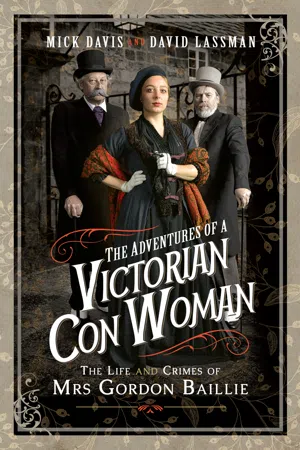
eBook - ePub
The Adventures of a Victorian Con Woman
The Life and Crimes of Mrs Gordon Baillie
- 264 pages
- English
- ePUB (mobile friendly)
- Available on iOS & Android
eBook - ePub
The Adventures of a Victorian Con Woman
The Life and Crimes of Mrs Gordon Baillie
About this book
Information
Print ISBN
9781526764867
Subtopic
Social Science BiographiesPart I
1848–1872
Chapter 1
Origins (1848–68)
In the mid-nineteenth century, Peterhead was a small fishing port in the Scottish county of Aberdeenshire, sited on the easternmost point of the mainland and facing the North Sea. It had once been a popular therapeutic spa town, but the excessive building boom that this success provoked spoiled the sparkling waters, while the growth of its fishing industry meant that the grand houses were divided into ever smaller units and the elegant town became run down. At the time our story begins, most of its inhabitants were involved in the herring industry; immense quantities of which were exported to the Baltic ports.
Running roughly from east to west in the town, and close to the port, stands Maiden Street; parallel rows of two-storey fishermen’s cottages built with large blocks of the local brown stone. Standing out among these was a slightly larger building, number forty-seven, which nestled between the stone and coal yards, close to the lime sheds. The house had long since been divided into single rooms and a Captain Mackie had just left his room there to move out to Fraserburgh, where he took up the position of harbour master. The next occupant was Katherine Reid, known to all as Kate. She had been born in 1820, the daughter of James Reid, a carter from Longside, Aberdeen, and his wife Anne Gibson. Kate is shown in the 1841 census with seven others of about the same age, working as a servant on a farm at Wester Barnyards, Peterhead. By 1847 she was in the employ of another local tenant farmer, John Newbond, in the same capacity, at his farm in Invereddie, Longside. Master and servant soon became lovers, but when she became pregnant with her third child, Newbond threw her out. At first he denied paternity, despite Kate having been his mistress for some time, and implicated ‘other parties’ who frequented the farm, though few doubted that he was the father. Kate found temporary employment on a nearby farm at Bogend, Longside, before taking the room in Maiden Street as the time of her confinement drew near. Kate gave birth to a daughter, whom she named Annie, on 21 February 1848, and soon after took her to stay with the baby’s grandfather, James Reid, who lived at Ugie Street in the north of the town. She found work ‘tramping fish meal’ in the holds of ships, then an important export from Peterhead, and helping to store corn and meal in granaries, before returning to work in the fields at harvest time.
An unnamed acquaintance of the Newbond family described Annie as having been brought up ‘in the purlieus about the Roanheads and across the damnation gutter’, an expression, the informant claims, that ‘could only be understood by those who knew the ideas of caste held by the dwellers on each side of the gutter’; in other words, she was born on the ‘wrong side of the tracks’. Annie’s baptism was not recorded in the register maintained by the Episcopal Church at Peterhead because, according to press reports, a ‘strange incumbent’ was officiating for a time in place of the regular one. The ceremony is alleged to have taken place about six months after the birth, although there are no entries recorded between April and November 1848; just three blank spaces left for names that were never entered. If Annie had been determined to lead a life of deception from the moment of her birth, she could not have planned it better: there is no mention of her in any official church records and there are stories of a dispute with one of the incumbents who left the job, taking some of the parish records with him and destroying them. Years later, when her age became an important issue, the police had to obtain the sworn testimony of two unnamed ‘witnesses to the birth and baptism’. Birth certificates did not become an official requirement in Scotland until 1855.
The first official mention of Annie comes from the 1851 census. On 30 March that year, Katherine Reid, 29, and Annie Newbond, aged 2, are listed as living in a small granite-built cottage in North Street, located just around the corner from James Reid’s house in Ugie Street; there is no mention of her other children. Why she gave her daughter the name of the estranged father, rather than her own, is not known – perhaps to embarrass him into admitting paternity or possibly as an act of spite. It is interesting that the woman who later operated under at least forty aliases never had an officially registered name of her own – in all likelihood she was never baptised. To add to this air of mystery, the census gives her name as Newbond, her mother’s name was Reid and she was brought up as Sutherland. No wonder she found it easy to adopt and discard names at will later in life.
Annie’s paternal family, the Newbonds – sometimes written as Newbound or Newbone – have an interesting connection with alternative identities. In 1790, an Aberdonian named Andrew Shirrefs, known to all as ‘Cripple Andy’ because he needed the aid of a crutch to get about, published a book entitled Poems, Chiefly in the Scottish Dialect. One of the plays in the book was called ‘Jamie and Bess’, a work described by the 1888 reporter for The Aberdeen Free Press who uncovered this link as ‘never rising above respectable mediocrity’. It tells the comic story of two people using false identities to court each other before discovering that they are, in fact, related. The play was first performed in Aberdeen on 12 January 1788, with the two main characters being played by a Mr and Mrs Newbound, who, the reporter claims – quoting an unnamed ‘reliable correspondent’ – were Annie’s grandparents. Their names are printed on the page preceding the play, which shows they must have had some standing in the theatrical world at the time. The famous Scottish poet Robbie Burns met Shirrefs during his third northern tour and noted: ‘Met Mr. Shirrefs, author of “Jamie & Bess” – little decrepit body with some abilities.’
It seems that in about 1818 the Newbonds (or Newbounds) had had enough of touring and settled in Peterhead, then still a fashionable bathing resort attracting, amongst others, the Duke and Duchess of Gordon, who were no doubt drawn by the chalybeate springs in the area. The former ‘strolling players’ settled down to run a pub and stabling establishment, which was notorious for gambling, attracting both local gentry and young ladies of easy virtue. This den of vice lay at the top of Flying Gigs Wynd in Broad Street, where the leading worthies of the town were wont to assemble, and which held a ‘Friday Club’ – a drinking and card-playing institution for those in the know with money to lose. The premises later became Forbes the Chemist. It is also known that Mr Newbond was at one time manager of the Theatre Royal in Peterhead, which flourished during the town’s heyday in the early 1800s. Newbond made a good Falstaff, it was said, and Mrs Newbond was a superior actress, one paper describing her as ‘as handsome a woman as ever trod the streets of Peterhead’. It was an attraction which she seems to have put to good use, as another newspaper credited her with having the reputation of easy morals, numerous male companions, and having conceived John (Annie’s father) via one of her ‘customers’ in 1822.
The pub, theatre and gambling den had, unsurprisingly, been very successful, and there was quite a bit of money left when Newbond senior died in 1827. Provost Alexander was the executor of his will and guardian to young John, whom he boarded with a family not far from the town. The census of 1841 shows Annie’s future father living at New Seat, Inverugie, Peterhead, and of independent means, in the household of George Paul, presumably a farmer. The likelihood is that the deceased Newbond’s estate was controlled by the provost and that the money was used to pay for John’s upkeep while he was taught farming. The boy was lame for a long time in his early years, but eventually gathered strength to become a strapping lad of 6 feet who was soon put into his own farm, at Invereddie, Longside, Buchan, Aberdeen. By the census of 1851 he was 28 years old and a tenant farmer of 180 acres under cultivation, with 20 acres of waste moss, employing at least two people on the land and with a household that consisted of five servants (former servant Kate Reid was in the same census, of course, living with 2-year-old Annie in North Street). He was unmarried. Despite these opportunities, it seems that he did not take to hard work, one report describing him as having ‘failed in business’ while other accounts say he was living ‘very fast’ and claimed that he was soon taken out of the farm and returned to Peterhead.
The Aberdeen Free Press of March 1888 quotes a childhood friend of Newbond as telling how he had to flee the country after an attempted rape in which the girl he assaulted had her spine injured. She recovered but was considerably deformed, although, as the paper puts it, ‘did eventually marry’. It is believed that he moved first to Ireland and then to Newcastle, where he was head of a horse-hiring establishment. Another old friend was reported as having seen him in Newcastle in later years, where he had married a widow who ran an inn at Monkwearmouth, and said that he was, at some point, also living in Sunderland, where he was employed superintending workmen for the local corporation, living comfortably and doing well for himself. Other reports indicate that he died soon after this time.
Whatever the truth about John Newbond’s final years, it seems that Annie was fully aware of her parentage. One story has it that she found a copy of a book entitled The British Herbalist that Newbond had left to cover a small debt, which she took as a ‘keepsake of her father’. Time would show that she had inherited her paternal grandmother’s good looks and acting ability, as, ever anxious to improve upon the truth of her own life, she would claim parentage from several high-born sources. During a visit to Peterhead some years later, she mentioned the name of a much-respected farmer, called Bruce, then deceased, in connection with her paternity.
Annie’s maternal grandfather, James Reid, was, at the time of her birth, 66 years of age and recorded as living in the same street as his daughter, near its junction with Ugie Street. With him was his second, possibly ‘common law’ wife, Janet, a domestic servant then aged 59. James died around 1855, sparking a lawsuit between Janet and the family of his first wife, Anne. Despite the hard and uncertain life James Reid had lived, it seems that there was something left worth fighting over – not to mention money for lawyers’ bills.
As for Kate Reid, Annie’s mother, after leaving seasonal work on the farms and docks she took up regular employment as a washerwoman. Annie would have been about 7 years old at the time. She was the third of her mother’s eventual five children – all illegitimate. When the fourth, James, was born in 1859 at Cruden, south of Peterhead, Annie was lodged in the Peterhead poorhouse for a fortnight. Shortly after this time, Kate took up with a local hawker named Bruce Sutherland. He was about ten years her junior and travelled the district with a cart selling crockery. Kate and Annie (who was by now around 11 years old) often travelled with him, during which time it was said that the girl became perfectly familiar with every lane, farm and village in the area. It was in this way that Annie spent her formative years and learned the basics of her future trade; knocking on doors with her stepfather and picking up much of the salesman’s patter, while at the same time constantly being told how pretty she was and appreciating the smiles and little treats handed out by the grown-ups. While visiting some of the grand houses she would have also noticed the well-born ladies in their fine clothes and the wonders on display in their homes. She was later to become an excellent horsewoman, and no doubt learnt the basics during this time through driving the cart between customers. It was far from an easy life, and for at least one further winter Annie was placed in the Peterhead poorhouse. Sometime after this she is said to have lived for about two years on a farm in the vicinity of New Maud, about 12 miles west of Peterhead, and it is believed that she received at least part of an education in that district. Annie’s young brother James appears later in the story, and apart from another brother named Hamish the fate of her siblings remain unknown – even their names are uncertain; perhaps they didn’t all survive childhood. As Annie grew into her teenage years she displayed a strong attraction to evangelical Christianity – either real or assumed – and as ‘Miss Sutherland’, having taken her stepfather’s name, acted as a ‘bible woman’. She addressed evangelistic meetings at a building known as ‘The Hospital’, an old hall at the extreme end of the Roanheads in Peterhead, now long since demolished.
Although born into poverty and illegitimacy, Annie possessed several great advantages over others of her station. All accounts describe her as stunningly attractive, possessed of a phenomenal memory and a fine mimic with a quick wit. Without these, her background would have excluded her from going far in life; perhaps if she had been lucky, she might have caught the eye of a rich man prepared to defy convention and take her as a wife. Alternatively, with her natural abilities she could have tried her hand at becoming an actress – but why confine herself to one stage when the whole world lay before her? She had also inherited a roving spirit, a fierce independence and a determination to make her own way in the world – no matter what the cost.
Chapter 2
A Growing Reputation (1868–70)
In the mid to late 1860s, Annie, now in her 20s with her widowed mother in tow, headed down the eastern coast of Scotland from Peterhead to Dundee. The city’s growth as a successful seaport began in the late twelfth century, and at the time the two women arrived it was experiencing the most prosperous period in its history as the centre of the global jute industry. A demand for cheaper, tough textiles during the earlier decades of the nineteenth century had brought the long, soft, shiny vegetable fibre – which could be spun into coarse, strong threads – to the fore. Dundee mills located on the north bank of the Firth of Tay estuary had rapidly converted from linen to jute, and with the expansion of supporting industries – jute needed to be lubricated with whale oil, for example – a time of inflated prosperity ensued. At the industry’s height, the city boasted sixty-two jute mills, employing some 50,000 workers.
Once in Dundee, Annie, with her adopted name of Mary Ann Bruce Sutherland, started teaching Bible classes at a Model Lodging House for females in King Street, located near the dockland area of the city. ‘Model’, in contrast to ‘Common’, lodging houses were purposely created to try and improve the lot of the labouring classes and many such places were new-builds, although in this case the building had been the Dundee Royal Infirmary until the mid-1850s. During the time Annie was teaching there, rumour had it that she became associated with an Italian gentleman, who taught her the basics of his language, although nothing further is known about him. From at least April 1869 she was living in Graham Place, off Princes Street, and it was also around this time that her criminal tendencies began to be noticed. She defrauded a few shopkeepers in the town, ordering goods without paying, and as word spread that she was not trustworthy, Annie thought it wise to leave both the vicinity and her mother and live on her own.
At the beginning of 1870, Annie – or Mary Ann Bruce Sutherland – moved around 70 miles back up the eastern coast to Aberdeen. Expensive infrastructure works had caused the city to become bankrupt in the early part of the nineteenth century, but by the latter decades its prosperity had recovered. Among the stories that would emerge from people who came to know Annie at this time is a letter from a Mr W. Christie Crowe, published in the Edinburgh Evening Despatch nearly two decades later:
‘Mrs Gordon Baillie [the name that Annie would choose later for her career in crime] took a prominent stand in Christian mission work in Aberdeen in about the year 1868 [Mr Crowe’s memory seems out by two years]. In the work of evangelistic and cottage meetings, widely carried on at the time, she identified herself, and was recognised, as one of a band of earnest workers. Her stay was short and even then her movements became somewhat mysterious. It was known she was a person without means, but this did not deter her from renting or lodging in an upper-class house near Kittybrewster. To some of us with very sober ideas of grandeur in those days this was nothing less than confounding, and I remember a highly respected gentleman in the city bitterly complaining that she had no more right to live in such a place than he had to occupy the palace of the Duke of Buccleuch. From the house out Calsayseat way she soon afterwards disappeared and nothing more was heard of her. In Aberdeen then, nearly 20 years ago, there appeared the shadow of the desperate events that were to follow. In her personal appearance and captivating manners lay, undoubtedly the evil influence of “Mrs Gordon Baillie”.’
W. Christie Crowe 2nd March 1888
The upper-class house that Mr Crowe recollected was in Powis Place, Kittybrewster, to the north of Aberdeen city centre, and Annie engaged an elderly spinster to clean it, telling her that if she needed hot water to get some coals and she would cover the cost, along with that of any food required. A dealer sent up some furniture and the old lady worked heartily to get the place in order. Miss Sutherland (Annie) explained her lack of clothes and personal effects by saying that her mother was to have come with some of her luggage but had let her down. Seeing that her mistress was without even a change of linen, the soft-hearted spinster offered the loan of her Sunday-best underclothing, an offer that was eagerly accepted, despite them having been worn at least once by the giver since being washed. The underwear was never seen again, nor were the pairs of footwear lent to Annie by the poor shopkeeper who lived opposite. Both victims would testify later, however, that their patroness was ‘the nicest spoken lady they ever saw’. We do not know if ‘Mamma’ did let Annie down with the luggage, but whatever the truth, the house was rented and furnished expensively in her mother’s name and the two were reunited there at some point, when Kate came to live with her daughter once more.
While residing in Powis Place, the pious Miss Sutherland set up a nondenominational mission school just around the corner in Nelson Street, beside the United Presbyterian Church, and engaged two assistant teachers. Soon she had a large attendance of very young scholars, but they were occupied more in singing and being lectured on religion and morals than they were in receiving a useful education. She made much of her devotion and organized a clothing society, along with mothers’ meetings, the latter patronized mainly by elderly females captivated by her eloquence and piety. She professed to be under influential patronage while engaged in these charitable works and this helped her to obtain large amounts of fabric for the seamstresses on credit, while women members paid a small weekly subscription. The whole enterprise seems to have been a front for raising funds so that Annie could feed her increasing appetite for improving her own comfort and social standing – although this is not to say that her little flock didn’t benefit as well. Such con...
Table of contents
- Cover
- Title
- Copyright
- Contents
- Introduction
- Part I: 1848–1872
- Part II: 1873–1884
- Part III: 1884–1888
- Part IV: Jan–Dec 1888
- Part V: 1889–1903
- Plate section
Trusted by 375,005 students
Access to over 1.5 million titles for a fair monthly price.
Study more efficiently using our study tools.
Frequently asked questions
Yes, you can cancel anytime from the Subscription tab in your account settings on the Perlego website. Your subscription will stay active until the end of your current billing period. Learn how to cancel your subscription
No, books cannot be downloaded as external files, such as PDFs, for use outside of Perlego. However, you can download books within the Perlego app for offline reading on mobile or tablet. Learn how to download books offline
Perlego offers two plans: Essential and Complete
- Essential is ideal for learners and professionals who enjoy exploring a wide range of subjects. Access the Essential Library with 800,000+ trusted titles and best-sellers across business, personal growth, and the humanities. Includes unlimited reading time and Standard Read Aloud voice.
- Complete: Perfect for advanced learners and researchers needing full, unrestricted access. Unlock 1.5M+ books across hundreds of subjects, including academic and specialized titles. The Complete Plan also includes advanced features like Premium Read Aloud and Research Assistant.
We are an online textbook subscription service, where you can get access to an entire online library for less than the price of a single book per month. With over 1.5 million books across 990+ topics, we’ve got you covered! Learn about our mission
Look out for the read-aloud symbol on your next book to see if you can listen to it. The read-aloud tool reads text aloud for you, highlighting the text as it is being read. You can pause it, speed it up and slow it down. Learn more about Read Aloud
Yes! You can use the Perlego app on both iOS and Android devices to read anytime, anywhere — even offline. Perfect for commutes or when you’re on the go.
Please note we cannot support devices running on iOS 13 and Android 7 or earlier. Learn more about using the app
Please note we cannot support devices running on iOS 13 and Android 7 or earlier. Learn more about using the app
Yes, you can access The Adventures of a Victorian Con Woman by Mick Davis,David Lassman in PDF and/or ePUB format. We have over 1.5 million books available in our catalogue for you to explore.