An acclaimed historian of twentieth century Germany provides a vivid account of Hitler's rise to power and its intimate connection to the Bavarian capital.
The immediate aftermath of the Great War and the Versailles Treaty created a perfect storm of economic, social, political and cultural factors which facilitated the rapid rise of Adolf Hitler's political career and the birth of the National Socialist German Worker's Party. The breeding ground for this world-changing evolution was the city of Munich. In
Hitler's Munich, renowned historian David Ian Hall examines the origins and growth of Hitler's National Socialism through the lens of this unique city.
By connecting the sites where Hitler and his accomplices built the movement, Hall offers a clear and concrete understanding of the causes, background, motivation, and structures of the Party.
Hitler's Munich is a cultural and political portrait of the city, a biography of the Fuhrer, and a history of National Socialism. All three interacted in this expertly rendered exploration of their interconnections and significance.
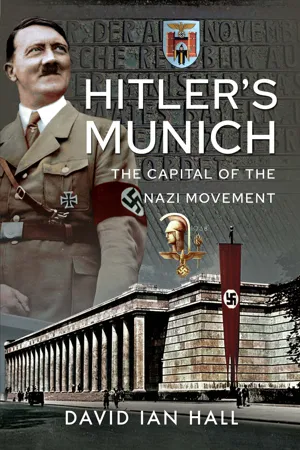
- 320 pages
- English
- ePUB (mobile friendly)
- Available on iOS & Android
eBook - ePub
About this book
Information
Notes
Austrian Beginnings
1. The Gasthaus was sold to Joseph Pommer in 1912. See: The Hitler Pages, Braunau am Inn (hitlerpages.com).
2. Adolf Hitler, Mein Kampf trans. Ralph Manheim (Boston: Houghton Mifflin Company, 1971) p.3.
3. Mein Kampf, p.123; Volker Ullrich, Hitler. Ascent 1889–1939 (2016), p.17; Werner Maser, Hitler (1973) p.25; and Gaab, Munich (2008) p.64.
4. Gustav (1885–87); Ida (1886–88); and Otto (1887 – shortly after birth).
5. Ullrich (2016), pp.18–19; Maser, pp.24–5.
6. Mein Kampf, p.6.
7. Franz Jetzinger, Hitler’s Youth (1958) p.57.
8. John Toland, Hitler (1997) p.9.
9. Mein Kampf, p.6.
10. Ibid, p.7.
11. Bundesarchiv (BA) Berlin-Lichterfelde, Bestand NS 26 (principal NSDAP archive). Johann Weinberger, NS 26/17a; Maser, p.28.
12. Ullrich (2016), pp.20–21; Toland, p.14; and Maser, p.33.
13. Mein Kampf, pp.15, 17.
14. BA Berlin-Lichterfelde, ‘Unser Führer Adolf Hitler als Student in Steyr von seinem einstigen Lehrer Gregor Goldbacher Prof. i. R’, NS 26/17a.
15. Hitler’s school report, 16 September 1905; and Heinrich Heim Report, 1942 as cited by Werner Maser. See Maser, p.35, fn.50 and 51.
16. Toland, p.19.
17. BA Berlin-Lichterfelde, Gregor Goldbacher NS 26/17a.
18. Anton Schmidt to Werner Maser, 1969. See Maser, p.37, fn.57.
19. Ulrich (2016), p 22.
Young Hitler in Linz
1. Mein Kampf, p.18.
2. August Kubizek, The Young Hitler I Knew (2006) p.30; and Brigitte Hamann, Hitler’s Vienna (1999) pp.21–3.
3. Kubizek, p.23.
4. Kubizek, p.105; and Toland, p.24.
5. Kubizek, p.34.
6. Ibid, p.86.
7. Thomas Mann, ‘Versuch über das Theater’ in Essays I: 1883–1914 (2002) p.139.
8. Mein Kampf, p.17.
9. Kubizek, pp.76, and 84.
10. Kubizek, p.118; and Ben Novak, ‘Hitler’s Rienzi Experience: Factuality’, Revista de Historia Actual Vol.5, No.5 (2007) pp.106–7.
11. Novak, pp.105–16; Speer, Spandau (1976) p.96;
12. Kubizek, p.85.
13. Hamann (1999), pp.26–7.
14. Ibid, pp.21–2.
15. Sandner, Hitler, Band I: 1889–1927 (2016) pp.80–81; and Kubizek, p.125.
16. Toland, pp.24–5; and Kubizek, pp.30, 38, and 127.
17. Maser, pp.39–41; Toland, pp.25–6.
18. Kubizek, p.135.
19. BA Berlin-Lichterfelde, Eduard Bloch, ‘Erinnerungen an den Führer und dessen verewigte Mutter’ (Nov. 1938) NS 26/65; Ullrich, p.27.
20. Sandner, p.84; and Eduard Bloch, ‘My Patient Hitler’ in Collier’s Weekly (15 and 22 March 1941).
21. Hamann (1999), pp.41–2. See also Sandner, p.85.
Vienna
1. Kubizek, p.151.
2. Kubizek, pp.185, 196–7; and Toland, pp.32–3.
3. Karl Kraus as quoted in Ullrich, pp.31–2. See Herre, Jahrhundertwende 1900 (1998) p.190.
4. Mein Kampf, p.123.
5. Hamann (1999), p.274; and Ian Kershaw, Hitler. 1889-1936: Hubris (1998) p.41.
6. Mein Kampf, pp.76, 92.
7. Hamann (1999), pp.12–13.
8. Hamann (1999), pp.274–5, 302; and Ullrich (2016), pp.35–6.
9. Mein Kampf, pp.21, 125.
10. Hamann (1999), pp.404–5; and Timothy W. Ryback, Hitler’s Private Library (2008) pp.38–9....
Table of contents
- Cover
- Title Page
- Copyright
- Contents
- Maps
- Preface
- I: Early Years, 1889–1918
- II: Political Beginnings, 1919–23
- III: Der Kampfzeit – The Long Struggle, 1924–33
- IV: Munich, 1933–39
- V: Munich During the War, 1939–45
- Epilogue
- Notes
- Bibliography and Sources
- Acknowledgements
- Image and Photograph Credits
- Plate section
Trusted by 375,005 students
Access to over 1.5 million titles for a fair monthly price.
Study more efficiently using our study tools.
Frequently asked questions
Yes, you can cancel anytime from the Subscription tab in your account settings on the Perlego website. Your subscription will stay active until the end of your current billing period. Learn how to cancel your subscription
No, books cannot be downloaded as external files, such as PDFs, for use outside of Perlego. However, you can download books within the Perlego app for offline reading on mobile or tablet. Learn how to download books offline
Perlego offers two plans: Essential and Complete
- Essential is ideal for learners and professionals who enjoy exploring a wide range of subjects. Access the Essential Library with 800,000+ trusted titles and best-sellers across business, personal growth, and the humanities. Includes unlimited reading time and Standard Read Aloud voice.
- Complete: Perfect for advanced learners and researchers needing full, unrestricted access. Unlock 1.5M+ books across hundreds of subjects, including academic and specialized titles. The Complete Plan also includes advanced features like Premium Read Aloud and Research Assistant.
We are an online textbook subscription service, where you can get access to an entire online library for less than the price of a single book per month. With over 1.5 million books across 990+ topics, we’ve got you covered! Learn about our mission
Look out for the read-aloud symbol on your next book to see if you can listen to it. The read-aloud tool reads text aloud for you, highlighting the text as it is being read. You can pause it, speed it up and slow it down. Learn more about Read Aloud
Yes! You can use the Perlego app on both iOS and Android devices to read anytime, anywhere — even offline. Perfect for commutes or when you’re on the go.
Please note we cannot support devices running on iOS 13 and Android 7 or earlier. Learn more about using the app
Please note we cannot support devices running on iOS 13 and Android 7 or earlier. Learn more about using the app
Yes, you can access Hitler's Munich by David Ian Hall in PDF and/or ePUB format, as well as other popular books in History & Political Biographies. We have over 1.5 million books available in our catalogue for you to explore.