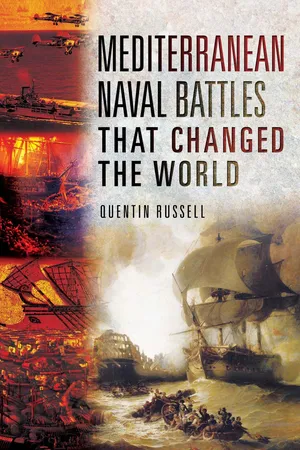
This epic naval history examines seven pivotal Mediterranean conflicts, from the Battle of Salamis in the fifth century BC to the Siege of Malta during WWII.
This book tells the story of the Mediterranean as a theater of war at sea. Historian Quentin Russell covers seven major battles or campaigns, each of which changed the balance of power and shape the course of history. Chronicling each battle in vivid detail, Russell also provides essential background, covering the history of naval power in the Mediterranean and the effect of the development of naval architecture and design on the outcomes.
Readers will learn that the Battle of Lepanto in 1571 was the last major battle fought between galleys; the Battle of Navarino in 1827 was the last to be fought entirely by sailing ships; and the Battle of Cape Matapan in 1941—where a young Duke of Edinburgh saw action—was the first operation to exploit the breaking of the Italian naval Enigma codes.
The battles included are: Salamis (480 BC), Actium (31 BC), Lepanto (1571), the Nile (aka Aboukir Bay, 1798), Navarino (1827), Cape Matapan (1941), and the Siege of Malta (1940-42).
- 240 pages
- English
- ePUB (mobile friendly)
- Available on iOS & Android
eBook - ePub
Mediterranean Naval Battles That Changed the World
About this book
Information
Chapter One
Development of Naval Warfare in the Mediterranean
A striking feature of the history of naval warfare is that most battles were fought close to land, often near a harbour or place of shelter. In ancient times sailors preferred to sail near to the coast, where protection could be sought in bad weather and supplies of food and water taken on board. This was particularly true of warships, where there was little storage space or room for the crew to rest. It is no surprise then that naval strategy was determined by proximity to land. It was not until the age of steam and advances in communications that navies could pursue one another across the expanse of ocean. Previously the best way to gain the upper hand was by bottling up opposing forces, giving them little room to manoeuvre or escape. The enclosed nature of the eastern Mediterranean, with its numerous islands and welcoming coves, offered an ideal environment to develop seamanship, and it was here that the first navies in the West developed. The sea was an ideal medium for exploration and trade in an age when crossing difficult terrain was slow and arduous. But slow trading vessels were easy prey to pirates and it appears that the first developments of naval power were a response to this threat. The legendary King Minos of Crete was credited with creating a navy for this purpose. The Cretans used their navy to take their civilisation throughout the Aegean creating a thalassocracy, or maritime empire.
The Mycenaean Greeks learned from their Cretan neighbours and when it came their turn to seize control they used their ships to raid and colonise Asia Minor and beyond. Memories of Mycenaean exploration and raiding became immortalised in legend: Jason who ventured into the Black Sea with his Argonauts to steal the Golden Fleece from Colchis, and the exploits of the kings and heroes who sacked Troy. When the civilisation of the Aegean waned at the end of the first millennium, a confederacy of displaced Aegean sailors, known as the ‘Sea Peoples’, terrorised the eastern Mediterranean. The difference between piracy and organised warfare was never clear and piracy was endemic from the earliest times whenever there was a lull in trade or the lack of a strong power to exercise control. In later ages the pirates would be termed privateers or corsairs, but their purpose was the same. Throughout the Sea’s history certain locations proved to be consistent havens for piracy; Rhodes, Crete, Cilicia and the Dalmatian coast in the east, Malta, Algiers, Corsica and the Balearics in the west.
Naval technology advanced slowly and most ships were transports and cargo vessels, and not designed exclusively for warfare, and the first response to piracy was merely to arm the ships. It was when ships began to be designed purely for military purposes that ambitious rulers and aggressive states began to build navies for offensive purposes. Often the early navies were used just as transports for armies, as in the fabled sacking of Troy by the Achaean Greeks sometime around 1100BC. When Darius of Persia invaded Greece over 500 years later he did not exploit the vast naval superiority at his disposal. The ships of his allies were used soley to perform the first recorded amphibious landing of an army in the build up to the Battle of Marathon.
The object of naval warfare was to disable or sink the enemy ships, but this was not easily accomplished, and usually the best ploy was to board the enemy vessel. This tactic was abandoned with the development of the ram on the ship’s prow, turning the ship itself into a weapon. Ramming required a high level of skill. The earliest surviving image of a Greek galley, depicted on a 16th century BC sherd from Volos, already shows what would be recognisable later characteristics; the side-steering oar at the curved upward stern and the pointed ram at the prow. In Homer’s (c.750–650BC) accounts of the Trojan War in the Iliad and Odyssey, composed well after the event, the Greek ships came in three sizes, twenty, thirty or fifty-oared galleys, with the rowers all on one level. The rowers would be aided in their efforts by a square-rigged sail.
The Greeks’ rivals, the Phoenicians, had commercial ships with one and two banks of oars, the larger protected by soldiers. For warfare they had a masted ship with a bowed stern and ramming prow and two banks of rowers beneath the shields of the defending soldiers, and by the 8th century BC, their navy was already in possession of war galleys with three banks of oars. Thucydides tells us that around the same time the Corinthians were the first Greeks to introduce the triērēs, the three-banked warship known to us as the trireme (from the Latin trirēmis), and to build a navy. It is a matter of contention who built the first triremes but Herodotus implies the Egyptians soon followed suit.

‘The Battle of the Delta’, Ramses III battles with the Sea Peoples from the temple of Medinet Habu, c.1200BC. (Public domain)
When the Persians took control of the coastal cities of Anatolia and the Levant they utilised the expertise of the conquered peoples to establish a navy, and the first recorded use of the trireme in battle was when Poly-crates, the tyrant of Samos, contributed forty triremes to the Persian invasion of Egypt (c.525BC). The trireme would remain a mainstay of ancient navies until the first century BC.
Greek interest in the coast of Anatolia persisted after the Trojan War and their period of early exploration, and they began to colonise its coast around 800BC. At the same time their commercial rivals, the Phoenicians from the Lebanon, were exploring westwards. Acknowledged as the pioneers of navigation, they set up trading networks that stretched as far as the Pillars of Hercules (Straits of Gibraltar). Before the compass, navigation was performed using the constellation Ursa Minor, which the Greeks called ‘Phoenician’. When exactly the Phoenicians settled in Spain is disputed, but they are believed to have founded Carthage (near modern Tunis) in the 9th century BC. It went on to become the most important trading centre in the Mediterranean.
In the east the Greek challenge to Phoenician control of the trade routes may have encouraged them to go further afield, and where they went the Greeks followed. In Sicily, Greeks and Phoenicians arrived more or less together to contest the island (c.800BC), and the Greeks established significant colonies in southern Italy and the south of France, including that of Massilia (Marseilles, c.600BC). Emboldened by their growing seamanship, Phoenicians and Greeks ventured beyond the Mediterranean into the Indian Ocean and the Atlantic. The Phoenicians were the first to explore the seas beyond the Straits, and the Egyptian Pharaoh, Necho II, whose native craft were only suitable for the calmer waters of the Nile and Red Sea, used Phoenician sailors to circumnavigate Africa around 600BC. They sailed from the Red Sea back to the Nile, entering the Mediterranean from the west. They were followed by two early Greek explorers from Massilia who ventured into the Atlantic; Euthymenes, who in the early 6th century BC sailed south along the coast of Africa, perhaps as far as Ghana, and around 325BC, Pythias, who was apparently motivated to acquire tin from Cornwall, but his voyages reputedly took him as far as circumnavigating Britain, venturing into the Baltic and even reaching what was thought to be the most northerly island, Ultima Thule, possibly Iceland.
The Phoenicians may well have been primarily traders, but they were not above a bit of occasional piracy, particularly the kidnapping of young boys and girls to be sold on as slaves in other countries. Slavery was seen as a legitimate business in antiquity (as it would be off and on for over 2,000 years), and it was often slaves who manned the oars of the warships. It was of course the fabled kidnapping of the willing Helen by Paris that brought about the Trojan War.

Assyrian bireme from the palace of Nineveh 700–692BC manned by Phoenician sailors for Sennacherib rowing with their backs to the pointed prow for ramming, shields hang from the protective ‘walls’. (British Museum, CC BY-SA 3.0)
In reality it was the need for resources (mainly metals), trade and land for settlement that was behind Greek incursions into Anatolia and their exploration and then colonisation of the wider Mediterranean and Black Sea littoral. Their success in this and the creation of a maritime network was largely created without direct resort to naval power, with the result that up until the 5th century Greek warships, despite the claims of the Corinthians, were still mainly pentekonteroi, fifty-oared vessels with the rowers seated on one long bench that went side to side, one man to an oar.
The Battle of Lade (494BC) was the first large-scale battle in which triremes were deployed. Fought off the small island of Lade, which protected the approach to the Greek city of Miletus in Anatolia, it was an opening encounter in the wars between the Greeks and Persia in which the Persians under Darius the Great were victorious. The coalition of Greek Ionian city-states in revolt against the Persian empire were defeated by a combined fleet of around 600 ships (according to Herodotus), outnumbering the Greeks by almost two to one, drawn from its subject peoples: Phoenicians, Egyptians, Cilicians and Cypriots.

The Siren Vase, Odysseus and the sirens 480–470BC, made in Attica and found in Lazio, Italy (British Museum, CC BY-NC-SA 4.0, public domain)
At Salamis, sixteen years later, outnumbered Greeks turned the tables. Under the firmer leadership of the Athenians’ commander, Themistocles, the mistakes of the previous encounter, where they had rowed out to meet their enemies in a chaotic engagement in which some contingents, notably the Samians, faltered, were not repeated.
Despite their proximity to the sea, Athenian recognition of the potential of sea power had been slow. During the 6th century BC they struggled to match the formidable mercantile supremacy of the island of Aegina, and their fierce economic rivalry eventually degenerated into open warfare. The dates of the encounters are disputed as our main source of information, Herodotus, appears to have conflated the timeline, but without a fleet Athens remained powerless to compete with its neighbour. When in 506BC the Athenians took the city of Chalcis and captured twenty ships, they burned them, not knowing what to do with them. It was not until Themistocles imposed his vision that the lessons were learnt. He realised that for Athens to be secure and successful it would have to develop a modern navy.
By the time of Salamis the trireme was a streamlined state-of-the-art warship built for speed, a ‘bronze-rammed floating chariot’ in the words of the poet Aeschylus, and it would reign supreme for another 200 years. The ships were up to 130 feet long and about 20 feet wide. Because the ship was long and narrow it was fragile and not suited to open water, and as a result trireme fleets hugged the coast. The rowers were arranged in three banks, the oars of the lower two protruded through the hull, while the oars of the upper deck were supported by an outrigger. The ram, made of wood and encased in bronze with three cutting blades at the front, was rather snub-nosed and protruded about seven feet from the prow at the waterline. The use of the ram reached its pinnacle under the Greeks. Until the development of a stronger bow, the tactic was to ram the enemy vessel from behind, which involved delicate manoeuvring. The attacker made for the stern section of the ship making sure not to get entangled with their oars so as to be able to back away easily. With their improved bows, the Corinthians introduced the practice of ramming head-on in 413BC. The Phoenician triremes carried a longer tapered ram, were broader and perhaps higher out of the water, and possessed no outrigger. Their wider decks made it possible to carry more marines, protected by a defensive bulwark lined with shields.
At her peak, Athens had a fleet of 400 ships, a force requiring close to 80,000 men. It is generally accepted that the Athenian triremes carried 170 rowers, though this figure has been disputed. A more likely number is estimated at 160 leaving room for officers, deckhands and marines to bring the number of crew up to 200. Triremes could either operate under sail or by rowing, but in battle the use of oars was preferable as it allowed greater manoeuvrability. These rowers, mainly drawn from Athens’ poorer citizens, were paid and were seldom slaves. A short treatise on the relationship between its naval supremacy and democracy, the Constitution of the Athenians (c.440–410BC), purported to be by Xenophon, argued that by employing citizen oarsmen the State gave them a vested interest in the maintenance of Athenian democracy, giving ‘poor’ and ‘ordinary people’:
more power than the noble and the rich, because it is the ordinary people who man the fleet and bring the city her power; they provide the helmsmen, the boatswains, the junior officers, the look-outs and the shipwrights; it is these people who make the city powerful much more than the hoplites and the noble and respectable citizens. This being so, it seems just that all should share in public office by lot and by election, and that any citizen who wishes should be able to speak in the Assembly. [Pseudo-Xenophon, 1.1–2]
The writer goes on to say that Athens’ influence amongst her maritime possessions and allies enabled these ordinary people involved in official capacities the opportunity to become adept sailors, learning to row and steer with great skill.

The Lenomant Relief (c.410BC) discovered in 1852 near the Erechtheum on the Athenian acropolis showing the centre part of a trireme. This with some other fragments showing twenty-five oarsmen, a helmsman, lookout and armed soldiers has enabled scholars to reconstruct a fifty-oared vessel. (Photo: Marsyas 2006, Acropolis Museum, CC2.5 generic)
Having realised that they had to have a navy to take on the might of Carthage, the Romans were still slow to embrace the tactics of naval warfare. Initially during the First Punic War (264–241BC), more confident as successful soldiers, they tried to fight a naval engagement as if it were a land battle. To maximise the superiority of their army, they turned to the idea of boarding the enemy ships rather than sinking them. To do this they employed the corvus, or drawbridge, mounted on the prow, which when dropped allowed the legionary marines to storm the opposing vessel. Although this proved successful in defeating the Carthaginians,...
Table of contents
- Cover
- Title
- Copyright
- Contents
- Maps
- Introduction
- 1. The Development of Naval Warfare in the Mediterranean
- 2. Salamis, 480BC
- 3. Actium, 31BC
- 4. Lepanto, 1571
- 5. Aboukir Bay, 1798
- 6. Navarino, 1827
- 7. Cape Matapan and the Battle for Malta, 1940–42
- Bibliography
Trusted by 375,005 students
Access to over 1.5 million titles for a fair monthly price.
Study more efficiently using our study tools.
Frequently asked questions
Yes, you can cancel anytime from the Subscription tab in your account settings on the Perlego website. Your subscription will stay active until the end of your current billing period. Learn how to cancel your subscription
No, books cannot be downloaded as external files, such as PDFs, for use outside of Perlego. However, you can download books within the Perlego app for offline reading on mobile or tablet. Learn how to download books offline
We are an online textbook subscription service, where you can get access to an entire online library for less than the price of a single book per month. With over 1.5 million books across 990+ topics, we’ve got you covered! Learn about our mission
Look out for the read-aloud symbol on your next book to see if you can listen to it. The read-aloud tool reads text aloud for you, highlighting the text as it is being read. You can pause it, speed it up and slow it down. Learn more about Read Aloud
Yes! You can use the Perlego app on both iOS and Android devices to read anytime, anywhere — even offline. Perfect for commutes or when you’re on the go.
Please note we cannot support devices running on iOS 13 and Android 7 or earlier. Learn more about using the app
Please note we cannot support devices running on iOS 13 and Android 7 or earlier. Learn more about using the app
Yes, you can access Mediterranean Naval Battles That Changed the World by Quentin Russell in PDF and/or ePUB format, as well as other popular books in History & European History. We have over 1.5 million books available in our catalogue for you to explore.