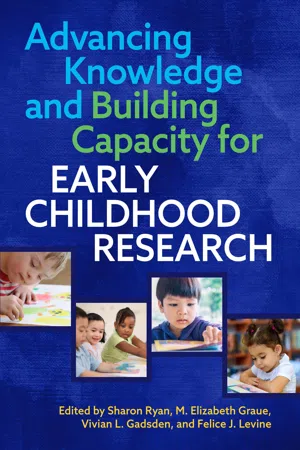
This volume employs a multidisciplinary approach to research on a high-profile topic very much on the agenda of state and national policy leaders: early childhood development and education. It aims to reflect how scholarly perspectives shape the contours of knowledge generation, and to illuminate the gaps that prevent productive interchange among scholars who value equity in the opportunities available to young children, their families, and teachers/caregivers. The editors and authors identify and prioritize critical research areas; assess the state of the field in terms of promising research designs and methodologies; and identify capacity-building needs and potential cross-group collaborations.
eBook - ePub
Advancing Knowledge and Building Capacity for Early Childhood Research
- 280 pages
- English
- ePUB (mobile friendly)
- Available on iOS & Android
eBook - ePub
Advancing Knowledge and Building Capacity for Early Childhood Research
About this book
Information
Topic
EducationSubtopic
Educational PolicyINTRODUCTION
Chapter 1
Reframing Research in Early Childhood Education: Debates, Challenges, and Opportunities
SHARON RYAN
Rutgers University
M. ELIZABETH GRAUE
University of Wisconsin, Madison
In 2015, the American Educational Research Association (AERA) sponsored a conference designed to bring together scholars who represented different perspectives on the research, methods, and practice of early childhood education. The catalyst for the conference was recognition that while many scholars focus on early childhood, they often work in intellectual siloes, rarely interacting. Here is an excerpt from the invitational letter to scholars engaged in this area of research:
The boundaries of research communities are particularly stark between those who come from practice in early education (studying teacher education, curriculum, social context), and those who employ disciplinary perspectives to analyze the topic of early education and its effects (child development researchers, economists, and policy researchers). One consequence of these boundaries is a striking lack of symmetry between graduate preparation, research funding, and publication venues that exacerbates the lack of communication among important groups of scholars. Yet early childhood education is an interdisciplinary field requiring that researchers of different communities work together to address complex problems of policy and practice.
A multidisciplinary group met in the summer of 2015, engaging in discussions about the many ways scholars engage in topics related to early childhood education. This volume comes out of that conference. It is designed to reflect how scholarly perspectives shape the contours of knowledge generation. In addition, we hope to illuminate the invisible gaps that prevent productive interchange among scholars who value equity in the opportunities available to young children, their families, and teachers/caregivers.
To do this we include work from people who come at early education from diverse perspectives. But we go beyond the inclusion of different voices to draw attention to the ways that these various perspectives allow us to see certain things and how they obscure others. This is not a subtractive exercise. Instead, we point to limits as opportunities for scholarly attention, as places that researchers from different viewpoints might work together to form a more extensive picture of young children’s opportunities, their families’ experiences, and their teachers’ work.
In the rest of this chapter, we describe some of these opportunities by exploring questions of who and what is researched and how certain kinds of research are used to inform policy. We point to the implications of these patterns—which have produced an early childhood knowledge base with depth in some areas and underdeveloped gaps in others—in the hope that more balanced approaches to early childhood research will be found.
Multiplicity in Early Childhood Education Research and Practice
The care and education of children from birth through age 8 has been a messy space in policy, practice, and research. (Hereinafter, we will use the term early childhood education to refer to education for children in this age range.) In efforts to meet wide-ranging societal needs, researchers interested in child care, Head Start, nursery school, kindergarten, and early elementary school reflect many different perspectives on (a) the purposes of early childhood programs (e.g., the “whole child” versus academic instruction); (b) who should have access (targeted or universal access); and (c) who should govern programs (public or private entities). Not surprisingly, the field has developed into a multilayered and fragmented array of program offerings, and its complicated evolution continues (Kagan & Kauerz, 2012).
Despite this fragmentation, early childhood education (ECE, which also stands for early care and education) is in the policy spotlight. The attention has brought needed resources, along with increasing standardization and oversight of services. For example, all 50 states now have early learning standards, many for infants and toddlers as well as for preschool through third grade (Graue, Ryan, Wilinski, Northey, & Nocera, 2018). At the same time, there is growing recognition of the importance of the early childhood workforce, and policy makers are interested in creating more consistency and coherence across the birth-through-third-grade continuum. However, we wonder whether the research base has kept pace with the field’s many reforms. Teachers, leaders, and policy makers often lack the information they need to make informed judgements about practices that serve the needs of increasingly diverse students and families.
It is not that research on early childhood is sparse. In fact, there are more publications and ECE-focused research centers generating new research findings than ever. Rather, there are unaddressed tensions surrounding the study of young children and the programs that serve them, which contribute to unevenness in the research base that is used to inform policy and practice. The tensions concern age-old questions: Which disciplines and methods are valued by decision makers for policy and practice? What and who is researched? Whose research perspectives are heard? This chapter considers each of these questions in an effort to highlight the tensions that block conversations and synergies among researchers and programs of inquiry. We worry that the lack of interaction could be a barrier to asking the questions, doing the research, and communicating the findings needed to meet the demands of educating young children in the 21st century. We delve into each of these tensions in more depth to provide a context for the chapters that follow.
What and Who Is Researched?
For much of its history, the field of early childhood education in the United States has used the child as the starting point for practice, learning, and programming. Since the second half of the 20th century, knowledge of young children’s development has been used as the primary source for decision making on curriculum and instruction (Silin, 1995). One example is the field’s reliance on concepts of developmentally appropriate practice (Copple & Bredekamp, 2009) for determining best practices. An understanding of developmentally appropriate practice guides teachers to base instruction on knowledge of children’s individual needs and cultures as well as on professional understanding of child development at particular ages and stages. Therefore, much of the research focus in early childhood has been on images of the child and children’s learning and development and not necessarily on content and early childhood pedagogy (Genishi, Ryan, Ochsner, & Yarnall, 2001). As a result, with a singular focus on the child, key aspects of curriculum and teaching have been overlooked.
Consider the case of teachers and teaching in the early childhood research literature. Research on teaching has been a line of inquiry in K–12 education since the 1960s, yet it is only in the past 15 years or so that teachers have become a focus in the range of settings comprising the early childhood field. Genishi et al. (2001) traced chapters in Virginia Richardson’s (2001) Handbook of Research on Teaching, noting that most of them focus on early childhood programs such as Head Start (e.g., Beller, 1973; Stallings & Stipek, 1986) or on research methods for observing teaching (Gordon & Jester, 1973), and not specifically on what teachers do or believe. To be sure, for some time teacher characteristics such as education and years of experience and other workforce features have been a central variable in analyses of program quality and its impact on child development (e.g., Helburn, 1995; Whitebook, Howes, & Phillips, 1990). However, these studies limit their analyses of teaching young children to a finite set of characteristics and provide little insight into what teachers do with children on a daily basis, what knowledge shapes teachers’ decision making, and how context mediates teachers’ words and actions.
The in-depth and descriptive research on early childhood teaching that has been conducted over the past decade has come from a handful of qualitative researchers interested mostly in teaching in state-funded preschool programs (e.g., Brown, 2009, 2010; Graue, Rauscher, & Sherfinski, 2009; Graue, Ryan, Nocera, Northey, & Willinsky, 2016; Graue, Ryan, Wilinski, Northey, & Nocera, 2018; Wilinski, 2017). Interviews with teachers and observations of their practice on a regular basis illustrate the complexities of this work and highlight how teachers’ work is often mediated by the leadership in the teachers’ professional settings and by public policy. In other words, it is not just the teachers’ education and experience that shape their work. However, this small volume of research, because of its up-close and in-depth approaches, cannot provide straightforward answers to questions about program effects and the like. The findings are always multiply contingent, which is unsatisfying to those seeking to generalize findings. Unfortunately, few studies combine qualitative portraits of early childhood teaching with quantitative data on program quality and child outcomes. As Ryan and Goffin (2008) have argued, in much of the research base on early childhood, teachers are still “missing in action.”
There is still much to be learned about the many roles that support early childhood programs. We do not know much about teaching assistants, program leaders, and others providing the infrastructure (Ryan & Whitebook, 2012) that supports those who work directly with young children, as well as those who work at the policy level. Similarly, little is known empirically about teacher education. While early childhood teacher educators have built up a predominantly qualitative research base on their practices, few larger surveys have been conducted on the content of teacher preparation programs and the knowledge, skills, and dispositions of those who deliver these programs. Yet there is an ever-increasing emphasis on the preparation of qualified and certified teachers of young children.
Researchers have compared the effects of specific curriculum models (e.g., High Scope, Creative Curriculum) on children’s learning and development, but we are only now seeing work that examines how subject matter other than literacy is taught in settings serving young children. A window on teaching was provided in the many analyses of the Early Childhood Longitudinal Study (ECLS-B and ECLS-K; e.g., Bassok, Latham, & Rorem, 2016; Engel, Claessens, Watts, & Farkas, 2016), using large-scale representative databases to explore the relations among children’s entry skills, instructional practices inferred from survey responses, and children’s outcomes. As a result of research investments focused on early math (e.g., DREME [Development and Research in Early Math Education] and the Early Mathematics Collaborative), there is a growing knowledge base related to mathematics teaching and learning, with strong efforts to translate knowledge into materials for practice. While some of that work has been curriculum focused, much has explored building teacher knowledge.
Similarly, because most studies of curriculum have been comparisons of the impacts of different models, we know much less about instruction—the day-to-day interactions between children and teachers around subject matter. Our knowledge base is very shallow when it comes to how early childhood educators teach key concepts. This kind of information is crucial when young children’s education is considered a way to ameliorate the effects of poverty.
In summary, an emphasis on young children’s development has channeled research into particular areas. As a consequence, a lot is known about how young children develop cognitively, socially, emotionally, and physically, but much less is known about curriculum and teaching in early childhood settings.
Which Disciplines and Methods Are Valued?
Education is an interdisciplinary field. Yet, for much of the history of early childhood education, psychology has been the primary discipline through which young children’s education has been considered (Bloch, 1987). Without this psychologically informed work, we would not have Head Start or the Cost, Quality and Outcomes Study (Peisner-Feinberg et al., 1999). More recently, economic analyses have entered discussions about policy and practice. Cost-benefit analyses (e.g., Barnett & Masse, 2007) that show the long-term savings of a high-quality early education have been used repeatedly by policy makers and advocates to argue for increased investment in programs for young children. Adding to this research are a number of longitudinal evaluations of small-scale experimental preschool programs (e.g., Heckman & Karapakula, 2019; and, specifically about the Perry Preschool Program, Schweinhart et al., 2005) and, more recently, state evaluations of public pre-K (e.g., Barnett, Jung, Youn, & Frede, 2013; Lipsey, Farran, & Durkin, 2018). These evaluations look at programs using various quality measures (e.g., Early Childhood Environment Rating Scale [ECERS], Classroom Assessment Scoring System [CLASS]) in relation to child outcomes, and in the case of longitudinal studies, follow-up surveys and other data to determine the long-term impacts of high-quality programs. We have learned a great deal from these analyses, which have been used to make compelling arguments for the importance of high-quality child care and for public pre-K programs.
However, this work has not given us insight into what early childhood programs look like in action, nor do they provide a sense of how programmatic elements come together to produce a high-quality education for young children. While the predominant question posed has been “Does it work?” we know much less about how programs are implemented, or how context and culture mediate program enactment. The K–12 education system has embraced the interpretive work of scholars who seek to understand actor sense-making (e.g., Cynthia Coburn or James Spillane); the early childhood community has been less welcoming of research that examines the tangled path of policy on its way to practice (Graue, Wilinski, & Nocera, 2016). Research like this provides a context for work on student outcomes, so that we are more likely to be able to understand why a policy or a curriculum does not work as expected. There is much we could gain if more resources went into this kind of scholarship.
At the same time, there is an ever-growing research base of examinations of early childhood programs using critical and sociocultural theories that are typically not part of policy and practice debates. Drawing on sociology, anthropology, and philosophy, as well as on insights from linguistics, feminism, and s...
Table of contents
- Cover
- Title
- Copyright
- Acknowledgments
- Contents
- 1 INTRODUCTION Reframing Research in Early Childhood Education: Debates, Challenges, and Opportunities
- 2 Fostering Equitable Developmental Opportunities for Dual-Language Learners in Early Education Settings
- 3 Developmentally Appropriate Practice in Early Childhood Education Redefined: The Case of Math
- 4 Connecting Research on Children’s Mathematical Thinking With Assessment: Toward Capturing More of What Children Know and Can Do
- 5 When Is a Child Not a Child Outcome? Humanizing Research in Early Childhood Education
- 6 Parents, Their Children, and Their Children’s Early Childhood Education Teachers
- 7 Conversations in Early Childhood Classrooms: Preliminary Findings From a Professional Development Intervention
- 8 Understanding Long-Term Preschool “Fadeout” Effects—Be Careful What You Ask For: Magical Thinking Revisited
- 9 Early Care and Education Quality
- 10 Toward Deeper and More Policy-Relevant Evidence on Early Childhood Programs
- 11 Early Childhood Systems for Birth Through Age 8: Conceptual Challenges and Research Needs
- 12 Scaling Up Effective Preschool Education: New Directions for Research
- 13 Looking Internationally
- 14 CONCLUSION Reflecting on and Repositioning Early Childhood Education Research
- About the Contributors
Trusted by 375,005 students
Access to over 1.5 million titles for a fair monthly price.
Study more efficiently using our study tools.
Frequently asked questions
Yes, you can cancel anytime from the Subscription tab in your account settings on the Perlego website. Your subscription will stay active until the end of your current billing period. Learn how to cancel your subscription
No, books cannot be downloaded as external files, such as PDFs, for use outside of Perlego. However, you can download books within the Perlego app for offline reading on mobile or tablet. Learn how to download books offline
Perlego offers two plans: Essential and Complete
- Essential is ideal for learners and professionals who enjoy exploring a wide range of subjects. Access the Essential Library with 800,000+ trusted titles and best-sellers across business, personal growth, and the humanities. Includes unlimited reading time and Standard Read Aloud voice.
- Complete: Perfect for advanced learners and researchers needing full, unrestricted access. Unlock 1.5M+ books across hundreds of subjects, including academic and specialized titles. The Complete Plan also includes advanced features like Premium Read Aloud and Research Assistant.
We are an online textbook subscription service, where you can get access to an entire online library for less than the price of a single book per month. With over 1.5 million books across 990+ topics, we’ve got you covered! Learn about our mission
Look out for the read-aloud symbol on your next book to see if you can listen to it. The read-aloud tool reads text aloud for you, highlighting the text as it is being read. You can pause it, speed it up and slow it down. Learn more about Read Aloud
Yes! You can use the Perlego app on both iOS and Android devices to read anytime, anywhere — even offline. Perfect for commutes or when you’re on the go.
Please note we cannot support devices running on iOS 13 and Android 7 or earlier. Learn more about using the app
Please note we cannot support devices running on iOS 13 and Android 7 or earlier. Learn more about using the app
Yes, you can access Advancing Knowledge and Building Capacity for Early Childhood Research by Sharon Ryan, M. Elizabeth Graue, Vivian L. Gadsden, Felice J. Levine in PDF and/or ePUB format, as well as other popular books in Education & Educational Policy. We have over 1.5 million books available in our catalogue for you to explore.