Archaeology is in crisis. Spatial turns, material turns and the ontological turn have directed the discipline away from its hard-won battle to find humanity in the past. Meanwhile, popularised science, camouflaged as archaeology, produces shock headlines built on ancient DNA that reduce humanity’s most intriguing historical problems to two-dimensional caricatures. Today archaeology finds itself less able than ever to proclaim its relevance to the modern world.
This volume foregrounds the relevance of the scholarship of John Barrett to this crisis. Twenty-four writers representing three generations of archaeologists scrutinise the current turmoil in the discipline and highlight the resolutions that may be found through Barrett’s analytical framework. Topics include archaeology and the senses, the continuing problem of the archaeological record, practice, discourse, and agency, reorienting archaeological field practice, the question of different expressions of human diversity, and material ecologies. Understanding archaeology as both a universal and highly specific discipline, case-studies range from the Aegean to Orkney, and encompass Anatolia, Korea, Romania, United Kingdom and the very nature of the Universe itself. This critical examination of John Barrett’s contribution to archaeology is simultaneously a response to his urgent call to arms to reorient archaeology in the service of humanity.
eBook - ePub
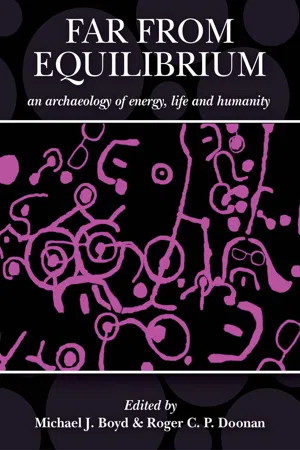
Far from Equilibrium: An archaeology of energy, life and humanity
A response to the archaeology of John C. Barrett
- 352 pages
- English
- ePUB (mobile friendly)
- Available on iOS & Android
eBook - ePub
Far from Equilibrium: An archaeology of energy, life and humanity
A response to the archaeology of John C. Barrett
About this book
Information
Subtopic
ArchaeologyIndex
Social SciencesFields of discourse and an archaeology of inhabitation
Chapter 7
‘Contextual archaeology’ revisited: reflections on archaeology, assemblages and semiotics
In this contribution I revisit a short paper by John Barrett, published in Antiquity in November 1987, in the midst of the early debates over Post-Processualism. ‘Contextual archaeology’ was a response to the publication of Ian Hodder’s Reading the Past, which had been recently reviewed in the journal. In the piece Barrett called for a more critical orientation toward the paired questions of how archaeologists conceptualise past symbolic worlds and how we have access to them. He made the point that processual and post-processual archaeologies shared some characteristics, notably that both viewed archaeological traces as a somewhat static record of the past. Where they differed was in how they understood ‘the link between past dynamics and the record’ (Barrett 1987, 469). In these reflections I consider both why processual archaeology ignored any kind of semiotic approach, and the failings of the post-processual turn to semiotics. Barrett’s comments remain as relevant today as they did in 1987, and the concerns that he outlines have continued to inform his archaeological perspective (cf. Barrett 2006).
Returning to this moment in archaeological theorising offers an opportunity to trace how the question of meaning and of semiotics entered archaeology, and how the theoretical choices that were made constrained the possibilities for what would come to be known as interpretive approaches. Archaeology started off on the wrong foot when it came to questions of meaning, and this has left us unable or unwilling to really grapple with the question of context. And context is not a straightforward or simple question. As Michael Taussig has put it, context is not ‘a secure epistemic nest in which our knowledge-eggs are to be safely hatched … [T]he very fabric of the context into which things are to be inserted, and hence explained, turns out to be that which most needs understanding!’ (Taussig 1992, 44–45). Most recently archaeologists have turned to various network or assemblage approaches to think through this problem, in some cases concluding that there is nothing beyond the assemblage and so therefore context itself is a mirage. So for Andrés Laguens, from ‘a multirelational point of view, context no longer exists. There are no associations, there are only relations’ (Laguens 2013, 106). Instead, he suggests, ‘the context is a configured space’. I take this to mean, following DeLanda (2006; 2016) that the specific configuration of an assemblage creates the territorialised and coded environment within which any particular element exists and is therefore understood. This leads to the question of how a particular configuration comes into being, stabilises around a particular element or elements and is recognised, if only momentarily, as a configured space. Laguens’ approach to configured space contrasts with Ben Alberti’s suggestion (after Fowler 2013a) that the assemblage concept supersedes that of context because assemblage ‘connotes openness rather than closure, an image of dynamic extension’ (2016, 167). In this case Alberti emphasises not the particular configuration of an assemblage, but rather its dynamic and permeable nature. He implies that the notion of context evokes a static and closed set of relationships, and that it fails to capture the dynamics of the assemblage. He also notes that this rejected model of context is linguistic in origin. Clearly, there is a sense that the notion of context, as Taussig identified, has often been left unexamined, and that it is often assumed as a problematically stable backdrop to the archaeological materials that we examine. Yet, at the same time, we need a way to think about how any particular assemblage comes into being as a particular constellation and the effect that this emergent arrangement has in turn on particular elements of the assemblage. By referring to context we draw attention to the conditions of possibility under which an assemblage emerges, shifts and stabilises. While we can certainly turn to DeLanda’s discussion of territorialising and coding operations as one way of addressing this question (cf. Lucas 2012, 199–200), I’d like to take a different but perhaps complementary approach (cf. Deleuze & Guattari 1987, 586). By turning back to the beginnings of post-processualism I hope to explore this question within a semeiotic framework that is not constrained to the linguistic. I will return to the varied and often-fruitful contributions of assemblage theories at the end of this paper after exploring archaeology’s relationship to semiotics.
In Taussig’s criticism of how context has been deployed by sociocultural anthropologists he remarked that the term was usually taken to mean the social formation within which a practice or action was situated. As he observed, this took for granted the ‘social’ which in itself was what needed to be defined and explored. By contrast, archaeology has always had a wider semantic range for the term. Context for archaeologists incorporates not only the pragmatic and discursive fields within which actions are situated, but also the more narrowly defined archaeological concept, as articulated primarily in relation to the deposition, excavation and provenience of artefacts (Papaconstantinou 2006). Gavin Lucas points out that when speaking of material deposits, the notion of a contextual envelope or container is similarly often deployed. Yet, he notes that in this case it draws attention to the work of gathering and bounding that is carried out by elements of the world. Lucas notes that spaces such as graves or buildings ‘divide up the spatial continuum into centres of gravity in which other entities assemble and, as such, act as containers for such entities, allowing some objects in and prohibiting others’ (2012, 196). This kind of context draws attention to the framing or gathering that takes place in relation to assemblages more broadly. As archaeologists we have already been working with a concept of context that cuts across the boundaries of mental and material, in ways in which we have yet to adequately engage. The history of how depositional and stylistic contexts came to be recognised as an important part of excavation and analysis has been traced by Papaconstantinou (2006), and the varying yet connected contexts of archaeologist and of past materials have been discussed by John Barrett (2006). What I want to consider in this chapter is what a focus on archaeological signs might contribute to understanding context at its most broadly constituted, bringing together all these senses in terms of the assemblage of associations that inform how any sign – archaeological or otherwise – is perceived, grasped and acted upon.
Archaeology has been termed ‘the discipline of things’ (Olsen et al. 2012). I’d like to push back strongly against this claim, to argue that if we have to reduce the richness of archaeology to such an axiom, then it should be as a discipline of traces, and that to ignore this is to fail to grasp both the potential and the limitations of archaeological evidence. Our experience of the archaeological past is always mediated and is therefore an exercise in material semiotics. The focus on archaeology as a discipline that studies assemblages of things has been linked to a rejection of representationalism in various forms. For example Chris Fowler embeds a ‘non-representationalist’ approach as part of a thoughtful critique of the correspondence theory of knowledge in archaeology (2013a; 2013b). This is as part of an attempt to move away from epistemologies where the truth of scientific representations inheres in the degree to which they mirror reality. In this dualist ontology representation remains on the side of the subject and reality is the object represented. I am in sympathy with Fowler’s move to reject simple correspondence theories of truth, but I find problems in some of the more strident approaches that more or less exclude representation from consideration. This is an act of purification, which implicitly sidelines ‘meaning’ along with the associated devalued terms of ‘subjectivity’, ‘discourse’, ‘symbols’ and ‘epistemology’ (see Crossland & Bauer 2017). Oliver Harris has drawn on Anderson & Harrison (2010) to suggest that a more-than-representational approach is needed to circumvent this problem (2018). This is to insist ‘on the non-representational basis of thought’ and to conceive the root of action ‘less in terms of willpower or cognitive deliberation and more via embodied and environmental affordances, dispositions and habits’ (Anderson & Harrison 2010, 7). This is a move that I am also in sympathy with, and it resonates strongly with the case that John Barrett has been building for many years now. We should note however, that it still sidelines representation, viewing it as secondary and derivative to dispositions and habits that sit outside of language. I am not arguing here for a recuperation of the subject as a privileged site of analytical purchase, but rather making the case that representation is merely one of many forms of semeiosis, and that semeiosis is neither restricted to humans, nor to cognitive processes, but rather traverses the boundaries of nature and culture, mind and body, things and their representation. For those who follow Peircean semeiotic1 approaches this claim is neither original nor startling (see Hoffmeyer 2009; Deacon 2011; Kohn 2013; Barrett 2014a), yet in the current intellectual climate in archaeology it bears repeating. Following how signs stitch together our bifurcated conceptual world offers a fecund resource for thinking the archaeological assemblage and the ways in which context is constituted. However, in order to properly conceptualise archaeology as a discipline of traces, it is necessary to broaden our view of semiotics and to move away from models based in language. This in turn will better allow us to appreciate the continuity in John Barrett’s kind of contextual archaeology, including the point that he has reiterated in recent publications that ‘life is a process of discerning the significance of the conditions it inhabits’ (2013, 581).
Semiotic histories
For most people, if the term ‘semiotics’ evokes anything, it calls to mind two general fields of investigation: on the one hand, Saussure’s structural study of linguistic signs, and on the other the poststructuralist critique and elaboration of Saussure’s insights. Both were concerned with human semiotic worlds, and with the chains of signification through which individual terms gain their meaning. However, the field of semiotics is much wider than that encompassed by structuralist and post-structuralist theories of meaning and we need as archaeologists to attend more closely to the whole range of possible semiotic forms and processes (see Preucel & Bauer 2001).
One of the most ancient areas of semiotic study must be the study of symptoms, of medical signs (e.g. Ginzburg 1989; Sebeok 1989). The spots and swellings of disease emerge regardless of whether there is anyone around to interpret them. Their meaning therefore is not assigned entirely through convention, but has a component that is constrained and channelled by natural processes. They await an interpreter. This is not to suggest that medical symptoms are not understood in ways that are highly conventionalised and historically specific, as Foucault (1973) and others have traced, but rather that their being as signs emerges in part from a physiological connection with the body rather than through a link established through conventions of language and culture. To study symptoms is to articulate a concern with the ontology of signs. The semiotic organisation of symptoms as medical signs clearly demonstrates three key dimensions of their being: first, the material symptom itself, its characteristics, and particular spatio-temporal qualities; second the nature of the relationship through which the symptom emerged as an effect of a particular illness; and third, how these two elements are then interpreted as a diagnosis. Medical signs are learnt through experience and through their association with particular sicknesses and interpretive traditions. They cannot be easily understood within a framework that attends to symbolic meanings growing from linguistic study, but instead challenge us to think about how signs cross the boundaries between human meaning-making and biological processes.
As one of the oldest forms of semiotic study medicine pays attention both to the past, in the form of diagnosis, and to the future, through medical prognosis. This temporality turns out to be a key element of semiosis as Charles S. Peirce theorised it (1998, 398–433). Similarly, divination is another ancient semiotic practice, which reads traces that both tell about the past and predict the future. The exigencies of divination call attention to the unreliability of some signs, to how signs can be selective, and conclusions drawn from them erroneous. Perhaps even more important, such divinatory practices make clear the temporal dimensions of semiosis. Sign relations unfold in the present relative to the past and the future. As such they are emergent and situated in time and place. Finally, an even more ancient study of signs is that of venatic tracks and traces, a form of semiotics closely tied to our evolutionary history as hunter-gathers (see Lockley 1999), and evidence of how humans have evolved not only within a world of signs but alongside theories of signs and their meanings. This kind of tracking is the basis of theories of detection and forensic evidence, as outlined by Ginzburg (1989), and also, of course provides the basis for archaeological inference. We should also remember that archaeology’s early modern origins as a form of historia serve to link antiquarianism with medical study, a field of interest which ‘straddled the distinction between natural and human subjects’ (Pomata & Siraisi 2005, 1–2). The study of signs then, not only takes us back to the origins of archaeology and beyond, but also reminds us of a different and often-unremarked genealogy of the discipline, one in which now-calcified disciplinary distinctions did not hold in the same way. As archaeologists we deal only with the fragmentary traces left by past people in thei...
Table of contents
- Cover
- Title Page
- Copyright
- Contents
- List of contributors
- List of tables
- List of figures
- Preface
- The archaeology of John C. Barrett
- Prehistory in transition
- Fields of discourse and an archaeology of inhabitation
- Practice and record
- Material ecologies and forms of humanness
- Perspective
Trusted by 375,005 students
Access to over 1.5 million titles for a fair monthly price.
Study more efficiently using our study tools.
Frequently asked questions
Yes, you can cancel anytime from the Subscription tab in your account settings on the Perlego website. Your subscription will stay active until the end of your current billing period. Learn how to cancel your subscription
No, books cannot be downloaded as external files, such as PDFs, for use outside of Perlego. However, you can download books within the Perlego app for offline reading on mobile or tablet. Learn how to download books offline
Perlego offers two plans: Essential and Complete
- Essential is ideal for learners and professionals who enjoy exploring a wide range of subjects. Access the Essential Library with 800,000+ trusted titles and best-sellers across business, personal growth, and the humanities. Includes unlimited reading time and Standard Read Aloud voice.
- Complete: Perfect for advanced learners and researchers needing full, unrestricted access. Unlock 1.5M+ books across hundreds of subjects, including academic and specialized titles. The Complete Plan also includes advanced features like Premium Read Aloud and Research Assistant.
We are an online textbook subscription service, where you can get access to an entire online library for less than the price of a single book per month. With over 1.5 million books across 990+ topics, we’ve got you covered! Learn about our mission
Look out for the read-aloud symbol on your next book to see if you can listen to it. The read-aloud tool reads text aloud for you, highlighting the text as it is being read. You can pause it, speed it up and slow it down. Learn more about Read Aloud
Yes! You can use the Perlego app on both iOS and Android devices to read anytime, anywhere — even offline. Perfect for commutes or when you’re on the go.
Please note we cannot support devices running on iOS 13 and Android 7 or earlier. Learn more about using the app
Please note we cannot support devices running on iOS 13 and Android 7 or earlier. Learn more about using the app
Yes, you can access Far from Equilibrium: An archaeology of energy, life and humanity by Michael J. Boyd, Roger C. P. Doonan, Michael J. Boyd,Roger C. P. Doonan in PDF and/or ePUB format, as well as other popular books in Social Sciences & Archaeology. We have over 1.5 million books available in our catalogue for you to explore.