Sustainability can create greater efficiency and cost savings in the supply chain. Supply chains, which are more complex and global than ever before, are full of both risks and opportunities. The risks range from inconsistent or poor quality, supply disruptions and health and safety concerns, to corruption. Businesses face pressure to adopt sustainable supply chain practices from various stakeholders and motivations typically come from one or more of four sources: customers, compliance, costs, competitive advantage. Sustainability in Global Value Chains is the guide to understanding all aspects and approaches of sustainable supply chains using in-depth research from leading academics from sixteen different universities.
Sustainability in Global Value Chains focuses on how to make supply chains sustainable, with an emphasis on new technologies and digitization. The research featured covers topics such as KPIs in production and supply chains, the role of standards, blockchain technology and algebraic models. This comprehensive book presents real world issues, problems in implementing sustainability in the supply chain and examples of best practice.
eBook - ePub
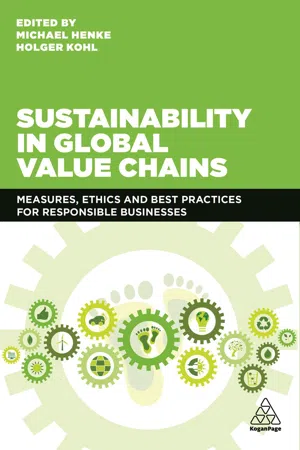
Sustainability in Global Value Chains
Measures, Ethics and Best Practices for Responsible Businesses
- English
- ePUB (mobile friendly)
- Available on iOS & Android
eBook - ePub
Sustainability in Global Value Chains
Measures, Ethics and Best Practices for Responsible Businesses
About this book
Information
Part One
Ethical principles of sustainable value chain management
It was only at the turn of the millennium that the inclusion of both ecological and social criteria in SCM increased (Handfield et al, 2002). This applies in particular to global SCM with a focus on emerging and developing countries (Lobel, 2006). A vivid example of the dimensions and impacts of this issue is that the United Nations Educational, Scientific and Cultural Organization (UNESCO) estimate that some 2.1 billion people lack access to clean and readily available drinking water at home. For the people concerned, this often results in poor health and living conditions, malnutrition, and a poor outlook for education and employment (UNESCO WWAP, 2019: 35). These circumstances facilitate social conflicts and even violence, which in turn leads to human displacement and migration (Miletto et al, 2017). While technological solutions along supply chains can address economic and environmental aspects of water saving and distribution, these solutions are not necessarily affordable or geographically accessible for those most affected by the water problem. This often eco-efficient motivation of scientific research (less water consumption = more cost savings) leads to short-sighted, primarily technical-economic considerations of these problems, which do not take sufficient account of the negative social impacts they can have.
A similar view emerges with regard to the problem of so-called ‘conflict minerals’ (Hofmann et al, 2018). These raw materials are mined and processed in crisis regions in such a way that non-governmental, criminal actors or terrorists benefit from the trade with these materials. The earnings are used to finance violent conflicts, especially in the Democratic Republic of Congo and its neighbouring states, under which the civilian population of these states suffers (Global Witness, 2013). Although this problem has been known since the reporting on ‘blood diamonds’ from Sierra Leone and Angola in the 1990s and is clearly related to the supply chain, it has received little attention in scientific (western) research because it lacks the obvious economic relevance (Rotter et al, 2014; Hofmann et al, 2018).
Within the framework of the project academy, the ethical foundations of the management of sustainable value chains will therefore be increasingly addressed as a foundation. At the same time, this area of work forms the basis for further joint research.
References
- Global Witness (2013) Breaking the links between natural resources and conflict: The case for EU regulation: A civil society position paper, Global Witness
- Handfield, R, Walton, SV, Sroufe, R and Melnyk, SA (2002) Applying environmental criteria to supplier assessment: A study in the application of the Analytical Hierarchy Process, European Journal of Operational Research, 141 (1), pp 70–87
- Hofmann, H, Schleper, MC and Blome, C (2018) Conflict minerals and supply chain due diligence: An exploratory study of multi-tier supply chains, Journal of Business Ethics, 147 (1), pp 115–41
- Lobel, O (2006) Sustainable capitalism or ethical transnationalism: Offshore production and economic development, Journal of Asian Economics, 17 (1), pp 56–62
- Miletto, M, Caretta, MA, Burchi, FM and Zanlucchi, G (2017) Migration and its Interdepencies with Water Scarcity, Gender and Youth Employment, United Nations Educational, Scientific, and Cultural Organization, Paris
- Rotter, JP, Airike, P-E and Mark-Herbert, C (2014) Exploring political corporate social responsibility in global supply chains, Journal of Business Ethics, 125 (4), pp 581–99
- UNESCO WWAP (2019) [accessed 23 September 2020] Leaving No One Behind: The United Nations world water development report 2019, UNESCO [Online] https://unesdoc.unesco.org/ark:/48223/pf0000367306 (archived at https://perma.cc/EPT3-ETTX)
04
Start-ups as relevant supporters and initiators of sustainability attributes in global value chains of the future
Introduction
How will sustainable start-ups have a noticeable influence on global value chains or supply chains in the future?
The economic relevance of start-ups is increasing. They invent new services and innovative business models, disrupt established markets as well as industry sectors, boost the digitalization and influence cooperation in global value chains or supply chains. This chapter focuses on start-ups with a sustainable entrepreneurial mindset and exploits their intended as well as their actual effects on value chains or supply chains. In terms of goals, intentions, results and impacts, sustainable start-ups are equally oriented towards social, ecological and economic attributes. These attributes determine the development and implementation of innovations. Their suppliers and logistics partners must cope with their high expectations to support their sustainable business activities. The chapter aims to develop approaches to operationalize these expectations by examining the ecological dimension (eg reduction of emissions), the economic dimension (eg scalability of solutions, purchasing decisions) and the social dimension (eg forms of cooperation and competition) of sustainable start-ups in value chains or supply chains, using case studies or conceptual considerations. The objective of this chapter is to gain insight into the question ‘How will sustainable start-ups have a noticeable influence on global value chains or supply chains in the future?’
A special context is the observation that companies, especially small and medium-sized enterprises (SMEs), cooperate within their sector in established value chains and that their ability to act jointly with asymmetric partners outside their own sector can be regarded as a key competence in the future. Interviews and case studies show that science and business notice a striking cooperation gap in the operational design of cooperation, the origin of which seems to stem from the factual and perceived asymmetry of the partnerships. It is therefore important to discuss the extent to which sustainable strategies of established companies and start-ups are based on cooperation with each other.
Framework
Asymmetric partnerships between start-ups and SMEs: A predetermined breaking point
Established companies are faced with the challenge of opening up their innovation processes to external impulses in order to actively use their corporate environment to increase their own innovation potential (ZEW, 2016). According to the Community Innovation Survey, 63.7 per cent of German companies pursued innovation activities between 2014 and 2016. Of these, a large proportion (60.8 per cent) implemented innovations of a technological or non-technological nature and are regarded as so-called innovative companies. As the number of employees increases, the proportion of innovative companies rises from 54.9 per cent for smaller companies to 74.2 per cent for medium-sized companies and 89.6 per cent for large companies. In particular, SMEs focus on either technological or non-technological innovation activities (IfM Bonn, 2019). Som (2015) states that, for example, SMEs cooperate in established value chains within their sector and anticipates their ability to cooperate with asymmetric partners outside their own sector as a future key competence. In the case study with Runamics, this contribution therefore focuses on a sustainable start-up as an asymmetric partner outside the industry for cooperation and innovation for SMEs (RKW, 2018; Deloitte, 2017).
According to prevailing opinion, start-ups act as technology input for value chains and disruptors of traditional business models. They are active drivers of cross-cutting issues such as sustainability or digitization and act as transfer channels from science and universities (Plöger, 2016). Some 67.1 per cent of start-ups cooperate with established companies (Kollmann et al, 2018). Their goals are a simplified market and customer access, proof of concept as well as image gains and technology expertise (Deloitte, 2017). Their motives for cooperation are technical (joint research and development), economic (cost reduction) or organizational (exchange of experience) (Deloitte, 2017). Cooperation takes place in pilot projects (50.3 per cent), in marketing (47.9 per cent) and in research and development (44.5 per cent) (Kollmann et al, 2018).
In Kühmayer’s Leadership Report 2017, start-ups are still regarded as ‘innovation pioneers’ (Kühmayer, 2016) but in his Leadership Report 2019 disillusionment sets in and the focus is once again on the ‘heroes of medium-sized businesses’ (Kühmayer, 2018). The state of the art is also divided in two fragments: optimistic contributions define cooperation between SMEs and start-ups as a promising success factor based on suitable cooperation models, t...
Table of contents
- List of figures and tables
- About the contributors
- Preface
- Acknowledgements
- List of abbreviations
- 01 Introduction: About the book Michael Henke, Holger Kohl and Denis Daus
- 02 The importance of supply chain management for sustainability in global value chains Holger Kohl, Michael Henke and Denis Daus
- 03 Interdisciplinary research work in the field of SSCM Michael Henke, Holger Kohl and Denis Daus
- Part One Ethical principles of sustainable value chain management
- 04 Start-ups as relevant supporters and initiators of sustainability attributes in global value chains of the future Stephanie Rabbe, Christoph von Viebahn and Marvin Auf der Landwehr
- 05 Global value chain sustainability governance: Implications for management research and practiceKlaus Fischer
- Part Two Measuring sustainability in global value chains
- 06 Sustainability controlling in integrated value chains Harry Müller
- 07 Measuring diversity among competing supply-value chains Kristan A Schneider
- 08 Sustainable buyer behaviour in value chains: Determinants and marketing implications Guido Grunwald and Valérie Swaen
- 09 Tactical planning measures for sustainable and efficient international transportation networks Michael Dircksen
- Part Three Actions to continuously improve sustainability in global value chains
- 10 Biomimetic principles for improved organizational information processing: Toward sustainable supply chains Lydia Bals
- 11 (How) Can research in the field of sustainable supply chain management become more forward-looking and future-shaping? Carsten Reuter
- 12 Success factors of voluntary sustainable supply chain management sector initiatives Julia Schwarzkopf, Klaus Fischer and Martin Müller
- 13 An institutional framework of urban logistics: Policy options and the role of the government Marcus Sidki and Igor Ivanov
- Index
Trusted by 375,005 students
Access to over 1.5 million titles for a fair monthly price.
Study more efficiently using our study tools.
Frequently asked questions
Yes, you can cancel anytime from the Subscription tab in your account settings on the Perlego website. Your subscription will stay active until the end of your current billing period. Learn how to cancel your subscription
No, books cannot be downloaded as external files, such as PDFs, for use outside of Perlego. However, you can download books within the Perlego app for offline reading on mobile or tablet. Learn how to download books offline
Perlego offers two plans: Essential and Complete
- Essential is ideal for learners and professionals who enjoy exploring a wide range of subjects. Access the Essential Library with 800,000+ trusted titles and best-sellers across business, personal growth, and the humanities. Includes unlimited reading time and Standard Read Aloud voice.
- Complete: Perfect for advanced learners and researchers needing full, unrestricted access. Unlock 1.5M+ books across hundreds of subjects, including academic and specialized titles. The Complete Plan also includes advanced features like Premium Read Aloud and Research Assistant.
We are an online textbook subscription service, where you can get access to an entire online library for less than the price of a single book per month. With over 1.5 million books across 990+ topics, we’ve got you covered! Learn about our mission
Look out for the read-aloud symbol on your next book to see if you can listen to it. The read-aloud tool reads text aloud for you, highlighting the text as it is being read. You can pause it, speed it up and slow it down. Learn more about Read Aloud
Yes! You can use the Perlego app on both iOS and Android devices to read anytime, anywhere — even offline. Perfect for commutes or when you’re on the go.
Please note we cannot support devices running on iOS 13 and Android 7 or earlier. Learn more about using the app
Please note we cannot support devices running on iOS 13 and Android 7 or earlier. Learn more about using the app
Yes, you can access Sustainability in Global Value Chains by Michael Henke,Holger Kohl in PDF and/or ePUB format, as well as other popular books in Business & Operations. We have over 1.5 million books available in our catalogue for you to explore.