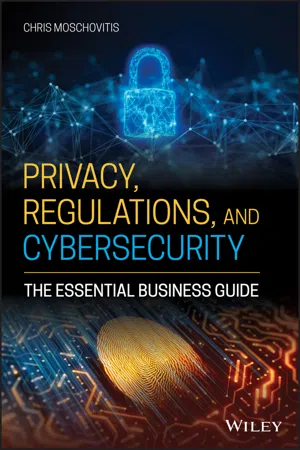
- English
- ePUB (mobile friendly)
- Available on iOS & Android
About this book
Protect business value, stay compliant with global regulations, and meet stakeholder demands with this privacy how-to
Privacy, Regulations, and Cybersecurity: The Essential Business Guide is your guide to understanding what "privacy" really means in a corporate environment: how privacy is different from cybersecurity, why privacy is essential for your business, and how to build privacy protections into your overall cybersecurity plan.
First, author Chris Moschovitis walks you through our evolving definitions of privacy, from the ancient world all the way to the General Law on Data Protection (GDPR). He then explainsāin friendly, accessible languageāhow to orient your preexisting cybersecurity program toward privacy, and how to make sure your systems are compliant with current regulations.
This bookāa sequel to Moschovitis' well-received Cybersecurity Program Development for Business āexplains which regulations apply in which regions, how they relate to the end goal of privacy, and how to build privacy into both new and existing cybersecurity programs. Keeping up with swiftly changing technology and business landscapes is no easy task. Moschovitis provides down-to-earth, actionable advice on how to avoid dangerous privacy leaks and protect your valuable data assets.
- Learn how to design your cybersecurity program with privacy in mind
- Apply lessons from the GDPR and other landmark laws
- Remain compliant and even get ahead of the curve, as privacy grows from a buzzword to a business must
- Learn how to protect what's of value to your company and your stakeholders, regardless of business size or industry
- Understand privacy regulations from a business standpoint, including which regulations apply and what they require
- Think through what privacy protections will mean in the post-COVID environment
Whether you're new to cybersecurity or already have the fundamentals, this book will help you design and build a privacy-centric, regulation-compliant cybersecurity program.
Frequently asked questions
- Essential is ideal for learners and professionals who enjoy exploring a wide range of subjects. Access the Essential Library with 800,000+ trusted titles and best-sellers across business, personal growth, and the humanities. Includes unlimited reading time and Standard Read Aloud voice.
- Complete: Perfect for advanced learners and researchers needing full, unrestricted access. Unlock 1.4M+ books across hundreds of subjects, including academic and specialized titles. The Complete Plan also includes advanced features like Premium Read Aloud and Research Assistant.
Please note we cannot support devices running on iOS 13 and Android 7 or earlier. Learn more about using the app.
Information
PART ONE
Privacy
CHAPTER 1
Understanding Privacy
- a: the quality or state of being apart from company or observation: SECLUSION b: freedom from unauthorized intrusion
- a: SECRECY b: a private matter: SECRET
- archaic: a place of seclusion
- A state in which one is not observed or disturbed by other people.
- 1.1 The state of being free from public attention.
- The state of being secluded from the presence, sight, or knowledge of others.
- Freedom from unwanted or undue disturbance of one's private life.
- Freedom from damaging publicity, public scrutiny, surveillance, and disclosure of personal information, usually by a government or a private organization.
- (obsolete) A place of seclusion.
- (obsolete, law) A relationship between parties seen as being a result of their mutual interest or participation in a given transaction, contract, etc.; Privity.
- (obsolete) Secrecy.
- (obsolete) A private matter; a secret.
- Physical: An imposition whereby another individual is restricted from experiencing an individual or a situation;
- Decisional: The imposition of a restriction that is exclusive to an entity;
- Informational: The prevention of searching for unknown information; and
- Dispositional: The prevention of attempts made to get to know the state of mind of an individual.
It's not that I have something to hide,I have nothing I want you to see.āAmanda Seyfried
- Temporal dynamic process of interpersonal boundaries (feelings about privacy change based on context);
- Desired and actual levels of privacy (what we hope for and what we get can differ);
- Non-monotonic function of privacy (what constitutes the āoptimalā amount can increase or decrease);
- Bi-directional nature of privacy (privacy involves both āinputsā and āoutputsā); and
- Bi-level nature of privacy (individual privacy is different from group).
Table of contents
- COVER
- TABLE OF CONTENTS
- TITLE PAGE
- COPYRIGHT
- FOREWORD
- PREFACE
- ABOUT THE AUTHOR
- ACKNOWLEDGMENTS
- PART ONE: Privacy
- PART TWO: Regulations
- PART THREE: Privacy and Cybersecurity
- BIBLIOGRAPHY
- INDEX
- END USER LICENSE AGREEMENT