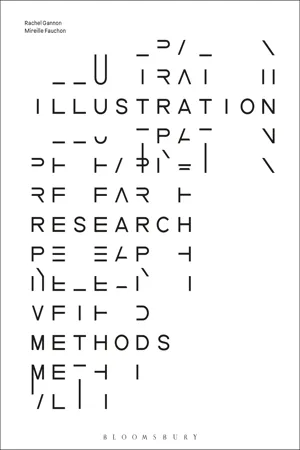
**Shortlisted for the 2021 British Book Design and Production Awards for the Best Jacket / Cover Design** For years illustration has lacked a strong critical history in which to frame it, with academics and media alike assessing it as part of design rather than a discipline in its own right. Illustration Research Methods addresses this void and adds to a fast-emerging discipline, establishing a lexicon that is specific to discussing contemporary illustration practice and research. The chapters are broken down into the various roles that exist within the industry and which illustration research can draw from, such as 'Reporting' and 'Education'. In doing so, users are able to explore a diverse range of disciplines that are rich in critical theory and can map these existing research methodologies to their own study and practice. Supported by a wealth of case studies from international educators, student projects sit alongside those of world-renowned illustrators. Thus allowing users the opportunity to put what they have learnt into context and offering insight into the thinking and techniques behind some of illustrations' greats.
- 200 pages
- English
- ePUB (mobile friendly)
- Available on iOS & Android
eBook - ePub
Illustration Research Methods
About this book
Information
1ILLUSTRATION RESEARCH
PART 1: ILLUSTRATION
Definitions
Illustration as process
Identity
Language and terminology
The principles of illustration practice
Shifting roles – an expanded practice
Can illustration ever be authorless?
PART 2: ILLUSTRATION AND RESEARCH
A social practice
Research into, through and for illustration – a framework for categorising methods
Rigour in illustration
Originality in illustration
Endnote
PART 1: ILLUSTRATION
Illustration is an enthralling discipline. As educators, we have gladly learnt to abandon expectations as year after year we witness practices develop that disrupt with gusto all previous known parameters. Professionally, illustrators are now multifarious beings, positioning their practices to respond to the subject matters they recognise as most urgent in the here and now. Illustration has come to not only describe a practice of creative making but also one of cognition, thinking and reasoning, capable of bearing significant theoretical weight. The illustrator’s knowledge is not only contained in the hands or in the manipulation of materials, it is also present in their canny perception, acute questioning and empathetic, intersubjective rapport. Illustrative forms and material outcomes refuse to be taken for granted. Practices are now expansive, as illustrators extend and shift their works to assume new roles and responsibilities. No longer is it sufficient to look to the past for reference and rationale. Rather, we must self-determine from within the crucible of a contemporary discipline, and project outwards with earnest and uncompromised ambition.
Definitions
The mandate of this book is not to anchor an all-encompassing definition of illustration, or to claim to exemplify all practices. With a discipline so chimera-like as contemporary illustration practice, such a task would be as futile as it would be thankless. However, it is important to recognise that definitions can offer clarity, a sense of belonging and an acknowledgement of distinction. Distinctions infer specialist knowledge and expertise; they describe a landscape within which we position ourselves while acknowledging a lineage and legacy. ‘Illustration’ encompasses much more than just visual additions to printed written texts, yet rudimentary dictionary definitions can still be found describing illustration as ‘a picture illustrating a book, newspaper’ etc. There certainly are forms of illustration that are more familiar and easily determinable, including decorative or representational pictorial images made in response to written sources. Professionally, illustration is also commonly associated as being brief-led and belonging within commissioned dynamics for commercial application within industries such as publishing, advertising, packaging and so on.
As practices emerge that divert, sometimes entirely, from familiar conventions, what is needed is a recognition of the increasing pluralism within illustration, and with it a confident and sophisticated vocabulary through which it can be critically described and examined.
This book claims a terminology designed specifically to articulate the languages and mechanisms through which illustration operates. The content is by no means definitive, but offers a working lexicon with the expectation that it will and should be extended, developed and reformed.
Illustration as process
With discipline-specific critical discourse in its infancy, the methods used by illustrators have never been formally framed in academic language. The absence of a common framework leaves little precedence in guiding discussions of how illustration methods might function and perform. Analysis and critique of illustration is often only concerned with visual outcomes. Outside the educational environment, analysis rarely extends to examining the complex, and often highly individual, methodologies involved in realising works of illustration. When processes are addressed, there can be a tendency to frame the discussion as examples of ‘good’ vocational practice. Materials and processes can be fetishised, with the figure of the illustrator seen as an elusive genius whose persona, visual style or methods of creation dare not be shared for fear of imitation.
However, if we consider the phrasing ‘to illustrate’ as an active verb, the illustration outcome or artefact forms just a limited part of a wider process in motion. Furthermore, it presents new questions of how illustration can be applied and commodified. Illustration is typically purchased as an outcome, whether acquired as a service or as an artefact. Might illustrators enjoy new employment opportunities if value was duly placed on the expertise involved in communicating and engaging with targeted audiences? This might involve illustration applied as methodology, or an illustrator engaged professionally as a creative consultant.
Method
A tool, process or technique utilised to realise a specific aim.
Methodology
A strategic system or series of methods selected to conduct a sustained inquiry or to perform a task.
Identity
One of the most important factors influencing the future of illustration is giving illustrators the confidence to describe themselves as such. Many of those exploring innovative or expanded notions of illustration choose to adopt more all-encompassing monikers – creative, designer, maker, artist – for lack of a seemingly more suited title. This means those actively engaged in challenging or progressing the discipline remove themselves and their pioneering practices from discipline-specific discussions.
Illustration’s versatility has often lead it to be described as interdisciplinary. As with all disciplines, there is no one particular method, form or concern, but this does not mean illustration is inherently interdisciplinary, and to describe it as such can induce feelings of insecurity. Illustration has its own distinctive methods and strategies. These are not, as it were, ‘interdisciplinary’ as in oscillating between various disciplines, but are particular within illustration. Of course, when practiced with innovation, illustration will look towards and learn from other subjects, but this is not to deny that there are recognisable discipline-specific models.
Language and terminology
Regardless of whether illustration is considered an established or emergent discipline, it has lacked the subject-specific critical eloquence established within other artistic disciplines. While much is gained from engaging in cross-disciplinary discourse, illustration too often looks outside itself for rationalisation and inspiration in the absence of its own intellectual tools. Terminologies and languages are frequently adopted from other fields to articulate illustration-specific behaviours and engagement; for example, illustration is often described as being ‘read’.
The development of illustration relies on investment in discipline-specific theory. To neglect this is a failure to recognise the complex processes in operation and to risk illustration being marginalised as a lesser art form. Within this text we have attempted to isolate and describe methods, not appropriated from the other subjects, but those we recognise as being particular to illustration.
The principles of illustration practice
In order to discuss how illustration performs, it is necessary to first offer a working model of the principles of illustration. The following describes the mechanisms we recognise as being commonly operational within illustrative works regardless of their final form, the subject matter addressed or the impetus for the project. The points made here do not claim to be exhaustive, nor do we suggest all works of illustration must concede to all these mandates. Rather, we intend to create a reference in order to aid a shared understanding of why we regard the works we discuss as illustration. This template also allows us to identify and relate those works which are not strictly illustrative as relevant to our inquires.
PRINCIPLES
Social / Public – practices often involve social engagement with people or the public. This may refer to research methods dependent on personally engaging with other creative collaborations or more pragmatic negotiation with professional partners and commissioners. Audience specific – audience reception is considered. Communicative – works that actively seek to engage and be understood. Multiform – illustration is not defined by material boundaries and can manifest in any way, including sculptural, time-dependent or virtual forms. Intent – practices are conscious and informed by motive, even if the knowledge sought or the results gained are initially unknown. For example, intentional practice may be exploratory, diagnostic or convey information.
COMMON STRATEGIES
Narrative – storytelling and narrative as a method of engaging, communicating and / or presenting information and content. Creative interpretation – use of fiction or imagination to extend knowledge and / or relate to and engage with audiences. Participation – works that rely on or incorporate audience engagement in order to be fully realised. Examples of participation could be physical engagement with a work such as reading a publication, a public showcase to gauge reception or involving audiences within activities such as workshops or performances. Participation may occur at any stage within an illustration project. Responsive – illustration methods are responsive and adaptable. Methodologies are tailored to the task at hand, the environment, people and situations that the illustrator is engaged with.
BEHAVIOURS
Subjective – often describing personal or specific viewpoints or positions. Empathic – engaging through use of emotion, e.g. humour, compassion, anxiety, etc. Persuasive – able to inform and influence opinion or decision-making. Provocation – used to prompt consideration or to challenge preconceived notions. Transferability – works that are mobile or adaptable to contexts and audiences, for example, illustration cont...
Table of contents
- Cover
- Title Page
- Contents
- INTRODUCTION
- 1 ILLUSTRATION RESEARCH
- 2 AUTHORSHIP
- 3 REPORTING
- 4 CRAFTING
- 5 ACTIVISM
- 6 EDUCATION
- 7 ILLUSTRATION FUTURES
- APPENDIX
- Index
- Acknowledgements
- eCopyright
Trusted by 375,005 students
Access to over 1.5 million titles for a fair monthly price.
Study more efficiently using our study tools.
Frequently asked questions
Yes, you can cancel anytime from the Subscription tab in your account settings on the Perlego website. Your subscription will stay active until the end of your current billing period. Learn how to cancel your subscription
No, books cannot be downloaded as external files, such as PDFs, for use outside of Perlego. However, you can download books within the Perlego app for offline reading on mobile or tablet. Learn how to download books offline
We are an online textbook subscription service, where you can get access to an entire online library for less than the price of a single book per month. With over 1.5 million books across 990+ topics, we’ve got you covered! Learn about our mission
Look out for the read-aloud symbol on your next book to see if you can listen to it. The read-aloud tool reads text aloud for you, highlighting the text as it is being read. You can pause it, speed it up and slow it down. Learn more about Read Aloud
Yes! You can use the Perlego app on both iOS and Android devices to read anytime, anywhere — even offline. Perfect for commutes or when you’re on the go.
Please note we cannot support devices running on iOS 13 and Android 7 or earlier. Learn more about using the app
Please note we cannot support devices running on iOS 13 and Android 7 or earlier. Learn more about using the app
Yes, you can access Illustration Research Methods by Rachel Gannon, Mireille Fauchon in PDF and/or ePUB format, as well as other popular books in Design & Graphic Design. We have over 1.5 million books available in our catalogue for you to explore.