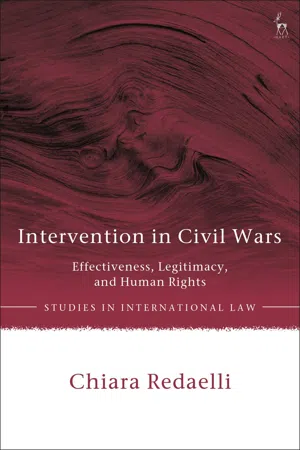
This book investigates the extent to which traditional international law regulating foreign interventions in internal conflicts has been affected by the human rights paradigm. Since the adoption of the Charter of the United Nations, foreign armed interventions in internal conflicts have turned into a common practice. At first sight, it might seem that state practice has developed in a chaotic fashion, however on closer examination, specific patterns emerge. The book charts these patterns by examining the traditional doctrines of intervention and testing them against state practise.
The book has two aims. Firstly, it seeks to clarify the current legal framework regulating interventions in internal conflicts. Secondly, it plots the emergence of new trends and investigates whether they are becoming part of positive international law. By taking this dual focus, it offers the first truly comprehensive examination of foreign interventions in internal conflicts.
- 344 pages
- English
- ePUB (mobile friendly)
- Available on iOS & Android
eBook - ePub
About this book
Information
Part I
Sovereignty, Intervention, and Human Rights: The Evolution of a Close Relationship
Remember the lessons of history. …
How many powerful men have craved to
dominate the world – and by overreaching
have lost everything they once possessed!
How many powerful men have craved to
dominate the world – and by overreaching
have lost everything they once possessed!
Xenophon
That men do not learn very much
from the lessons of history is the most
important of all the lessons of history.
from the lessons of history is the most
important of all the lessons of history.
Ariel Durant
Since the adoption of the UN Charter, interventions in internal conflicts have been extremely common: governments and rebels alike have frequently sought foreign help to defeat their enemies. However, the legal framework regulating these instances is substantially unclear, while state practice is often perceived as chaotic. This confusion derives in part from the paucity and lack of clarity of rules explicitly addressing interventions in internal conflicts: while the principle of non-intervention and the ban on the use of force are the primary sources regulating these instances, their exact content is uncertain. Furthermore, the question of the legality of interventions in internal conflicts touches upon fundamental dilemmas of international law, namely sovereignty, human rights, and intervention. In light of this, this Part seeks to define and clarify crucial concepts addressed in this study. Specifically, it will analyse pivotal issues relating to interventions in internal conflicts, thus framing our discussion.
The practice of interventions in internal conflicts did not emerge ex abrupto during the twentieth century: since the Middle Ages, dilemmas on the possibility to intervene to protect people from a tyrant, on the relationship between intervention and sovereignty, and on the legality of the use of force have been central in legal debates. Therefore, before engaging in discussions on the current legal framework regulating interventions in internal conflicts, it is crucial to analyse how the relationship between sovereignty, human rights, and intervention evolved over the centuries. Indeed, as noted by Hoffmann:
To be able to talk intelligently about what looks like the extraordinary amount of intervention that occurs in the present-day international system, or about the seemingly original network of contemporary transnational relations, it is useful to be able to compare the present system with past ones. We may discover that the amount of intervention today is not at all that unusual and that the network of transnational relations is far less original than many have claimed.1
Bearing these considerations in mind, this part is structured as follows. Chapter one will focus on interventions in internal conflicts in the pre-Charter era. Specifically, it will invite the reader to follow the evolution of concepts which are going to have a crucial role in this study. Unlike what is commonly believed, in ancient times war was not waged without restraint. Notably, theories on just wars flourished in the Middle Ages and raised conundrums which are still relevant nowadays. Furthermore, the emergence of the principle of non-intervention triggered debates on sovereignty and its limits. Finally, in the nineteenth century, the recognition of belligerency and insurgency helped reframe the terms of the discussion. However, questions on sovereignty, intervention, and human rights did not lose their relevance.
Building on this historical analysis, chapter two will clarify the main concepts addressed in this work. First, it will define the concepts of intervention and non-international armed conflict. Despite its crucial significance in international law, the meaning and scope of the principle of non-intervention is still unclear. Similarly, determining the existence of a NIAC is not always an easy task, especially due to the lack of certain criteria to identify the lower threshold and the increase of situations when both internal and international conflicts take place simultaneously in a country. Second, chapter two will discuss the content and nature of the ban on the use of force. Furthermore, it will address longstanding debates on the threshold of control required to attribute the actions of rebels to a state that is helping them. Lastly, this Part will analyse the current state of the relationship between non-intervention, sovereignty, and human rights in light of the historical overview conducted in chapter one.
1S Hoffmann, ‘Hedley Bull and His Contribution to International Relations’ (1986) 62(2) International Affairs 179–95.
1
Interventions in Internal Conflicts in the Pre-Charter Era
I.THE USE OF FORCE AS CRUCIAL PREROGATIVE OF STATE SOVEREIGNTY: FROM BELLUM JUSTUM DOCTRINES TO THE RIGHT TO WAR
A.Just War Doctrines
i.The Origins of Bellum Justum Doctrines
There is a common perception that in ancient times war was waged without restraint and with no attempts to avoid it. However, this assumption does not reflect the historical realities. Already in the first millennium BCE some nations had developed a legal framework regulating the use of force. For instance, Jewish religious thought distinguished between mitzvah, ie an obligatory war ordered by God to defend Israel, and reshut, the war which was permitted in other circumstances at the discretion of the ruler.1 However, Walzer notes that such distinction between commanded/permitted war did ‘not translate into just/unjust’.2 Thus, restraints on the use of force seemed to stem more from ‘instrumental prudence’ than from moral considerations on the justness of war.3
It was only with the Greek and Roman cultures that the idea of justice (dikê/justitia) was introduced into decisions as to whether to wage war.4 In ancient Greece people were well aware of the trauma stemming from war and its impact on society. Homer describes the struggle of the men who returned from war: people who ‘have fallen victim to useless labour and dreadful diseases and hardly curable madness’.5 Xenophon writes about ritualistic dances practised for their therapeutic value.6 In Athens, the cathartic function of theatre was directed towards the same end.7 As the Greeks experienced the horrors of war and its dramatic consequences, they also developed means to prevent armed conflicts. War was considered as a last resort: peaceful means to resolve differences should have been undertaken when feasible.8 For instance, Homer, describing the tense period preceding the Trojan War, mentions diplomacy as crucial effort to settle conflicts before the kings turned into wars.9 Should endeavours to peacefully settle differences fail, the use of military force had to be based on a just cause. While self-defence was the most common justification, commentators also mentioned breaking treaty obligations and breaching neutrality.10
Similarly, the Romans often mentioned self-defence as a basis for legitimately waging war: in the words of Cicero, ‘if our lives are endangered by enemies, any and every method of protecting ourselves is morally right’.11 However, a just cause was not sufficient: the decision to engage in an armed conflict could be adopted only by a person who had the legitimate authority.12 According to Cicero, ‘no war is just unless it is waged after a formal demand for restoration, or unless it has been formally announced and declared beforehand’.13 Bellum justum was hence a defensive war conducted in response to an offence against Rome and as such in line with the will of the Gods.14 The fetiales were a special priesthood whose duties entailed ensuring the justness of war. When Rome suffered a grievance, the fetiales were in charge of following specific rituals and procedures that could lead to waging war. First, the priests had to ask for satisfaction (rerum repetitio). In case the opponent did not comply with such demand within a specific time frame, the fetiales could proceed with a formal declaration of war, following specific rituals.15 Thus, bellum was not justum unless it followed specific and complex procedures and had the final imprimatur of the fetiales.16
ii.Just War in the Scholastic Thought
Bellum justum doctrines did not fall out of fashion with the fetiales: the Canonist thought embraced and developed the idea that war should be just. Inasmuch as the Roman Empire was pagan, the Church adopted a strictly pacifist approach: war was in contrast with the evangelical message and Christians could not become soldiers. However, with Constantine and his Edict (313 AD) Christians were integrated into the empire. The army was no longer synonymous with persecution and thus ‘the stigma which the originally pacific spirit...
Table of contents
- Cover
- Dedication
- Title Page
- Acknowledgements
- Abstract
- Contents
- Abbreviations
- Table of Cases
- Table of Treaties and National Legislation
- Table of Documents and Resolutions
- Introduction
- PART I: SOVEREIGNTY, INTERVENTION, AND HUMAN RIGHTS: THE EVOLUTION OF A CLOSE RELATIONSHIP
- PART II: INTERVENTIONS IN FAVOUR OF GOVERNMENTS
- PART III: INTERVENTIONS IN FAVOUR OF REBELS
- Bibliography
- Index
- Copyright Page
Trusted by 375,005 students
Access to over 1.5 million titles for a fair monthly price.
Study more efficiently using our study tools.
Frequently asked questions
Yes, you can cancel anytime from the Subscription tab in your account settings on the Perlego website. Your subscription will stay active until the end of your current billing period. Learn how to cancel your subscription
No, books cannot be downloaded as external files, such as PDFs, for use outside of Perlego. However, you can download books within the Perlego app for offline reading on mobile or tablet. Learn how to download books offline
Perlego offers two plans: Essential and Complete
- Essential is ideal for learners and professionals who enjoy exploring a wide range of subjects. Access the Essential Library with 800,000+ trusted titles and best-sellers across business, personal growth, and the humanities. Includes unlimited reading time and Standard Read Aloud voice.
- Complete: Perfect for advanced learners and researchers needing full, unrestricted access. Unlock 1.5M+ books across hundreds of subjects, including academic and specialized titles. The Complete Plan also includes advanced features like Premium Read Aloud and Research Assistant.
We are an online textbook subscription service, where you can get access to an entire online library for less than the price of a single book per month. With over 1.5 million books across 990+ topics, we’ve got you covered! Learn about our mission
Look out for the read-aloud symbol on your next book to see if you can listen to it. The read-aloud tool reads text aloud for you, highlighting the text as it is being read. You can pause it, speed it up and slow it down. Learn more about Read Aloud
Yes! You can use the Perlego app on both iOS and Android devices to read anytime, anywhere — even offline. Perfect for commutes or when you’re on the go.
Please note we cannot support devices running on iOS 13 and Android 7 or earlier. Learn more about using the app
Please note we cannot support devices running on iOS 13 and Android 7 or earlier. Learn more about using the app
Yes, you can access Intervention in Civil Wars by Chiara Redaelli in PDF and/or ePUB format, as well as other popular books in Law & International Law. We have over 1.5 million books available in our catalogue for you to explore.