This volume moves discussion of ancient Israelite culture beyond concepts of isolation and borders, factoring in already well-known insights from classical studies and ancient history that take greater account of the impressive connections between all the countries bordering the Mediterranean Sea. Specifically, the contributors focus on Cyprus and the Bible and offer archaeological and biblical insights to consider how and in what ways, Cyprus and Cypriot culture was related to biblical life and perceptions.
Though the Mediterranean separated Palestine from Cyprus, it also joined them; archaeological finds expose significant trade relations and cultural commonalities, not only in the Hellenistic and late-Roman eras, but for many centuries prior. These relations developed and became even more intimate in the later biblical period, as evidenced by early Jewish and Christian writings. By exploring various methods of cultural contact, the contributors suggest that further examination of cultural links between Cyprus and Palestine in the biblical period can repay dividends in understanding the development of ancient Israelite religion, early Judaism, and early Christianity.
eBook - ePub
Cyprus Within the Biblical World
Are Borders Barriers?
- 224 pages
- English
- ePUB (mobile friendly)
- Available on iOS & Android
eBook - ePub
Cyprus Within the Biblical World
Are Borders Barriers?
About this book
Information
1
Cyprus and the Land of Israel
The Mediterranean as a Bridge and the Diverse Consequences of Cultural Contact
From at least the early second millennium BCE, the eastern Mediterranean served more as a bridge than a barrier, and it appears as if the land of Israel and Cyprus maintained continuous maritime connections ever since. This relationship is best exemplified in pottery, and from the Middle Bronze Age1 onwards, ceramic objects manufactured on Cyprus were almost always present in the Southern Levant, often in large quantities. Cypriote influence can further be seen in local imitations that were quite popular in various periods.
Contacts, however, can produce a variety of outcomes, and in addition to the importation of actual artifacts, and evidence of their emulation by indigenous potters, some local groups reacted in other ways and even rejected the foreign imports. In this chapter, I briefly present the overall pattern of continued contacts between Cyprus and Canaan during the second and first millennia BCE and will then focus on two specific and distinct Iron Age phenomena—the Ashdod Ware of the southern coastal plain and the Israelite avoidance of imported pottery—each reflecting a different outcome of cultural interaction.
Cypriot Pottery in the Land of Israel during the Second and the Beginning of the First Millennium BCE: Setting the Scene
It is not my aim in this chapter to summarize the history of Cypriot importations to the land of Israel, and the brief summary below is meant to serve as a background for the more detailed discussion of the Iron Age reactions to intercultural trade.
Significant contacts, and a growing number of Cypriot imports, are clearly evident in the Middle Bronze Age, with the number of imports peaking toward the end of this period.2 Importation continued in the Late Bronze Age (Figure 1.1), increasing with time until reaching a peak in the thirteenth century BCE,3 when the entire eastern Mediterranean became significantly integrated into a complex web of political and economic relations.4
It is commonly agreed that international trade ceased during the late thirteenth century,5 but recent evidence suggests that as far as Cyprus’ relations with the Southern Levant are concerned there was only a decline, and trade contacts continued throughout the era. This decline is clearly manifested in northern ports like Tyre and Dor, where connections were intense,6 but also in other regions, like Philistia, where influences are clear, reflecting continued contacts between the new settlers in Israel’s southern coastal plain and their contemporaries in Cyprus.7
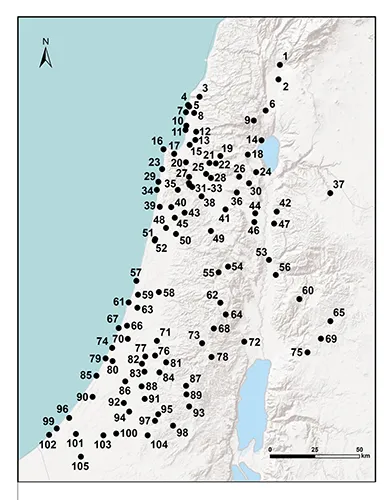
Figure 1.1 A map showing the distribution of Late Bronze Age Cypriot imports in the land of Israel (prepared by Haggai Cohen Klonymus on the basis of data collected by Aaron Greener).
Key
| 1 Dan | 36 Afula | 71 Gezer |
| 2 Anafa | 37 Fukhar | 72 Jericho |
| 3 Hanita | 38 Megiddo | 73 Gibeon |
| 4 Akhziv | 39 Mevorakh | 74 Mor |
| 5 Gesher HaZiv | 40 Sit Leila | 75 Heshban |
| 6 Hazor | 41 Ta’anach | 76 Batash |
| 7 Nahariyah | 42 Abu Kharaz | 77 Miqne |
| 8 Kabri | 43 Ara | 78 Jerusalem |
| 9 Safed | 44 Beth Shean | 79 Ashdod (southern beach) |
| 10 Acco (Persian gardens) | 45 Esur | 80 Ashdod |
| 11 Acco | 46 Rehov | 81 Beth Shemesh |
| 12 Uza | 47 Pella | 82 Harasim |
| 13 Kison | 48 Zeror | 83 Zafit |
| 14 Chinnereth | 49 Dothan | 84 Azekah |
| 15 Aphek (N) | 50 Jatt | 85 Ashkelon |
| 16 Shiqmona | 51 Hefer | 86 Zippor |
| 17 Abu Hawam | 52 Ma’abarot | 87 Gedor |
| 18 Qarney Hittin | 53 Sa’idiyeh | 88 Zayit |
| 19 Wawiyat | 54 Far’ah (N) | 89 Beth Zur |
| 20 Regev | 55 Shechem | 90 Netiv Ha’asara |
| 21 Yiftah’el | 56 Deir ‘Alla | 91 Lachish |
| 22 En Zippori | 57 Michal | 92 Hesi |
| 23 Megadim | 58 Aphek (S) | 93 Hebron |
| 24 Yin’am | 59 Gerisa | 94 Nagila |
| 25 Nazareth | 60 Umm ad Dananir | 95 Eton |
| 26 Zelef | 61 Jaffa | 96 Ajjul |
| 27 Qashish | 62 Shilo | 97 Beit Mirsim |
| 28 Ein el-Hilu | 63 Azor | 98 Rabud |
| 29 Nami | 64 Ein Samiyeh | 99 Deir el-Balah |
| 30 Rekhesh | 65 Amman | 100 Sera’ |
| 31 Yoqne’am | 66 Humra | 101 Jemmeh |
| 32 Qiri | 67 Palmachim/Yavneh Yam | 102 Ridan |
| 33 Abu Zureik | 68 Bethel | 103 Haror |
| 34 Dor | 69 Umeiri | 104 Halif |
| 35 En Haggit | 70 Yavneh | 105 Far’ah (S) |
International trade resumed on a larger scale during the Iron II, and Cypriot pottery is again found in an increasing number of sites throughout the region.8 Iron II imports include various families (e.g., bichrome) but most common is the Black on Red (BoR) pottery, also known as Cypro-Phoenician pottery (Figure 1.2).9 BoR pottery is found throughout the region, and it appears that Ashdod Ware (Figure 1.3, and see below), common in the south, is a local imitation of this form.10
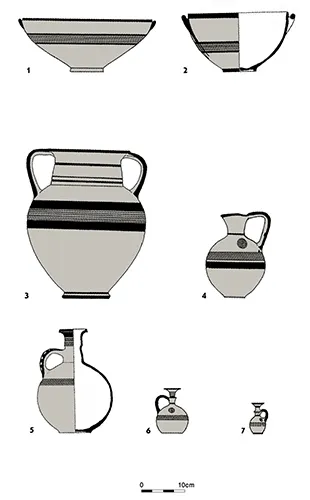
Figure 1.2 Sample of Cypro-Phoenician pottery (BoR) (based on Schreiber [2003] and prepared by Michal Marmelshtein and Sivan Landenberg).
Key
| # | Type | Redrawn after: |
| 1 | BoR I | Schreiber 2003: Fig. 3:2 |
| 2 | BoR II | Schreiber 2003: Fig. 4:13 |
| 3 | BoR I | Schreiber 2003: Fig. 3:17 |
| 4 | BoR I | Schreiber 2003: Fig. 3:11 |
| 5 | BoR I | Schreiber 2003: Fig. 3:18 |
| 6 | BoR II | Schreiber 2003: Fig. 4:21 |
| 7 | BoR I | Schreiber 2003: Fig. 3:9 |
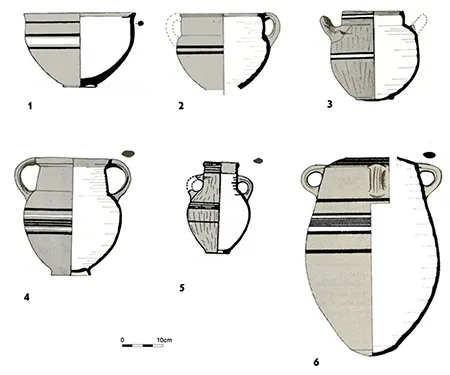
Figure 1.3 Ashdod Ware plate (prepared by Michal Marmelshtein and Sivan Landenberg).
Key
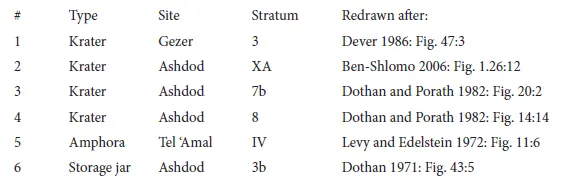
Cypriot Imports during the Iron II and the Local Reactions to International Trade
Iron Age II in the Southern Levant is one of the best archaeologically known periods in history. Not only is the region the most studied in the world,11 but Iron II is extremely well represented even in the Southern Levant. This period was marked by a demographic peak12 and usually constitutes the uppermost layer of significant occupation on most mounds. Hence, strata from this era are found in most sites and are often widely exposed. In addition, this is a “historical” period, and we also have (relative to previous eras) a wealth of textual information, both biblical and extra-biblical. All these factors have made the period both interesting to scholars and well suited to detailed social studies.13
In the following pages I would like to focus on two phenomena that are of interest in the context of studying the relations between Cyprus and the Southern Levant: (1) the Ashdod Ware of the southern coastal plain and (2) the Israelite ceramic assemblage.
Ashdod Ware and Cyprus
In the Iron IIA a new type of pottery appears mainly in the southern coastal plain—Ashdod Ware (Figure 1.3, sometimes also known as Late Philistine Decorated Ware [LPDW]).14 Dothan and Freedman (1967, ...
Table of contents
- Cover
- Title Page
- Contents
- List of Figures
- List of Maps
- List of Contributors
- Preface: Planning the Cyprus Congress
- Foreword
- List of Abbreviations
- Is Cyprus a Neglected Dimension of Biblical Research and Are Borders Barriers?
- 1 Cyprus and the Land of Israel: The Mediterranean as a Bridge and the Diverse Consequences of Cultural Contact
- 2 “In Sorrow Thou Shalt Bring Forth Children”: Archaeological Perspectives on Delivery Practices in Canaan and Cyprus
- 3 Cyprus and the Shore of Israel during the Persian Period: According to Metal Finds
- 4 Did Lazarus Flee Jerusalem for Cyprus?
- 5 Barnabas: The Levite from Cyprus
- 6 Levites on Cyprus—Not Only in the Jerusalem Temple
- 7 Meeting the Romans: The Encounter of Paul and Sergius Paulus according to Acts
- 8 The Motivations for Paul’s Choice of Mission Areas
- 9 Cyprus and Early Christianity: Did Everybody Know Everybody?
- 10 Visions of Cyprus: A Phenomenological Background to Jewish and Christian Scripture
- Conclusions Regarding Cyprus and the Holy Land in the Biblical Period
- Cyprus and the Holy Land in History, Archaeology, and Scripture: A Selected Bibliography
- Ancient Sources Index
- Modern Authors Index
- Subject Index
- Imprint
Trusted by 375,005 students
Access to over 1.5 million titles for a fair monthly price.
Study more efficiently using our study tools.
Frequently asked questions
Yes, you can cancel anytime from the Subscription tab in your account settings on the Perlego website. Your subscription will stay active until the end of your current billing period. Learn how to cancel your subscription
No, books cannot be downloaded as external files, such as PDFs, for use outside of Perlego. However, you can download books within the Perlego app for offline reading on mobile or tablet. Learn how to download books offline
Perlego offers two plans: Essential and Complete
- Essential is ideal for learners and professionals who enjoy exploring a wide range of subjects. Access the Essential Library with 800,000+ trusted titles and best-sellers across business, personal growth, and the humanities. Includes unlimited reading time and Standard Read Aloud voice.
- Complete: Perfect for advanced learners and researchers needing full, unrestricted access. Unlock 1.5M+ books across hundreds of subjects, including academic and specialized titles. The Complete Plan also includes advanced features like Premium Read Aloud and Research Assistant.
We are an online textbook subscription service, where you can get access to an entire online library for less than the price of a single book per month. With over 1.5 million books across 990+ topics, we’ve got you covered! Learn about our mission
Look out for the read-aloud symbol on your next book to see if you can listen to it. The read-aloud tool reads text aloud for you, highlighting the text as it is being read. You can pause it, speed it up and slow it down. Learn more about Read Aloud
Yes! You can use the Perlego app on both iOS and Android devices to read anytime, anywhere — even offline. Perfect for commutes or when you’re on the go.
Please note we cannot support devices running on iOS 13 and Android 7 or earlier. Learn more about using the app
Please note we cannot support devices running on iOS 13 and Android 7 or earlier. Learn more about using the app
Yes, you can access Cyprus Within the Biblical World by James H. Charlesworth, Jolyon G. R. Pruszinski, James H. Charlesworth,Jolyon G. R. Pruszinski in PDF and/or ePUB format, as well as other popular books in Theology & Religion & Biblical Criticism & Interpretation. We have over 1.5 million books available in our catalogue for you to explore.