This book arises out of contemporary questions regarding the nature and formation of the church amidst an economically divided society. Looking to Augustine of Hippo for guidance, Jonathan D. Ryan argues that the movement from private self-interest toward common love of God and neighbor is fundamental to the church's formation and identity amidst contemporary contexts of economic inequality.
Ryan demonstrates the centrality of this theme in Augustine's Sermons and his monastic instruction (principally the Rule), illustrating how it shapes his pastoral guidance on matters pertinent to economic division, including use of material resources, and attitudes toward rich and poor. By reading Augustine's Sermons alongside his monastic instruction, this volume allows for a closer understanding of how Augustine's vision of a common life is reflected in his pastoral guidance to the wider congregation. The book's concluding reflections consider what the church in our time might learn from these aspects of Augustine's teaching regarding the formation of a common life, as members are drawn together in love of God and neighbour.
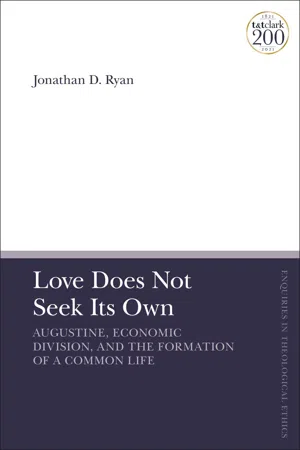
eBook - ePub
Love Does Not Seek Its Own
Augustine, Economic Division, and the Formation of a Common Life
- 272 pages
- English
- ePUB (mobile friendly)
- Available on iOS & Android
eBook - ePub
Love Does Not Seek Its Own
Augustine, Economic Division, and the Formation of a Common Life
About this book
Information
Chapter 1
THE CALL TO LOVE GOD AND NEIGHBOR
Before all else, dearest brothers, let God be loved and then your neighbor, because these are the chief commandments which have been given us.
—Reg. 2: 1
When Augustine invites his congregation to consider Christ’s call to love God and to love neighbor (Mt. 22:34–40) in Sermon 90A(D11/M40), he is not simply asking them to ponder a theological theme. Rather, he hopes that they themselves might hear Christ addressing them with these commands. Drawing his listeners into this gospel scene, he invites them to stand in the place of the enquiring lawyer and voice his question, so that they might hear Christ’s words in reply: “So let us make our own the desire of the man who asked him what the great commandment was in the law.… Let us, though, ask the question as believers, in order as questioners to find the truth; let us too say, ‘Lord, which is the great commandment in the law?’ (Mt 22:36).”1 In his commandment to love God and neighbor, Christ responds to our questions about what it means to live rightly before God.
Amidst the economic divisions of the present day, we too are in need of such guidance. For while few would dispute that the church should be concerned about economic inequality, many questions arise about how the church should respond. What is the particular role that the church is called to play? How does the narrative of faith shape our response to others in need? Is the worshiping and devotional life of the Christian community relevant to such matters, and if so, how? With such concerns in view, this chapter considers the role of love for God and neighbor in Augustine’s instruction to the Christian community. These two loves are foregrounded at the beginning of Augustine’s monastic instruction, orienting the community toward that which is of greatest importance.2 In this chapter I demonstrate that the call to love God and neighbor similarly shapes Augustine’s direction to the wider church community. And yet, in doing so, my purpose is not to analyze a theme or principle,3 but rather, by drawing on Augustine’s pastoral instruction, to illustrate how Christ’s commandment addresses our contemporary questions about how to live rightly in an age of economic inequality.
Love of God and neighbor is a regular theme in Augustine’s preaching, although he does not always quote Matthew 22:37–40 (or parallel texts) directly. Of particular interest for this chapter is Sermon 90A(D11/M40), which Augustine preached in 397, possibly in Carthage.4 In this sermon, Augustine attends to the nature of our love for our neighbor, helping his listeners to appreciate that in order to love our neighbor rightly, we must learn to love God. Exploring Augustine’s instruction in Sermon 90A(D11/M40) provides a basic frame for this chapter, in which I also consider a variety of other sermons and relevant works.
Reading and Living with Love
What does it mean to be the church, in contexts of ever-increasing division between rich and poor? Grappling with this question, we may begin by turning to Scripture for guidance. But which Scriptures should guide us? Are we to protest against those who “trample on the poor” (Amos 5:11, NRSV)? Should we be working for change as “God’s servants” (Rom. 13:6, NRSV) amidst governmental institutions? Should we focus on proclaiming “good news to the poor” (Lk. 4:18, NRSV) or on confronting the rich (e.g., 1 Tim. 6:17–19)? Those seeking to be faithful to the calling of God’s people cannot help but be overwhelmed by these requirements. However, in Sermon 90A(D11/M40), Augustine invites listeners to approach Christ with the question, “Lord, which is the great commandment in the law?” (Mt. 22:36), and to hear his response: “You shall love, he says, the Lord your God with your whole heart and with your whole soul and with your whole mind. This is the first and great commandment. But the second, he says, is like this one: you shall love your neighbor as yourself. On these two commandments depend the whole law, and the prophets” (vv. 37–40).5
In his response, Christ interprets the Scriptures, and Augustine understands this to be a demonstration of Christ’s kindness toward his followers. “The law,” Augustine explains, is “like an endless forest, sprouting commandments on every page.”6 However, Christ, who “is full of mercy,” has “enclosed the length and breadth of the law in a short precept.”7 Although not all have time or ability to read the entire Scriptures, Christ has made the message of the Scriptures accessible to all in this succinct instruction.8 For Augustine, Christ’s call to love God and neighbor is the lens through which the rest of Scripture must be read. Those being received into the catechumenate are taught to interpret Scripture in this way: in Instructing Beginners in Faith, Augustine advises that when a part of Scripture does not appear to direct us toward love of God and neighbor, it should be interpreted “in a figurative sense,” and even then, should be understood “in terms of its relationship to that twofold love.”9 And in Teaching Christianity (De Doctrina Christiana), Augustine commends this interpretive approach to aspiring preachers.10
Christ’s instruction enables us to attend to that which is of greatest importance in the Christian life. The expansiveness of Scripture, with all its instruction and demands, might appear overwhelming to the average Christian, resulting in indecisiveness or idleness. By elevating the call to love God and neighbor, however, Christ spurs us into action, as Augustine explains in Sermon 90A(D11/M40): “Mercy has put a stop to laziness; don’t think any more about how long it will take you to learn them [the commandments], but rather about how to carry out what you have learned in a trice.”11 By interpreting Scripture in this way, Christ’s purpose is not simply to enable us to read rightly, but to live rightly.
Indeed, Christ’s call to love God and neighbor guides much of Augustine’s instruction about the Christian life. This is reflected at the very beginning of the Regulations for a Monastery, where Augustine emphasizes the primacy of these two loves for the monastic community: “Before all else, dearest brothers, let God be loved and then your neighbor, because these are the chief commandments which have been given us.”12 Amidst the many other monastic guidelines Augustine provides, love of God and neighbor remains the fundamental and ultimate task of the Christian community. All other monastic precepts must be directed toward this end. Furthermore, the call to love God and neighbor must be emphasized at the outset, because without this love, the monastic rules will be pursued in vain. As Augustine instructs the wider congregation, “without this twin love, the law cannot be fulfilled.”13 A unified community that shares its resources with the needy is praiseworthy, yet unless it is motivated by and directed toward the love of God and neighbor, it cannot attain to that which is truly good.
As this chapter demonstrates, Christ’s call to love God and neighbor also plays a broader interpretive function for Augustine, shaping his theological perspective as a whole.14 When discussing the sickness of humanity in Sermon 278, he describes the call to love God and neighbor as two “prescriptions” that Christ, the doctor, has provided for the healing of “two sorts of sins: by one you sin against God, by the other against human beings.”15 Just as Augustine seeks to read Scripture in light of Christ’s call to love God and neighbor, he also reads our human situation in this light. Sin has this dual orientation: in our turn toward self-interest, we have alienated ourselves from God and neighbor. Thus, when Augustine addresses the Christian community about issues of wealth and poverty, he is not simply concerned with the reallocation of resources, but more fundamentally about the restoration of these relationships, prescribing Christ’s call to love God and neighbor as the necessary remedy.
Beginning with the Neighbor
Do the commandments to love God and to love neighbor compete with one another? Augustine poses this question to the congregation in Sermon 90A(D11/M40). “When you hear, Love God with whole heart, whole soul, whole mind, there seems to be no room for love of neighbor,” Augustine observes.16 Conversely, the congregation has also heard Paul instruct that “Whoever loves neighbor has fulfilled the law (Rom 13:8)”; and yet in his comprehensive call to love of neighbor (vv. 9–10), Paul makes no mention of love of God.17 How is it possible, then, to faithfully obey both commandments? Does our love for God diminish the love with which we might love our neighbor? Does loving our neighbor inhibit us from fully devoting ourselves to God?18 This tension can be observed as the contemporary church considers its calling amidst economic inequality. For some, the church’s task is primarily an ethical one: we must love our neighbor more, and not w...
Table of contents
- Cover
- Halftitle Page
- Title Page
- Dedication Page
- Contents
- Acknowledgments
- Abbreviations
- Introduction
- Chapter 1 The Call to Love God and Neighbor
- Chapter 2 Division and Unity of Heart
- Chapter 3 Avarice and the Common Good
- Chapter 4 Envy and the Question of Need
- Chapter 5 Pride and the Common Life
- Chapter 6 Shepherding the Community
- Chapter 7 Observing This Instruction with Love
- Conclusion
- Bibliography
- Index
- Imprint
Trusted by 375,005 students
Access to over 1.5 million titles for a fair monthly price.
Study more efficiently using our study tools.
Frequently asked questions
Yes, you can cancel anytime from the Subscription tab in your account settings on the Perlego website. Your subscription will stay active until the end of your current billing period. Learn how to cancel your subscription
No, books cannot be downloaded as external files, such as PDFs, for use outside of Perlego. However, you can download books within the Perlego app for offline reading on mobile or tablet. Learn how to download books offline
Perlego offers two plans: Essential and Complete
- Essential is ideal for learners and professionals who enjoy exploring a wide range of subjects. Access the Essential Library with 800,000+ trusted titles and best-sellers across business, personal growth, and the humanities. Includes unlimited reading time and Standard Read Aloud voice.
- Complete: Perfect for advanced learners and researchers needing full, unrestricted access. Unlock 1.5M+ books across hundreds of subjects, including academic and specialized titles. The Complete Plan also includes advanced features like Premium Read Aloud and Research Assistant.
We are an online textbook subscription service, where you can get access to an entire online library for less than the price of a single book per month. With over 1.5 million books across 990+ topics, we’ve got you covered! Learn about our mission
Look out for the read-aloud symbol on your next book to see if you can listen to it. The read-aloud tool reads text aloud for you, highlighting the text as it is being read. You can pause it, speed it up and slow it down. Learn more about Read Aloud
Yes! You can use the Perlego app on both iOS and Android devices to read anytime, anywhere — even offline. Perfect for commutes or when you’re on the go.
Please note we cannot support devices running on iOS 13 and Android 7 or earlier. Learn more about using the app
Please note we cannot support devices running on iOS 13 and Android 7 or earlier. Learn more about using the app
Yes, you can access Love Does Not Seek Its Own by Jonathan D. Ryan in PDF and/or ePUB format, as well as other popular books in Theology & Religion & Christian Denominations. We have over 1.5 million books available in our catalogue for you to explore.